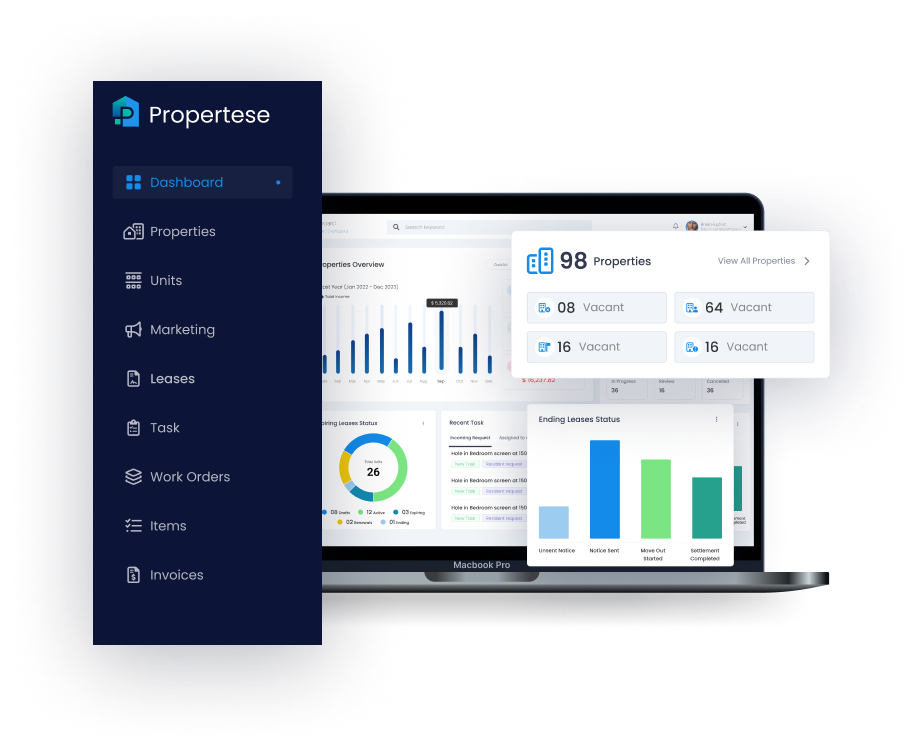
CPI rent escalation clauses protect the real value of rental income by adjusting rent according to inflation. For landlords and property managers, understanding how these clauses are structured, calculated, and automated is essential for operational accuracy and compliance. This article explains how to calculate CPI-based rent adjustments, select the appropriate index, define precise clause language, and implement a scalable automation architecture. With Propertese’s unified lease data platform, property professionals can convert complex CPI clauses into streamlined, transparent, and error-free workflows that sync seamlessly across portfolios.
Key takeaways
- CPI rent escalation clauses tie rent to inflation with clear index selection and calculation.
- Specify population, geography, and base period to avoid disputes and errors.
- Use simple formulas with clear caps and floors, and define fallback rules.
- Connect lease data, CPI inputs, and billing in one system to reduce risk and improve audit control.
Understanding CPI rent escalation clauses
A CPI rent escalation clause links rent adjustments to changes in a specified Consumer Price Index (CPI). The clause ensures rent keeps pace with inflation, preserving the landlord’s real income value while keeping terms predictable for tenants.
CPI is not a single figure. It comprises multiple series that differ by geography, population group, and reference period. This variability makes precise index specification critical. For example, a contract must identify whether it uses the national CPI U U.S. City Average or a regional variant. Ambiguous index selection can cause disputes or inconsistent rent calculations.
In practice, well-structured CPI clauses provide both inflation protection for landlords and predictability for tenants, serving as a key financial control within modern lease frameworks managed through platforms like Propertese.
Standard calculation methods for CPI rent adjustments
The standard method to calculate a rent adjustment under CPI rent escalation clauses is:
New Rent = Current Rent × (Current CPI ÷ Base CPI)
This formula proportionally increases rent according to the change in CPI between the base period and the current review date. In some leases, this may appear as Pn = P1 × (CPI2 ÷ CPI1), where P1 is the current rent and Pn is the new rent.
Key variants
CPI escalations differ across leases in how increases are applied:
- Cumulative vs non-cumulative: Cumulative increases compound annually. Non-cumulative methods reference the original rent as a fixed base.
- Caps and floors: A cap limits the maximum increase, while a floor ensures rent does not fall below a minimum threshold.
- “Greater of” clauses: Some leases require the higher of CPI or a fixed percentage increase.
| Variant Type | Calculation Basis | Impact Example |
|---|---|---|
| Non compounding | Original rent | Gradual growth |
| Compounding | Prior year rent | Accelerated growth |
| With cap (5%) | CPI-based limited to 5% | Inflation cushion |
| With floor (0%) | No negative CPI effect | Rent stability |
Example:
If base rent is $50,000, base CPI = 250, and current CPI = 260:
New Rent = 50,000 × (260 ÷ 250) = $52,000 (4% increase).
Selecting the appropriate CPI index for lease clauses
The Consumer Price Index measures average price changes across a defined basket of goods and services. It is published by statistical agencies and reflects inflation trends that influence rent escalation calculations.
When drafting CPI rent escalation clauses, the Bureau of Labor Statistics advises clarity on four factors:
- Population group: CPI U urban consumers or CPI W wage earners.
- Item category: Use All items to represent general inflation.
- Geography: Specify whether the index is national, regional, or metropolitan.
- Adjustment type: Use not seasonally adjusted data for legal consistency.
It is also vital to reference the series base, such as 1982 to 1984 equals 100.
A precise lease reference might state: “CPI U; U.S. City Average; All items; not seasonally adjusted; 1982 to 1984 equals 100.”
| CPI Component | Options | Best Practice |
|---|---|---|
| Population | CPI U, CPI W | CPI U |
| Geography | National, regional, local | Match property region |
| Category | All items, shelter, others | All items |
| Adjustment | Seasonally adjusted / not | Not seasonally adjusted |
| Base period | e.g., 1982 to 1984 equals 100 | Always specify |
A unified property management system like Propertese ensures these clause parameters are consistently captured and standardized across portfolios. This consistency also supports short-term rentals management in mixed portfolios, keeping rules aligned across property types. Learn more about short-term rentals management with Propertese.
Defining lease metadata and clause language best practices
Accurate CPI automation starts with well-structured lease metadata. Each clause should record:
- Index type, population group, and geographic area
- Base or reference month and publication lag
- Series adjustment seasonal vs. non-seasonal
- Rules for discontinued indexes or negative CPI changes
- Caps, floors, and compounding logic
A sample clause might read:
“Base rent shall adjust annually on the lease anniversary date in proportion to the percentage change in the U.S. CPI U, All Items, not seasonally adjusted, 1982 to 1984 equals 100, as published by the Bureau of Labor Statistics. Negative changes shall not reduce rent below the prior year’s level.”
Common pitfalls include vague CPI references, missing base periods, or absent procedures for missing data. Propertese mitigates these issues through metadata configuration tools that enforce structured, validated input at the lease record level.
Building an automation architecture for CPI rent escalation
Automation connects lease text with operational accuracy for CPI rent escalation clauses. A robust architecture for CPI rent escalation typically includes:
- Lease metadata capture: During onboarding, extract and normalize all CPI clause data.
- CPI data integration: Connect to authoritative sources like the Bureau of Labor Statistics API for real-time value retrieval.
- Computation engine: Apply formulas, caps, and fallback logic with configurable rules.
- Workflow automation: Trigger notifications, generate adjustment notices, update billing systems, and log approvals. Support online rent payments and collections to keep cash flow aligned with new rent.
- Compliance tracking: Maintain timestamped audit records and exception reporting.
Modern platforms enhance this process with AI-driven document parsing that identifies and populates required fields from lease documents. Propertese integrates these capabilities within its ERP-connected environment, linking lease data, CPI inputs, and billing modules to automate escalations across entire portfolios. This reduces manual review and provides full audit transparency. For a practical overview of related workflows, see how rent collection automation works in property management software.
Step-by-step implementation guide for CPI rent escalation automation
Implement CPI automation in a systematic way to ensure accuracy and sustainability. An effective rollout follows these steps:
- Standardize lease metadata. Define fields for index, geography, base period, caps, and notice timing.
- Document the CPI series and publication lag in the clause database.
- Encode formulas and escalation rules in your automation or ERP system.
- Automate CPI data retrieval to align with official release schedules.
- Test results, approve adjustments, issue tenant notices, and sync billing updates.
- Monitor exceptions and apply fallback rules for missing or revised data.
Each step aligns with Propertese workflow modules, which enable real-time data sync, configurable notifications, and secure approval routing. This ensures CPI adjustments execute consistently and on schedule. If you also want to improve how tenants pay, consider choosing the right online rent payment system for your property management.
Monitoring, exception handling, and compliance controls
A mature automation framework continuously validates data integrity and compliance. Best practices include:
- Monitoring: Track escalation cycles, CPI updates, and calculation outcomes.
- Exception handling: Flag anomalies such as missing CPI releases or disputes, and apply fallback indexes or proxy logic.
- Compliance controls: Enforce mandatory data fields, timestamped audit logs, and document generation records for all escalations.
| Exception Scenario | Response Workflow | Data Rule |
|---|---|---|
| CPI index discontinued | Use predefined successor index | Fallback logic |
| Negative CPI | Apply floor or freeze rent | Clause-defined |
| Publication delay | Use last available CPI | Temporary substitution |
| Tenant dispute | Pause automation, trigger review | Manual override |
Built-in controls within Propertese ensure each escalation remains traceable and compliant. This delivers both consistency and defensibility for property managers.
Frequently asked questions about CPI rent escalation clauses
How is a CPI rent increase calculated?
Multiply current rent by the ratio of current CPI to base CPI. Propertese applies this automatically with configured formulas.
What is the difference between compounding and non-compounding increases?
Compounding applies each CPI increase to the new rent, while non-compounding references the original base rent.
What are caps, collars, and ratchets?
Caps limit maximum increases, collars set minimums, and ratchets modulate escalation effects based on clause terms.
Which CPI series should be used?
Use a clearly specified series such as CPI U, U.S. City Average, All Items, not seasonally adjusted.
What is the base date, and why does it matter?
It anchors the comparison period for CPI calculations and ensures accuracy in escalation timing.
How do I source the correct CPI figures?
Obtain official data directly from recognized statistical agencies, and confirm the appropriate series and date.
Should seasonally adjusted data be used?
No. Use not seasonally adjusted data for consistency with contractual language and legal standards.
How frequently are CPI reviews typically scheduled?
Most leases schedule annual reviews, often on the anniversary date.
What lease details determine how the review works?
Index series, base period, review schedule, and compounding rules define escalation behavior.
What happens if review dates or notice steps are unclear?
Unclear terms lead to disputes. Define all review timing and notice steps before lease execution.
In what order should modifying provisions be applied?
Follow the sequence stated in the lease. Rearranging it can distort escalation results.
Conclusion
Propertese enables property teams to transform static CPI clauses into connected, automated processes, which merge data precision with operational efficiency for consistent, inflation-protected lease performance.
A clear approach to CPI rent escalation can protect income, reduce disputes, and improve tenant communication. If you want to standardize your CPI workflow and link it to billing and payments in one place, consider Propertese for a simple path from clause to collection. Our team can walk you through a configuration that fits your portfolio.
Table of Contents
Stay Updated
Subscribe to get the latest news, industry trends, blog posts, and updates...