
Florida Property Management License & Laws: Complete Guide
Florida’s property market rewards speed, but compliance mistakes compound just as fast. For owners, operators, and executives, the real concern isn’t whether Florida Property Management is regulated. It’s how to stay compliant in 2026 without creating operational drag, legal exposure, or investor friction.
This guide explains licensing realities, CAM vs broker obligations, the landlord-tenant rules that actually affect daily operations, and how to build a scalable compliance system that holds up under audits, disputes, and growth.
Summary
- Florida has no standalone property management license, but many activities fall under real estate brokerage law.
- HOA and condominium management may require CAM licensing, even when rental management does not.
- The highest-risk areas are security deposits, statutory notices, and eviction process discipline.
- Strong operators run compliance like finance: controls, templates, audits, and evidence
- This guide focuses on operational execution, not legal theory.
Do You Need a License for Florida Property Management in 2026?
Florida does not issue a dedicated “property management license.” In practice, many paid property management activities are treated as real estate brokerage activities, meaning they must be performed by, or under the supervision of a licensed real estate broker unless a specific exemption applies.
Florida Senate – Real Estate Licensing (Chapter 475):
https://www.flsenate.gov/Laws/Statutes/2023/Chapter475
Florida DBPR – Real Estate Commission rules & statutes:
https://www2.myfloridalicense.com/real-estate-commission/statutes-and-rules/
Why this matters for business leaders
Licensing gaps don’t usually surface during onboarding; they surface during:
- Owner disputes
- Tenant complaints
- Investor diligence
- Acquisition or exit events
That’s why mature operators treat licensing as governance.
Broker vs CAM — Where Florida Property Management Teams Get It Wrong
One of the most common compliance failures in Florida is confusing rental property management with community association management.
When CAM licensing applies
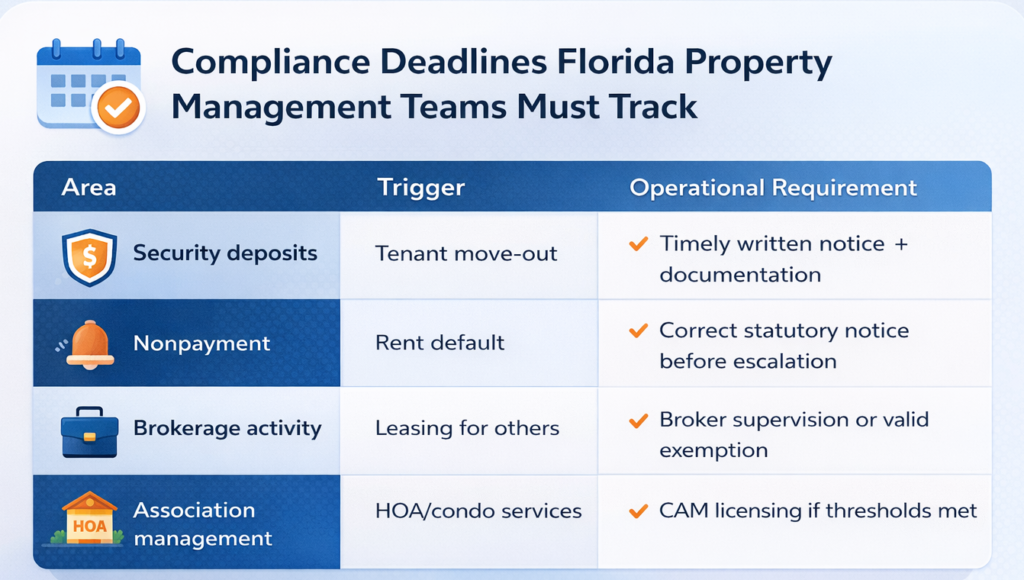
If your company is compensated to manage HOAs, condominiums, or cooperative associations, Florida may require a Community Association Manager (CAM) license once statutory thresholds are met (unit count and/or budget).
DBPR – CAM program overview:
https://www2.myfloridalicense.com/community-association-managers-and-firms/
Why CAM compliance goes beyond licensing
CAM obligations also touch:
- Association records
- Contracts and termination procedures
- Board communications
- Professional conduct standards
These issues usually appear during transitions or disputes, not at setup.
Exemptions, Staffing Models, and Operational Risk
Florida allows exemptions—but they are narrow, role-specific, and easy to misuse.
Exemptions operators often rely on
- Onsite, salaried leasing staff with limited authority
- Administrative roles that do not negotiate or solicit
What exemptions do not protect:
- Independent contractors
- Third-party managers acting for multiple owners
- Teams negotiating lease terms without broker supervision
How strong operators operationalize exemptions
- Written role definitions
- Approval workflows for negotiation-sensitive actions
- Periodic role audits after turnover
Florida Landlord–Tenant Laws That Impact Daily Operations
Most compliance risk shows up after move-in, not during licensing.
Security deposits: the most common operational failure
Florida law sets strict rules for:
- Deposit handling
- Notice timelines for deductions
- Documentation requirements
Missing timelines or sending incomplete notices often leads to forfeited claims and disputes.
Consumer resource (FDACS):
https://www.fdacs.gov/Consumer-Resources/Landlord-Tenant-Law-in-Florida
Notices and evictions
Florida eviction workflows are procedural. Incorrect notice format or timing delays enforcement and increases legal spend.
How to Build a Scalable Compliance System (What Mature Operators Do)
The best Florida Property Management teams don’t “know the law”, they systemize it.
A practical compliance operating model
- Role authority matrix (who can do what)
- Approved notice and letter templates
- Clear escalation rules
- Monthly and quarterly audits
- Scenario-based training
- Exportable compliance evidence
Conclusion
Florida Property Management compliance in 2026 is not about memorizing statutes. It’s about executing the same compliant process every time, regardless of scale, staff changes, or portfolio complexity.
Actionable takeaway: Build a Florida-specific compliance evidence pack, licenses, notice templates, deposit timelines, audit logs. It reduces disputes, accelerates diligence, and protects growth.
Next step: If you operate in multiple states, standardize your approach.