
Key Features of Modern Property Management ERP Software
Key Takeaways
- Most platform demos show the wrong features first and the ones that matter most at scale rarely come up until after the contract is signed.
- The general ledger is the feature that separates platforms because rent collection and maintenance tracking work similarly across almost every tool on the market.
- Lease accounting depth matters far more than a renewal reminder since any system can store a lease end date but very few handle ASC 842 and IFRS 16 automatically.
- AI features in property management software are useful but narrow with predictive maintenance and document processing being the only capabilities that are production-ready today.
- Integration depth between modules matters more than feature count because a platform with thirty well-connected features outperforms one with eighty features that require manual handoffs.
Most real estate teams that switch platforms do so because of something that happened after go-live, not before it.
The evaluation went well. The platform covered everything on the checklist. The team felt confident in the decision. Then the portfolio added two new entities. A lender asked for segmented financial statements. The month-end close that used to take five days started taking twelve.
The platform did not fail at what it promised. The evaluation focused on the surface layer of features. These are the easiest to demonstrate but also the most similar across every platform on the market. The property management software features that determine whether a platform holds up over time are the ones underneath. That means the general ledger, the entity structure, the audit trail, and the reporting engine.
This post covers the key features of property management software at the level a decision-stage evaluator needs. Not a first-pass overview. A structured framework covering what to look for, what to ask during evaluation, and where most platforms stop short as portfolios grow.
What Is the Difference Between Basic and Enterprise Property Management ERP Software Features?
Basic property management software covers operations. Enterprise property management ERP covers operations plus the full financial backbone underneath.
Basic tools handle rent collection, maintenance requests, tenant communication, and lease tracking. These are the features of property management software that most teams evaluate first, and most platforms handle them reasonably well.
Enterprise platforms do all of that and add a real estate-specific general ledger, multi-entity accounting, compliance-grade audit trails, and investor-ready reporting. The operational features overlap significantly across platforms. The financial features do not.
The Eckelkamp case study is one of the clearest examples of this in practice. After consolidating operations onto a single ERP-connected platform, the team went from managing operations across separate systems to a unified setup with automated reconciliation and real-time financial visibility across the entire portfolio.
What Financial Management Features Should Property Management ERP Software Include?
Financial management is the layer that everything else in the platform depends on. A platform with strong tenant portals and a weak general ledger is an operations tool, not an ERP.
A General Ledger Built for Real Estate
A real estate-specific general ledger handles property-level transactions natively, meaning rent rolls, CAM reconciliation, tenant billing, and owner distributions all post without manual journal entries.
Most standard accounting tools were not built for these transaction types. CAM reconciliation alone involves allocating shared expenses across tenants based on lease terms, calculating caps, and billing the difference. If the platform handles that natively, it saves hours every quarter. If it does not, someone on the finance team is building those calculations manually.
During evaluation, ask the vendor to demonstrate a CAM reconciliation from source transaction to final tenant billing without exporting at any point. If an export appears anywhere in that demonstration, the general ledger is not as native as the sales materials suggest. Propertese handles common area maintenance natively within the platform, with CAM charges calculated and billed directly from lease terms.
This depth of financial infrastructure runs through the NetSuite integration, which brings enterprise-grade general ledger capabilities into the platform.
Accounts Receivable and Payable
AR and AP should run through the same platform as the general ledger so rent receipts, vendor invoices, and owner disbursements all post to the same ledger automatically.
When AR and AP live in a separate accounting tool, every transaction requires a sync that can drift, break, or create reconciliation gaps. Real Estate ERP like Propertese handles online rent payments and collections natively, so payments post directly to the correct ledger entries without a separate accounting integration.
Approval Workflows for Financial Transactions
Financial transactions that require approval should move through the platform’s own workflow engine rather than through email chains or external tools.
A vendor invoice should be created, routed for approval, approved, and posted to accounts payable without leaving the platform. Approval workflows handle this across rent payments, vendor bills, and lease events, which is one of the reasons Propertese clients report invoice processing running sixty-six percent faster after implementation.
Revenue Recognition
Revenue recognition in real estate involves more complexity than standard accounting handles well. Prepaid rent, security deposits, percentage-rent clauses in commercial leases, and stepped-rent schedules each follow specific rules. A platform that handles these natively, without manual journal entries at month-end, removes one of the most time-consuming parts of the finance team’s monthly cycle.
What Are the Key Features of Property Management ERP Software for Leasing?
Lease management is where the gap between basic and enterprise platforms shows up most clearly. Any platform can store a lease and send a renewal reminder. The question is what happens to that lease data once it is in the system.
Lease Accounting Under ASC 842 and IFRS 16
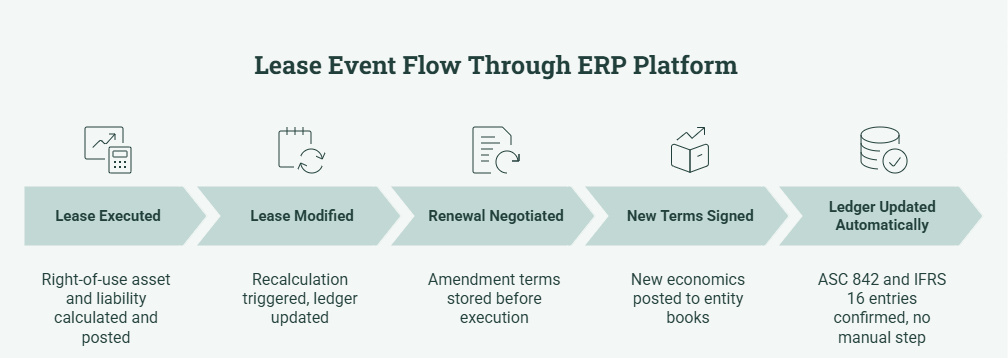
For any portfolio holding commercial leases, the platform needs to calculate right-of-use assets and lease liabilities natively and post those entries to the general ledger automatically when a lease event occurs.
A lease modification, a renewal, or an early termination should trigger recalculations and update the ledger without a manual step. When these calculations happen in a spreadsheet alongside a Property Management tool, every lease event is a risk. A missed update creates a compliance gap that may not appear until an auditor finds it.
Getting the lease terms right before they reach the ledger matters just as much as the compliance entries themselves. A closer look at setting up a maintenance request portal shows how the same principle applies on the operations side: the workflow needs to be right before the financial posting can be trusted.
Propertese handles leasing and lease accounting through leasing management, where lease events post directly to the general ledger and ASC 842 entries update automatically.
Automated Rent Collection and Reconciliation
Rent collection automation is a standard feature in most platforms. What varies is reconciliation depth. The key question is whether collected rent posts to the correct tenant ledger, property account, and entity books simultaneously, or whether the finance team verifies and assigns postings manually after the fact.
Lease Renewal Workflows
A renewal alert tells someone a lease is expiring. A renewal workflow manages the entire process from negotiation through execution and updates the financial records once the new terms are signed. For portfolios managing hundreds of leases, automated renewal notices remove one of the most common sources of missed income and lapsed tenant relationships.
How Should Property Management ERP Software Handle Multiple Entities?
ERP-grade platforms manage multiple legal entities from a single login, with each entity keeping its own books and rolling up into a consolidated view automatically.
Most standalone property management platforms treat the entire portfolio as a single set of books. As soon as a business operates through more than one legal entity, which is common as soon as properties are held under different ownership structures or fund vehicles, that single-book approach breaks down.
1. Property and Unit Management Across Entities
Each property in the portfolio needs to be tracked at the unit level, including occupancy, lease details, and tenant records, while also mapping correctly to the legal entity that owns it. Property and unit management in Propertese tracks this at both levels simultaneously, so occupancy data and financial data always reflect the same underlying reality.
2. Consolidated Reporting Across Entities
Consolidated financial statements spanning multiple entities, segmented by property, fund, and subsidiary, should come directly from the platform without a manual assembly step. If producing a portfolio-wide income statement requires exporting entity-level reports and combining them in a spreadsheet, the platform is not handling consolidation natively.
During evaluation, ask the vendor to produce a consolidated income statement for a three-entity portfolio in real time. That demonstration tells more about multi-entity depth than any feature checklist.
What Maintenance and Operations Features Matter Most?
Maintenance is the feature category where most platforms perform consistently well, and where the differences between platforms are narrower than in the financial layer. The meaningful distinctions come down to how well the operations side connects to the financial side.
1. Work Order Management and Cost Tracking
Work orders should connect directly to the financial layer so a completed repair job posts to the correct property account and entity automatically when the work order is closed.
When this connection does not exist, the finance team receives invoices, matches them to work orders manually, creates journal entries, and posts them to the right accounts by hand. That process works for a small portfolio. It becomes a persistent backlog as the portfolio grows.
Maintenance request management tracks work orders from tenant submission through vendor assignment, completion, and cost posting, with every expense landing in the correct ledger entry without a separate step.
2. Vendor Management and Payment Processing
Vendor invoices tied to work orders should flow into accounts payable automatically. When work order management and vendor payments live in separate modules without a direct connection, each invoice requires a manual handoff that grows harder to manage at scale.
3. Preventive Maintenance Scheduling
Preventive maintenance scheduling should be tied to asset records rather than calendar reminders. A roof inspection is due because the asset record shows the last inspection date and the required interval, not because someone set a reminder ninety days ago.
What Does Good Reporting Look Like in Property Management Software?
Most platforms can produce a rent roll. Far fewer can produce a consolidated income statement across multiple entities, segmented by property and fund, pulled from live data without an export step. This is the clearest dividing line between tools that work for small portfolios and tools that scale with them.
Operational Versus Financial Reporting
Operational reports cover occupancy, rent collection, lease expiration schedules, and maintenance status. Financial reports cover income statements, balance sheets, cash flow, and audit-ready trial balances. Both should be native to the platform and draw from the same data source.
When operational and financial reporting pull from different sources, the numbers frequently disagree. Someone always has to reconcile them before they can be trusted.
Investor and Owner Reporting
For portfolios that report to outside investors or property owners, reports need to meet a higher standard than operational summaries. Segmented financials, distribution calculations, and period-over-period comparisons should come directly from the platform rather than from a spreadsheet layer on top of it.
Where Do AI Features Actually Add Value in Property Management ERP Software?
The AI features in property management ERP software that are production-ready today fall into two categories: predictive maintenance alerts and document processing.
Everything else, fully autonomous reporting, compliance verification, investment decisions, is still in early development at most platforms. During evaluation, ask to see any AI feature working live on real data before counting it as a capability.
Predictive Maintenance Alerts
Machine learning models trained on asset age, work order history, and maintenance frequency can flag equipment likely to need attention before it fails. For large portfolios where manual tracking across hundreds of units is impractical, this reduces emergency repair costs and unplanned capital expenditure.
Document Processing and Lease Abstraction
AI-assisted document processing can extract key terms from lease agreements, reduce manual data entry when setting up new leases, and flag discrepancies between what a lease says and what was entered into the platform. For portfolios processing large volumes of new leases each quarter, this saves meaningful time.
How Do You Build a Property Management ERP Software Features List That Works?
The best features in property management software are not universal. The right starting point is the specific problem the portfolio is experiencing right now, not a vendor’s marketing checklist.
Working backward from three questions produces a more useful evaluation framework than any pre-built features list.
Where does the current setup break down?
If month-end close is the problem, the evaluation should focus on general ledger depth, reconciliation automation, and reporting, whereas if multi-entity management is the issue, subsidiary accounting and consolidation are the priority. If lease administration is the recurring pain point, ASC 842 handling and renewal workflow depth matter most.
What does the portfolio look like in two years?
A platform that handles the current entity count may not handle the count after the next acquisition or fund raise. Evaluating against the two-year structure rather than today’s structure avoids a painful migration twelve months later.
How well do the features connect to each other?
A platform with strong lease management and a separate accounting tool that syncs once a night is a different product from one where both functions share the same data layer in real time. The integration depth between modules determines whether the feature list holds up under real operating conditions.
Frequently Asked Questions
What is the most important feature in property management software?
It depends on the portfolio. For single-entity operations, rent collection and lease tracking cover most daily needs. For portfolios with multiple entities or investor reporting, the general ledger is what determines whether the platform holds up over time.
How many features should a property management platform have?
Feature count does not matter. What matters is how well the features connect to each other. A platform where thirty features share the same data layer outperforms one with eighty features that require manual handoffs between them.
Is cloud-based property management software better than on-premise?
For most growing portfolios, yes. Cloud platforms release updates faster and maintain compliance changes without IT involvement. On-premise gives more data control but requires internal resources to keep the platform current.
How do I evaluate AI features in a property management demo?
Ask to see the feature running on real data in a live environment, not a staged walkthrough. Ask whether it is in general availability or still in beta.
What is the most overlooked feature during property management software evaluation?
The audit trail. It is invisible during normal operations but becomes critical the first time an auditor or investor asks to trace a specific transaction back to its source.
What to Do Next
The right property management ERP software features for any portfolio depend on where the business is today and where it is headed. If the current setup handles everything the portfolio needs, there is no reason to change. If specific capabilities are creating friction that keeps growing, that is worth a direct conversation about what a different platform would actually change.
Talk to Propertese about which features matter most for the portfolio today and where gaps are likely to appear as the business grows.