
Implementing ERP Software in Real Estate: Timeline and Expectations
Key Takeaways
- Vendors almost always quote the timeline the client wants to hear. Mid-market implementations realistically average 12 to 16 months. Enterprise organizations should plan for 24 to 36 months.
- Data migration is where most real estate ERP projects lose time and budget. Start the data audit six months before implementation begins, not after the vendor arrives.
- Hidden costs typically double the initial vendor quote. Internal staff time, consultant overages, and post-go-live support are real costs that appear nowhere in the sales proposal.
- Real estate breaks generic ERP logic. Multi-entity structures, CAM reconciliation, and lease accounting under ASC 842 and IFRS 16 require depth that most general-purpose platforms do not have natively.
- Tangible financial return in real estate takes 18 to 30 months. The first year is stabilization. The second year is when the efficiency gains actually show up.
When the Sydney Harbour Bridge was first proposed in the 1880s, engineers estimated it would take a few years to build. Construction did not begin until 1923. It opened in 1932. The delays were not because the engineers were incompetent. They were because the actual complexity of the project kept revealing itself as work progressed, and each new discovery added time nobody had originally accounted for.
Real estate ERP implementations follow the same pattern. The original timeline looks reasonable on paper. Then the data migration reveals 800 lease documents that need manual abstraction, and the CAM configuration takes three months instead of three weeks. Then the controller who owned the migration leaves mid-project.
This is not an unusual situation. It is the standard pattern for implementing ERP software in real estate.
Implementing ERP software in real estate is different from implementing ERP in manufacturing or professional services. Revenue is contractual. Entity structures involve dozens of legal entities. Lease accounting under ASC 842 and IFRS 16 requires architecture most general-purpose platforms simply do not have. According to ERP Research, the mismatch between vendor promises and real-world implementation outcomes is one of the most consistent patterns in the industry (source).
This post covers what mid-market and enterprise real estate teams should actually expect: realistic timelines, the eight phases and where each breaks down, the data migration problem in plain terms, hidden costs nobody budgets for, and what good looks like at 6, 12, and 24 months.
Why Is Implementing ERP Software in Real Estate More Complex Than Other Industries
Most ERP platforms were built for industries with predictable transaction cycles. A manufacturer ships a product, recognizes revenue, done. Real estate does not work that way.
Here is what makes real estate uniquely difficult for any ERP system:
1. Revenue recognition is contractual and time-distributed
A single commercial lease can carry more accounting complexity than an entire product line at a mid-sized manufacturer. Lease type, escalation schedules, TI allowances, free-rent periods, and ASC 842 balance sheet treatment all affect how revenue is recognized.
2. Multi-entity structures are extreme by any ERP standard
A 40-property portfolio may run 40 to 120 separate legal entities, each in its own LLC. Every entity needs its own chart of accounts, bank reconciliation, and tax treatment. Generic ERP systems handle two to five entities reasonably. Beyond that, the architecture begins to strain.
3. CAM reconciliation does not exist in generic ERP logic
The annual process of comparing actual operating expenses against tenant estimates, settling the difference, and applying property-specific gross-up provisions, cap structures, and exclusion lists requires months of configuration even in purpose-built platforms.
4. Investor and fund reporting is a separate discipline entirely
Waterfall calculations, preferred return tracking, IRR by asset and by fund, and K-1 preparation support are not financial accounting. They require either a dedicated module or a separate platform integrated with the ERP.
The net result: a real estate company implementing a generic ERP is fitting a general-purpose tool onto a highly specialized business and spending years backfilling the gaps with spreadsheets.
What Is a Realistic Real Estate ERP Software Implementation Timeline?
Vendors quote the timeline the client wants to hear during the sales process. By the time the real timeline becomes clear, the contract is already signed.
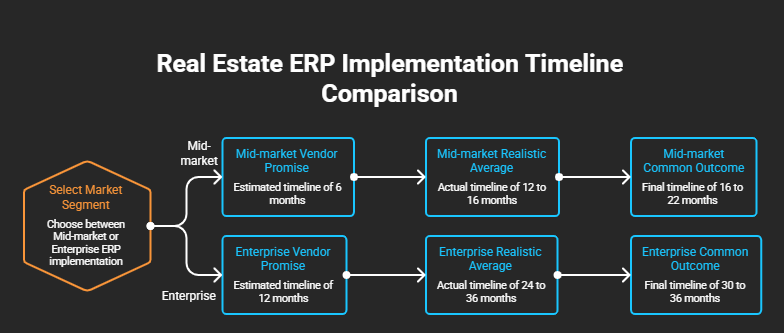
Mid-Market Real Estate Companies (5 to 50 Properties)
- Vendor promise: 6 months
- Realistic average: 12 to 16 months
- Common outcome: 16 to 22 months with meaningful budget overrun
The biggest timeline drivers at this size:
- Entity structure setup across multiple LLCs
- Lease data migration and abstraction
- Integration development between property management and financial systems
- Year-end validation of CAM reconciliation, investor distributions, and tax reporting
The bandwidth problem is also real. The controller and property accountants are the only people who can validate data and configure workflows. They are also running the existing business simultaneously.
Enterprise Real Estate Organizations (100+ Properties or $500M+ AUM)
- Vendor promise: 12 months
- Realistic average: 24 to 36 months
- Common outcome: 30 to 36 months for multi-country, multi-GAAP implementations
One pattern worth naming explicitly: enterprise organizations frequently sign contracts with senior consultants and receive junior or offshore delivery. This is industry-wide. Ask explicitly who will be assigned to the project, what their real estate ERP credentials are, and whether contractual guarantees exist against personnel changes.
What Are the Eight Phases of Real Estate ERP Implementation?
Understanding the real estate software implementation steps, rather than the vendor-scripted version, is what separates teams that go in prepared from those that discover the gaps in month seven.
Phase 1: Scoping
Vendor promise: Complete requirements locked in two to four weeks.
Reality: Six to twelve weeks, and requirements keep evolving.
The most common failure: requirements are documented but not validated by the people who will actually use the system. Property accountants, asset managers, and leasing coordinators are rarely in the room. Edge cases surface as emergencies later.
Phase 2: Vendor Selection
Vendor promise: A platform that fits 90% of real estate needs out of the box.
Reality: Most real estate firms need significant customization or third-party modules for the remaining 30%.
Selecting on UI aesthetics or the sales relationship rather than architecture fit is one of the most expensive mistakes in real estate technology.
Phase 3: Data Migration
Covered in its own section below. The short version: every real estate ERP implementation underestimates data migration. Every single one.
Phase 4: Configuration and Customization
Vendor promise: Minimal customization needed, configured in a few weeks.
Reality: CAM structures, intercompany rules, and approval workflows require months of configuration or custom development.
Configuration decisions made early, particularly chart of accounts design and entity structure, frequently prove wrong when tested against real data and must be rebuilt.
Phase 5: User Training
Vendor promise: Three to five training sessions and the team is ready.
Reality: Training is delivered on sample data, not the organization’s own data, so staff cannot practice real workflows.
Property accountants, the most critical users, are consistently the last group trained. Without an internal super-user program, day-to-day questions have no clear owner after go-live.
Phase 6: Parallel Run
Vendor promise: A brief two to four-week validation period.
Reality: Staff is doing twice the work, two systems, reconciling both, while managing daily operations.
Parallel runs are routinely cut short due to exhaustion. Discrepancies between old and new systems are frequently not resolved before go-live.
Phase 7: Go-Live
Vendor promise: A clean cutover with support standing by.
Reality: Controlled chaos. Senior consultants who knew the configuration are already on the next project. Users have forgotten key workflows from training weeks earlier.
Going live before month-end, year-end, or peak leasing season is one of the most avoidable mistakes.
Phase 8: Post-Go-Live Stabilization
Vendor promise: 30 to 90 days of hypercare and the implementation is complete.
Reality: The first month-end close in the new system takes two to three times longer than normal. The first CAM reconciliation surfaces configuration errors that testing did not catch.
Stabilization runs 6 to 12 months before the platform is actually stable. Treating it as done after vendor hypercare ends consistently leads to struggling through the first annual cycle.
Why Is Data Migration the Hardest Part of Real Estate ERP Implementation?
Data migration is consistently budgeted at 10 to 15% of implementation effort. The actual effort runs 25 to 40%. In real estate, the problem is worse than in most industries.
What Real Estate Data Migration Actually Involves
Lease records are the biggest challenge. Every active lease requires full abstraction:
- Commencement and expiration dates
- All renewal options with notice requirements and rent reset mechanisms
- Base rent and escalation schedules
- TI allowances, free-rent periods, and CAM exclusion lists
- Every modification since the original document
For a 200-tenant commercial portfolio with two to four lease modifications per tenant over ten years, that is 600 to 800 legal documents read, interpreted, and entered accurately.
Chart of accounts is an accounting redesign exercise. Most organizations have one that evolved organically and was never designed for the reporting the business now needs. Getting the controller, CFO, and auditors to agree on how the business should be categorized financially takes four to eight weeks in mid-market implementations.
CAM reconciliation history creates a timing trap. If the cutover happens mid-CAM cycle, partial-year data must be completed in the legacy system before migration or migrated accurately enough to finish in the new one. Most organizations discover this problem during implementation, not during planning.
The fundamental issue: data migration is a business validation task, not a technical one. Every record must be reviewed by someone who understands what it should look like. That person is the property accountant or controller, who is already fully employed managing the existing business.
Best practice: Start the data audit six months before implementation begins. Treat data remediation as a resourced, independent workstream with its own dedicated owner.
What Are the Hidden Costs of Implementing ERP in Real Estate?
Most companies underestimate ERP implementation costs by 30 to 50%. A 25 to 35% contingency reserve on top of any vendor quote is responsible planning.
Internal Staff Time
The largest hidden cost never appears on the vendor invoice.
- Controller: 40 to 80% of working time during implementation
- Property accounting teams: 30 to 70%
- Operations: 20 to 50%
A controller earning $150,000 giving 50% of their time for 12 months is a $75,000 cost the vendor proposal never mentions.
Consultant Overages
Every out-of-scope request, configuration change, or data issue requiring consultant time is billed as a change order. Without a rigorous approval process, professional services budgets are routinely exceeded by 40 to 80%.
Third-Party Integrations
Integrations between the ERP and existing tools, CRM systems, payment portals, document management, and investor portals, each require development, testing, and ongoing maintenance. Annual support and maintenance runs 15 to 22% of license value after go-live.
Well-configured integrations eliminate significant manual work. The guide on automating rental income tracking shows how much reconciliation effort disappears when payment portals connect directly to the ledger. Without that integration, the accounting team reconciles manually every single month.
Post-Go-Live Support
Standard vendor support covers product bugs. It does not cover configuration issues, reporting development, or workflow optimization. A post-go-live support retainer of $5,000 to $20,000 per month is operationally necessary for most mid-market organizations. It is almost never budgeted.
What Are the Biggest ERP Implementation Challenges in Real Estate?
Real estate ERP implementation fails for predictable reasons. Most of them are within the organization’s control.
1. Treating It as an IT Project
When the CIO owns the implementation and the CFO and COO are peripheral stakeholders, the system gets configured for technical correctness rather than operational usability. Real estate ERP implementations must be owned by Finance and Operations, with IT as a supporting function.
2. No Empowered Decision-Maker
Every configuration question requires someone with authority to decide quickly. Organizations that route decisions through committees experience constant delays as questions queue up for weeks at a time.
3. Going Live at the Wrong Time
Launching during quarter-end, fiscal year-end, a major acquisition, or a capital raise means running two parallel crises simultaneously. The external business pressure always wins.
4. Over-Customization
The pattern is consistent: implementation teams customize to match existing processes rather than redesigning processes to fit the platform. The result is a heavily modified system that breaks on every upgrade and requires ongoing maintenance the organization never budgeted for.
5. Wrong Platform for the Business Model
A commercial REIT implementing a platform designed primarily for residential property management will spend the entire project fighting the software’s assumptions. Platform-business model mismatch is one of the most expensive mistakes in real estate technology and nearly impossible to fix without a full re-implementation.
Serious financial analysis, like the discount rate selection in real estate DCF models, depends on clean, trustworthy financial data from the ERP. If the platform cannot produce that data accurately, the analysis fails regardless of how sophisticated the model is.
What Does Good Look Like at 6, 12, and 24 Months?
Understanding what success looks like at each stage prevents organizations from declaring victory too early or panicking during normal stabilization.
At 6 Months Post-Go-Live
Success looks like:
- Monthly close running at or below the pre-implementation timeline
- Go-live data backlogs cleared
- Critical integrations functioning without daily manual intervention
- An internal system owner with real authority to manage the platform
Real adoption metrics:
- 85%+ user login rates weekly
- Less than 10% of transactions processed outside the system
- Helpdesk ticket volume trending downward
At 12 Months Post-Go-Live
Success looks like:
- First CAM reconciliation completed in the new system with fewer manual adjustments than before
- Year-end close at or faster than legacy timelines
- External audit completed without material system-related findings
- Investor reporting generated from the platform, not assembled in a spreadsheet
Target metric: 20% reduction in time to produce monthly financial packages.
At 24 Months Post-Go-Live
Success looks like:
- New staff trained on the platform as standard onboarding
- Reporting driving business decisions rather than satisfying compliance alone
- ERP treated as the system of record across the organization
Research from The CFO Club finds that 97% of businesses with ERP systems report improved processes. In real estate, tangible financial return takes 18 to 30 months because the first year is stabilization and the second is when optimization actually begins.
ERP Implementation Checklist for Real Estate Teams
Having solid contract management and document management infrastructure before implementation begins significantly reduces the time needed to extract and validate lease data.
Before signing the contract:
- Model total cost of ownership beyond licensing and implementation fees
- Confirm who will be assigned to the project and verify their real estate ERP experience
- Identify an internal business owner with decision-making authority
- Budget a 25 to 35% contingency reserve above the vendor quote
Before data migration begins:
- Start the data audit six months before implementation
- Assign a dedicated owner for data remediation, not a part-time responsibility
- Resolve duplicate vendor records and inconsistent naming conventions in the legacy system
- Agree with the CFO and auditors on how much financial history to migrate
During implementation:
- Schedule go-live away from month-end, year-end, and any major business events
- Establish a change-order approval process before the first invoice arrives
- Run parallel in all critical processes, including CAM and investor reporting, before go-live sign-off
- Train internal super-users who will own the platform after the vendor leaves
Post-go-live:
- Do not end hypercare until month-end close has run at least twice in the new system
- Track user login rates, manual journal entry counts, and helpdesk volume monthly
- Budget 12 months of ongoing support from the implementation partner
- Treat the first CAM reconciliation cycle as a project, not a routine task
Frequently Asked Questions
How long does real estate ERP implementation take?
Mid-market portfolios realistically take 12 to 16 months. Enterprise organizations should plan for 24 to 36 months, regardless of what the vendor quotes during the sales process.
What causes most real estate ERP implementations to fail?
Bad data going in is the single most consistent cause. The second is handing ownership to IT instead of keeping Finance and Operations in control of every major decision.
How much does real estate ERP implementation actually cost?
Plan for two to four times the vendor’s initial quote. Internal staff time, consultant overages, third-party integrations, and post-go-live support rarely appear in the proposal but always appear in the final bill.
What is the single biggest mistake teams make before go-live?
Scheduling go-live during month-end, year-end, or a major business event. Two parallel crises always means one loses, and it is almost never the external one.
When does real estate ERP start delivering a return?
Expect 18 to 30 months before tangible financial return shows up. The first year is stabilization. The second is when efficiency gains become measurable.
Do we need to clean our data before implementation starts?
Yes, and the audit should begin six months before implementation, not after the vendor arrives. Data remediation started late is the most reliable predictor of a delayed go-live.
Conclusion
Before signing anything, two questions are worth sitting with. First, is the data clean enough to migrate? Second, is there one person in the organization with the authority and the time to own this project from day one to go-live?
If the answer to both is yes, the implementation has a real chance of staying on track. If either answer is uncertain, that is the conversation to have first.
Propertese can help work through both before a contract is ever signed.