
Why Real Estate Finance Teams Are Drowning in Spreadsheets
Key Takeaways
- Real estate finance spreadsheets are a symptom of disconnected tools that do not share data automatically, not the root problem in themselves.
- Spreadsheet errors in real estate compound silently, and a wrong formula in January can quietly become a billing dispute by March.
- Each new entity or investor makes the problem worse, not better.
- The fix is fewer tools that share the same data, not more tools added to a stack that is already fragmented.
- Propertese clients report month-end close running 10 days shorter and invoice processing 66% faster after switching to a single connected platform.
In 1996, a single spreadsheet error at a UK investment bank caused a $24 million loss. The mistake was a misplaced formula that went undetected because nobody was checking whether the numbers coming out matched reality. They looked right but they were not.
Most real estate finance teams are not managing investment bank portfolios. But they are running the same risk, at a smaller scale, every single month.
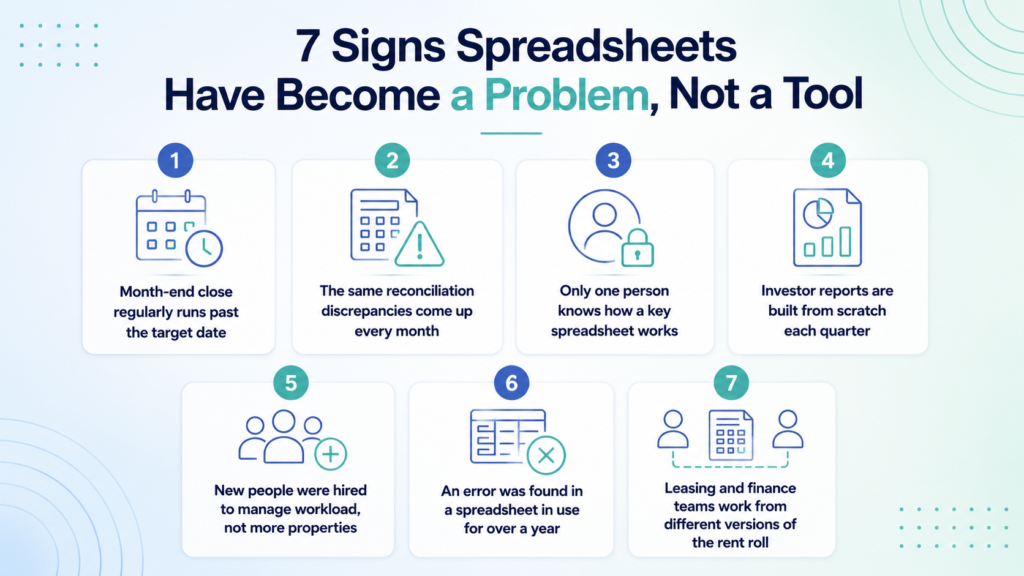
A formula that pulls from the wrong column. A rent roll that has not been updated since the last lease amendment. An escalation schedule that was correct when it was built two years ago, and nobody has touched it since. These are not catastrophic failures. They are quiet ones that accumulate over months before showing up as a reconciliation discrepancy nobody can trace back.
McKinsey’s CFO Pulse Survey found that a plurality of CFOs report just one-quarter or less of their finance processes are currently digitized or automated, despite nearly all of them having invested in digitization. In real estate, where lease terms are complex, entity structures multiply, and reporting obligations grow with every investor, the gap between what is automated and what should be is wider than in almost any other industry.
Real estate finance spreadsheets are not a technology problem. They are the result of a finance stack that was built one tool at a time, and nobody ever stopped to ask whether those tools were talking to each other.
Why Do Real Estate Companies Still Rely on Spreadsheets?
Spreadsheets do not take over a finance operation suddenly. They take over gradually, one tab at a time, because each individual addition made sense when it was made.
Most real estate businesses start simple, with one entity, a handful of properties, and a rent roll in Excel, and that setup works well at that scale. Then the portfolio grows, a new entity gets added, an investor asks for a separate report. The leasing team tracks renewals in their own file. The accounting team keeps a separate general ledger. The rent roll spreadsheet becomes the connective tissue between all of them because no single platform holds everything at once.
Real estate finance team challenges rarely begin with a visible failure. They begin with a second tab. Then a version saved for a specific investor. Then a formula that references a file only one person on the team knows how to update. By the time the problem is visible, the spreadsheet is load-bearing. Removing any piece of it means rebuilding something else, which nobody has time to do while managing a live portfolio.
What Does Running Finance on Spreadsheets Cost?
The cost of real estate finance spreadsheets is rarely tracked because it does not appear as a line item. It shows up as time, and nobody invoices for the hours a senior accountant spent reconciling two files that should have matched automatically.
Here is what that cost looks like broken down:
1. Month-End Close Runs Longer Than It Should
When the general ledger, the rent roll, and the expense tracker each live in different places, someone has to pull them together manually every single month. Propertese clients who moved to a connected platform report month-end close running 10 days shorter. For a senior accountant earning a competitive salary, ten days is a meaningful number before even accounting for the knock-on effect on investor reporting deadlines.
2. Invoice Approvals Create a Backlog No One Can See
When approvals happen over email, the accounting system has no idea they are happening. Invoices queue up in inboxes. Nobody can tell at a glance what is approved and what is waiting. Moving invoice approvals into a connected workflow removes the backlog and creates a full audit trail automatically. Teams that have taken their invoice approval process off email and into a structured workflow report processing invoices 66% faster, based on Propertese client data.
3. Rent Reconciliation Becomes a Monthly Manual Job
For a portfolio with hundreds of tenants, matching payments to ledger entries by hand is a weekly task. It adds nothing to the financial analysis the team should be doing. When rent collection connects directly to the general ledger, every payment posts automatically and the matching step disappears.
4. Investor Reports Become a Project Instead of a Pull
Commercial property management teams reporting to investors face a quarterly ritual of pulling data from multiple sources, standardizing formats, and assembling a report that should come out of the system in minutes. Understanding how much work goes into a single NOI calculation helps explain why this takes so long. When those data points live in separate spreadsheets, producing a reliable investor report is a construction project, not a report run.
Where Do Spreadsheet Errors Do the Most Damage in Real Estate?
Real estate data management errors in spreadsheets rarely appear immediately. The expensive ones build over months before anyone connects the symptom to the source.
1. CAM Reconciliation
CAM reconciliation depends on expense pool calculations that are often maintained in spreadsheets separate from the lease tracking system. When a lease amendment changes a tenant’s pro-rata share, the spreadsheet needs to be updated manually. If it is not, the annual reconciliation produces incorrect billings. Tenants dispute them and the resolution drags on for months.
2. Rent Escalation Tracking
Lease escalation schedules in spreadsheets miss trigger dates more often than most teams realize. The escalation is recorded in the lease document. The spreadsheet was not updated. The rent collects at the old rate for six months before someone catches it. On a significant rent roll, even a modest miss rate is material uncollected income.
3. Multi-Entity Consolidation
For portfolios running through multiple legal entities, each entity often has its own spreadsheets. Producing a consolidated view means pulling each entity’s data, standardizing formats, and combining results manually. Investment management firms handling fund-level reporting across multiple entities face this every quarter, spending days on a process a connected platform handles automatically.
4. Audit Preparation
When financial records exist across spreadsheets, emails, and separate systems, preparing for an audit means reconstructing the trail from scratch. An auditor asking to trace one specific expense back to its source can turn a two-day audit into a two-week documentation project.
How Do Real Estate Teams Move Past Manual Reporting?
Moving past real estate finance spreadsheets does not require replacing everything at once. Most teams that succeed start with the function creating the most friction and build from there.
1. Connect the general ledger to operations first
The single change with the broadest impact is connecting property operations to the financial records so data moves automatically rather than manually. When a rent payment or a lease amendment updates the financials as part of the same workflow that recorded it, the reconciliation step disappears. Propertese is built on NetSuite’s financial infrastructure, which means the general ledger, AR, AP, and revenue recognition all run from the same data source as the property operations layer.
For a detailed look at how automated rent collection connects to financial reporting, the post on automating rental income tracking covers what this connection eliminates from the monthly close process and how to set it up.
2. Automate lease event tracking
Rent escalations, renewal deadlines, and option exercise dates should trigger from the lease data automatically, not from someone watching a spreadsheet. When lease events post to the financial records without manual input, the missed escalation problem goes away.
Real estate reporting automation at the lease level is one of the highest-return changes for commercial portfolios because the financial impact of missed events is direct and immediate.
3. Replace the email approval chain
Invoice approvals that happen over email are invisible to the accounting system. Moving them into a connected workflow removes the manual data entry step and creates a complete approval history the accounting team can actually use.
4. Use real estate automation software built for multiple entities
For portfolios with multiple legal entities, the consolidation problem does not go away until a platform manages the entity structure natively. General-purpose property accounting software handles parts of this. A platform designed for commercial property management at scale handles the full picture, including intercompany eliminations and consolidated reporting.
Frequently Asked Questions
Why do real estate finance teams still run on spreadsheets?
Spreadsheets were the right tool at an earlier stage and nobody had a clear moment to replace them. Each new spreadsheet seemed reasonable at the time. The problem built gradually until removing any piece of it felt riskier than keeping it.
How much time does manual reconciliation actually take?
Propertese clients on disconnected systems spent four to five hours of senior staff time per month on reconciliation alone. Over a year that is 50 to 60 hours per person on work that produces no analytical value.
What should a real estate finance team automate first?
Connect rent payments to the general ledger. It is the highest-frequency manual task in most portfolios and has the most direct effect on close time.
How do spreadsheet errors show up in real estate finance?
Usually as reconciliation discrepancies at month-end or incorrect CAM billings. The original error happened weeks earlier and went unnoticed because no system was cross-checking the data in real time.
Is this only a problem for large portfolios?
Portfolio size matters less than entity count and reporting complexity. A single-entity portfolio with no investor reporting can run on spreadsheets for years. A portfolio with five entities and quarterly investor reporting will feel the strain much sooner.
Conclusion
Every portfolio eventually reaches the point where the time spent managing the spreadsheet stack costs more than the time it would take to replace it. The teams that wait do so because the problem is invisible day to day. The month gets closed, the report goes out, and everything looks fine from the outside.
What does not appear on any report is how much capacity went into the close instead of into analysis, planning, or growth. That is the real cost of real estate finance spreadsheets, and it compounds every month.
If the current setup is taking more from the team than it is giving back, that is worth a direct conversation about what a connected platform would actually change.
Talk to Propertese about where the manual work is and what removing it looks like for a portfolio at your stage.