Property management becomes operationally complex long before it becomes large. You have to cater to maintenance requests and answer the resident/tenant questions all the time. Even small portfolios struggle with delayed rent, missed maintenance follow-ups, inconsistent tenant communication, and manual reporting. These issues stem from manual, fragmented workflows that don’t scale.
If you want to learn about property management automation, this guide will walk you through 15 core tasks that are commonly automated, with context on how these tasks work, where manual processes break down, and why streamlining them improves day-to-day operations.
Key Takeaways
- Automation solves the “triple threat” of repetitive tasks, strict deadlines, and information gaps by replacing manual memory with consistent, rule-based triggers.
- It prioritizes streamlining the most critical operations, specifically financial collection, maintenance routing, and legal compliance for stable cash flow and reduced risk.
- By treating automation as foundational infrastructure, property managers can expand their portfolios without increasing administrative overhead or relying on individual staff memory.
What is Property Management Automation
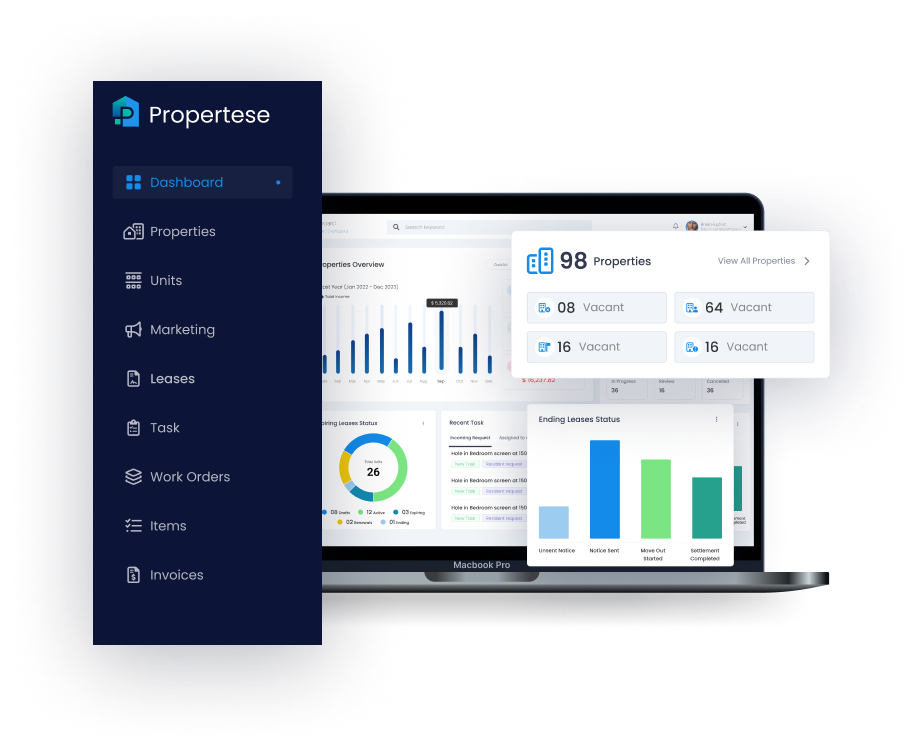
Tools or processes that help reduce the manual effort to manage properties and automate repetitive tasks are what we call property management automation. This does not mean that human resources are completely removed. It means that a property manager can help its resources manage day-to-day repetitive and time-consuming tasks with technology and tools like Propertese.
As Millennials and Gen Z have become the major chunk of tenants and residents, it is only fair that the residences and properties are kept up-to-date with technology. This tech adoption makes the job of a property manager a hundred times easier and helps them communicate with the residents and tenants more efficiently.
What Property Management Automation Actually Solves
At its core, property management automation solves three recurring problems:
- Repetition – The same actions are performed every day across tenants, units, and properties
- Timing sensitivity – Many tasks must happen on exact dates (rent, renewals, notices)
- Information gaps – Manual systems create delays, errors, and lost context
Automation introduces rules, triggers, and workflows so tasks happen consistently without relying on memory, spreadsheets, or follow-ups.
How Property Management Automation Works (In Simple Terms)
Most automated workflows follow the same pattern:
- Trigger: An event occurs (rent due, maintenance request submitted, lease nearing expiration)
- Rule: The system checks predefined conditions (date, lease terms, issue type)
- Action: Notifications, updates, assignments, or calculations happen automatically
- Tracking: Status and history are logged for reporting and accountability
Understanding this flow makes it easier to see why certain tasks are ideal for automation.
1. Rent Collection and Payment Processing
How it works manually
Manual rent collection involves reminders, payment tracking, reconciliation, and follow-ups. Each missed payment creates extra work and uncertainty.
How automation changes the workflow
Automated rent collection systems:
- Notify tenants before rent is due
- Accept online payments through predefined methods
- Record payments instantly against the correct lease
Why streamlining matters
Rent is the most time-sensitive and high-impact workflow. Automating it stabilizes cash flow and removes daily administrative overhead.
2. Late Fee Calculation and Enforcement
The manual challenge
Late fees are often applied inconsistently, leading to tenant disputes and accounting corrections.
Automated approach
Automation applies late fees based on lease rules:
- Grace periods are enforced uniformly
- Fees are calculated automatically
- Tenants receive system-generated notices
Operational benefit
Consistency protects revenue and reduces subjective enforcement.
3. Maintenance Request Intake
What usually breaks
Maintenance requests arrive via email, phone calls, or texts, which usually leads to lost issues and slow responses.
Automated intake workflow
Automation of maintenance requests centralizes requests:
- Tenants submit issues through a single channel
- Requests are categorized and timestamped
- Urgent issues are flagged automatically
Why this matters
Centralized intake improves response time and accountability.
4. Maintenance Work Order Routing
Manual bottleneck
Assigning tasks manually leads to delays and miscommunication.
Automated routing
Work orders can be:
- Assigned based on issue type
- Routed to vendors or internal staff
- Tracked from creation to completion
Result
Faster resolution and clearer ownership of tasks.
5. Vendor Coordination and Follow-Ups
The problem
Vendor scheduling and follow-ups consume significant administrative time.
Automation in action
Automated workflows:
- Notify vendors of new jobs
- Share property and access details
- Track completion and invoice submission
Why it’s essential
Reduces manual coordination and improves vendor reliability.
6. Tenant Communication and Notifications
Manual inefficiency
Sending individual messages leads to inconsistency and missed updates.
Automated communication
For automated communication, systems send:
- Rent reminders
- Maintenance updates
- Policy or building notices
Outcome
Consistent communication without added workload.
7. Lease Expiration and Renewal Tracking
What goes wrong manually
Missed renewal dates lead to vacancies and revenue loss.
Automated lease tracking
Automation:
- Flags upcoming expirations
- Sends renewal reminders
- Supports advanced planning
Why it matters
Protects occupancy rates and forecasting accuracy.
8. Lease and Document Management
Manual risk
Paper files and scattered digital folders slow audits and compliance checks.
Automated document workflows
For document management, documents are:
- Stored centrally
- Linked to properties and leases
- Accessible based on permissions
Operational value
Improves audit readiness and reduces document loss.
9. Move-In and Move-Out Processes
Complexity without automation
Each move-in or move-out transition involves inspections, utilities, deposits, and documentation.
Automated workflows
Checklists ensure:
- Steps happen in the correct order
- Nothing is missed
- Staff accountability is clear
Benefit
Standardized tenant experiences across the portfolio.
10. Security Deposit Tracking
Why is this sensitive
Security deposits are governed by strict timelines and documentation rules.
Automation support
Systems track:
- Deposit amounts
- Deductions
- Refund deadlines
Why automate
Reduces legal risk and tenant disputes.
11. Accounting and Financial Reconciliation
Manual strain
Reconciling transactions manually is time-consuming and error-prone.
Automated accounting
Automation supports:
- Transaction categorization
- Reconciliation
- Real-time financial visibility
Impact
Cleaner financials and faster reporting cycles.
12. Owner Reporting and Statements
Manual reporting issues
Custom reports consume time and delay insights.
Automated reporting
Reports are:
- Generated on a schedule
- Based on real-time data
- Consistent across properties
Result
Improved transparency and owner trust.
13. Compliance Tracking and Reminders
High-risk manual task
Missed inspections or renewals carry penalties.
Automation advantage
Automated reminders track:
- Regulatory deadlines
- Insurance expirations
- Licensing requirements
Why this matters
Prevents compliance lapses.
14. Vacancy Listings and Marketing
Manual marketing gaps
When you upload vacant listings, they become outdated or inconsistent.
Automated syndication
Listings:
- Pull data directly from unit records
- Sync across platforms
- Update automatically when leased
Operational impact
Shorter vacancy periods.
15. Portfolio Performance Reporting
From data to insight
Manual portfolio reports rarely provide actionable insights.
Automated analytics
Dashboards track:
- Occupancy trends
- Maintenance performance
- Collection rates
Strategic value
Supports data-driven decisions.
Why Property Management Automation Is a Foundation, Not a Feature
Automation works best when viewed as operational infrastructure, not a one-time improvement. It creates consistency, reduces dependency on individuals, and enables sustainable growth. The most successful teams automate:
- What happens often
- What happens on a schedule
- What happens the same way every time
Final Takeaway
Property management automation helps property managers design workflows that work without constant oversight. If you want to automate the above-mentioned 15 tasks, you can get Propertese for your real estate business. How will it help? Your real estate business will have less friction in tenenat/resident communication, better accuracy, on-time rent deposits, accurate lease renewals, and better operations overall, so you can scale your business easily.
Table of Contents
Stay Updated
Subscribe to get the latest news, industry trends, blog posts, and updates...