If you manage rental properties, you need more than spreadsheets—you need accounting that understands doors, owners, tenants, and trust accounts. Many modern property management systems (PMS) include built‑in accounting, while others connect to general‑purpose ledgers like QuickBooks or Zoho. The right choice depends on your portfolio, compliance needs (1099s in the US, VAT in the GCC), and how tightly you want accounting to work with leasing, maintenance, payments, and owner reporting.
If you’re new to the space, start with our comprehensive overview, all about property management accounting. For a deeper look at evaluation criteria, see real estate accounting software: key features and benefits explained.
Key takeaways
- Prioritize true trust accounting and 3‑way reconciliation to stay compliant and audit‑ready.
- Decide between PMS‑native accounting and a general ledger stack based on workflow depth and flexibility.
- Validate regional compliance early (US 1099s, GCC VAT, multi‑currency) before committing to a platform.
- Ensure payment rails, bank feeds, and integrations support accurate, scalable month‑end closes.
- Evaluate total cost beyond subscription: processing fees, onboarding, training, and time savings.
Do property management platforms include built-in accounting?
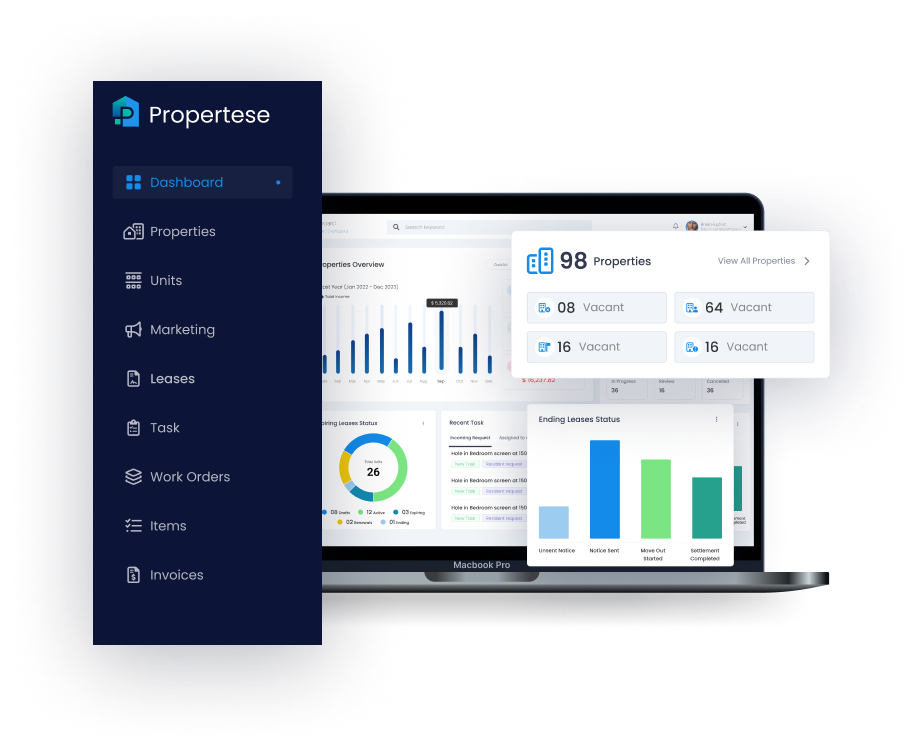
- Yes—many leading PMS solutions (e.g., Propertese, Buildium, AppFolio, Yardi Breeze Premier, DoorLoop, Rent Manager, Propertyware, MRI, Rentec Direct) offer full accounting modules purpose‑built for property management, including trust accounting, bank reconciliations, payables/receivables, and owner statements.
- Others use integrations: some operators pair QuickBooks Online or Zoho Books with a property stack to capture rent, fees, and maintenance flows, then sync to the general ledger for financial reporting.
- Both models exist, with trade‑offs in workflow depth and flexibility.
Why property managers need accounting tools
- Trust accounting to segregate client funds and stay audit‑ready
- Automated rent invoicing, late fees, and receivables tracking
- Vendor bills, work orders, purchase orders, and payables
- Bank feeds and 3‑way reconciliations (operating, security deposits, trust)
- Owner statements, distributions, and consolidated portfolio reporting
- Compliance outputs (US 1099s/financials; GCC VAT invoices/returns)
- Strong audit trails, user permissions, and approval workflows
- Scalable processes for onboarding properties and growing door counts
For step‑by‑step guidance on rent recognition, invoicing, and reconciliations, explore our rental income accounting guide.
How built-in accounting helps (MENA and US)
- United States: Streamlines 1099‑NEC/1099‑MISC preparation, tenant/owner ledgers, security‑deposit tracking by state rules, and ACH/card payment reconciliation—saving month‑end time and reducing errors.
- MENA/GCC: Helps issue compliant VAT tax invoices, track multi‑currency rent and FX differences for expatriate remittances, and align with local filing cycles—while mapping revenue/expense by property and owner entity. Some platforms also support local payment gateways and regional tax settings; verify capabilities for your specific country.
How to choose property management accounting software
Core accounting capabilities (trust accounting, AR/AP, bank reconciliation, reporting)
- True trust accounting with tenant/owner sub‑ledgers and bank‑level segregation
- AR: recurring charges, proration, late fees, partial payments, write‑offs
- AP: bills, POs, work orders, approvals, 1099 vendor tagging (US)
- Reconciliations: multi‑account, auto‑match, uncleared transaction handling
- Reporting: property/owner P&L, balance sheet, cash flow, custom statements, exportable schedules
Regional compliance and taxes (US 1099s, MENA VAT/GCC, multi-currency)
- US: 1099‑NEC/MISC e‑file support, W‑9 capture, rent vs. services coding
- GCC: VAT rates by country, compliant tax invoices, reverse charge where applicable
- Multi‑currency: invoice/receipt in tenant currency, ledger in base currency, FX revaluation and realized gains/losses
Integrations and payment rails
- Payments: ACH, cards, and regionally supported rails; settlement timing; chargeback workflows
- Banking: direct bank feeds, file import, and rules for auto‑categorization
- Ecosystem: maintenance, screening, listing, CRM, and BI connectors; API availability
Scalability, portfolio types, and user roles
- Residential, commercial, HOAs/condos, short‑term, student, affordable, mixed‑use
- Door/owner/entity modeling; intercompany and consolidation support
- Roles/permissions, audit logs, and approval routing for larger teams
If you manage HOAs or community associations, review HOA accounting best practices for assessments, reserves, and board reporting.
Pricing and total cost of ownership
- Subscription model (per unit, tiered) plus add‑ons (payments, e‑filing, advanced reports)
- Payment processing fees, onboarding/implementation, and training costs
- Time savings from automation vs. manual bookkeeping hours
Considering free tools? Read the pros and cons of free property management accounting software to understand trade‑offs in controls, support, and scalability.
10 Best Options Compared (2026)
Propertese
- Best for: Managers seeking modern, trust‑compliant accounting tightly integrated with leasing, maintenance, payments, and owner reporting across US and MENA portfolios.
- Accounting highlights: Trust accounting with tenant/owner sub‑ledgers, AR/AP, 3‑way bank reconciliations, owner statements, and regional tax workflows (US 1099s, GCC VAT).
- Considerations: Confirm plan availability, regional tax settings, multi‑currency, and migration support for your specific portfolio and country.
DoorLoop
- Best for: Small to mid‑size residential portfolios seeking all‑in‑one simplicity.
- Accounting highlights: Trust accounting, AR/AP, owner statements, reconciliations, and built‑in payments tightly tied to leases and maintenance.
- Considerations: Verify regional taxes (VAT) and multi‑currency needs if operating in MENA.
Buildium
- Best for: Residential property managers and associations needing proven, end‑to‑end workflows.
- Accounting highlights: Strong trust accounting, bank recs, AP, owner portals, and 1099 support.
- Considerations: Review plan tiers for advanced reporting and e‑filing options.
AppFolio Property Manager
- Best for: Growth‑oriented shops with mixed portfolios and deep workflow needs.
- Accounting highlights: Robust trust accounting, automated receivables, AP approvals, owner packets, and payment rails.
- Considerations: Tier thresholds and add‑on fees can impact TCO; confirm for your door count.
Yardi Breeze Premier
- Best for: Managers who want Yardi’s processes in a streamlined, cloud experience.
- Accounting highlights: Trust accounting, CAM/recoveries for commercial, bank recs, and owner reporting.
- Considerations: Feature access varies by plan; validate regional tax handling and consolidations.
Rent Manager
- Best for: Operators wanting high configurability and a strong integration marketplace.
- Accounting highlights: Full GL, trust accounting, AP/AR, customizable reports, and API ecosystem.
- Considerations: Flexibility may require more admin setup and governance.
Propertyware
- Best for: Single‑family specialists and dispersed residential portfolios.
- Accounting highlights: Trust accounting, owner statements, maintenance‑to‑AP linkage, and payments.
- Considerations: Review plan tiers and implementation scope if migrating at scale.
Rentec Direct
- Best for: Budget‑conscious managers and landlords who still need proper trust accounting.
- Accounting highlights: Bank recs, owner/tenant ledgers, e‑payments, and tax prep aids.
- Considerations: Validate advanced reporting needs and regional tax specifics.
QuickBooks Online (with property management stacks)
- Best for: Teams standardized on QBO who prefer open stacks.
- Accounting highlights: Mature GL, AR/AP, and reporting; property workflows achieved via PMS integrations and apps.
- Considerations: Requires disciplined mapping (classes/locations) and reliable sync for property‑level reporting.
Zoho Books (with property management integrations)
- Best for: Cost‑sensitive teams in regions where Zoho is widely adopted.
- Accounting highlights: Strong core accounting; property context via integrated PMS/vertical apps and custom fields.
- Considerations: Confirm VAT specifics and multi‑currency workflows; ensure integrations cover trust accounting nuances.
Side-by-side comparison
Feature matrix (accounting depth, trust accounting, payments, maintenance, portals)
- Propertese: Accounting depth (Full); Trust accounting (Yes); Payments (Built‑in + Integrations); Maintenance (Built‑in); Portals (Owner/Tenant)
- DoorLoop: Accounting depth (Full); Trust accounting (Yes); Payments (Built‑in); Maintenance (Built‑in); Portals (Owner/Tenant)
- Buildium: Accounting depth (Full); Trust accounting (Yes); Payments (Built‑in); Maintenance (Built‑in); Portals (Owner/Tenant/Board)
- AppFolio: Accounting depth (Full); Trust accounting (Yes); Payments (Built‑in); Maintenance (Built‑in); Portals (Owner/Tenant/Vendor)
- Yardi Breeze Premier: Accounting depth (Full); Trust accounting (Yes); Payments (Built‑in); Maintenance (Built‑in); Portals (Owner/Tenant)
- Rent Manager: Accounting depth (Full); Trust accounting (Yes); Payments (Built‑in + Integrations); Maintenance (Built‑in); Portals (Owner/Tenant)
- Propertyware: Accounting depth (Full); Trust accounting (Yes); Payments (Built‑in); Maintenance (Built‑in); Portals (Owner/Tenant)
- Rentec Direct: Accounting depth (Solid); Trust accounting (Yes); Payments (Built‑in); Maintenance (Built‑in); Portals (Owner/Tenant)
- QuickBooks Online (with stack): Accounting depth (General ledger); Trust accounting (Via workflows/integrations); Payments (Integrations); Maintenance (Via PMS); Portals (Via PMS)
- Zoho Books (with integrations): Accounting depth (General ledger); Trust accounting (Via workflows/integrations); Payments (Integrations); Maintenance (Via PMS); Portals (Via PMS)
Note: Capabilities vary by plan and region. Confirm required features, especially for VAT, multi‑currency, and local payments.
Pricing snapshot and plan gotchas
- Pricing models: Typically per‑unit or tiered subscriptions; some vendors have minimums.
- Add‑ons: E‑payments, 1099 e‑file, advanced analytics, premium support, data migration.
- Processing fees: ACH vs. card rates, chargeback fees, and timing of settlement.
- Implementation: One‑time onboarding, data services, and training can materially affect year‑one cost.
- Contracts: Annual commitments may discount rates; verify cancellation and data export terms.
Implementation and migration
Chart of accounts setup for property portfolios
- Start with a property‑centric COA: rent income, other income, refundable deposits, repairs, utilities, management fees—segmented by property/owner as needed.
- Standardize classes/locations/entities to isolate properties and owners (especially when using general ledgers like QBO or Zoho).
- Map maintenance workflows to AP accounts for clean job‑costing and owner visibility.
Opening balances and trust reconciliation
- Import beginning balances for each property, owner, tenant, vendor, and bank account.
- Load unpaid bills/invoices and security‑deposit liabilities by tenant.
- Perform first 3‑way reconciliation (bank, book, and tenant/owner sub‑ledgers) before going live.
Training, controls, and month-end close checklist
- Role‑based permissions, approval thresholds, and audit logs enabled.
- Month‑end checklist:
- Post all rent and fee charges; apply receipts and concessions
- Review delinquencies; finalize late fees and payment plans
- Close work orders; capture invoices; route approvals
- Reconcile all bank accounts (operating, security deposit, trust)
- Generate owner statements and process distributions
- File 1099 updates (US) or VAT drafts (GCC) as needed
- Lock period and archive reports
FAQs
Do I still need separate accounting if my PMS has accounting?
Often no for day‑to‑day operations—full‑stack PMS can cover trust accounting, AR/AP, recs, and owner reporting end‑to‑end. Some firms still keep a general ledger (e.g., QBO/Zoho) for corporate consolidation, multi‑entity accounting, or CPA workflows. Choose the model that minimizes duplicate entry and preserves compliance.
Trust accounting vs general bookkeeping
General bookkeeping tracks income/expenses for a business. Trust accounting adds regulated segregation of client funds, tenant/owner sub‑ledgers, and 3‑way reconciliation. Many jurisdictions and management agreements require trust accounting—ensure your stack supports it accurately.
Handling multi-currency, VAT, and 1099s
- Multi‑currency: Invoice in tenant currency while keeping a base‑currency ledger; record FX gains/losses.
- VAT (GCC): Use compliant tax invoices, correct rates by country, and proper reporting outputs.
- 1099s (US): Tag vendors and payments correctly, separate rent vs. services, and e‑file on time. Consult platform docs and your accountant; verify capabilities against your specific portfolio and jurisdiction.
Conclusion
Built‑in accounting can dramatically simplify operations by unifying leases, maintenance, payments, and financials—especially where trust rules, VAT, or 1099s apply. Shortlist platforms that fit your portfolio type and regional requirements, test workflows with sample properties, and validate reporting before migrating.
Table of Contents
Stay Updated
Subscribe to get the latest news, industry trends, blog posts, and updates...