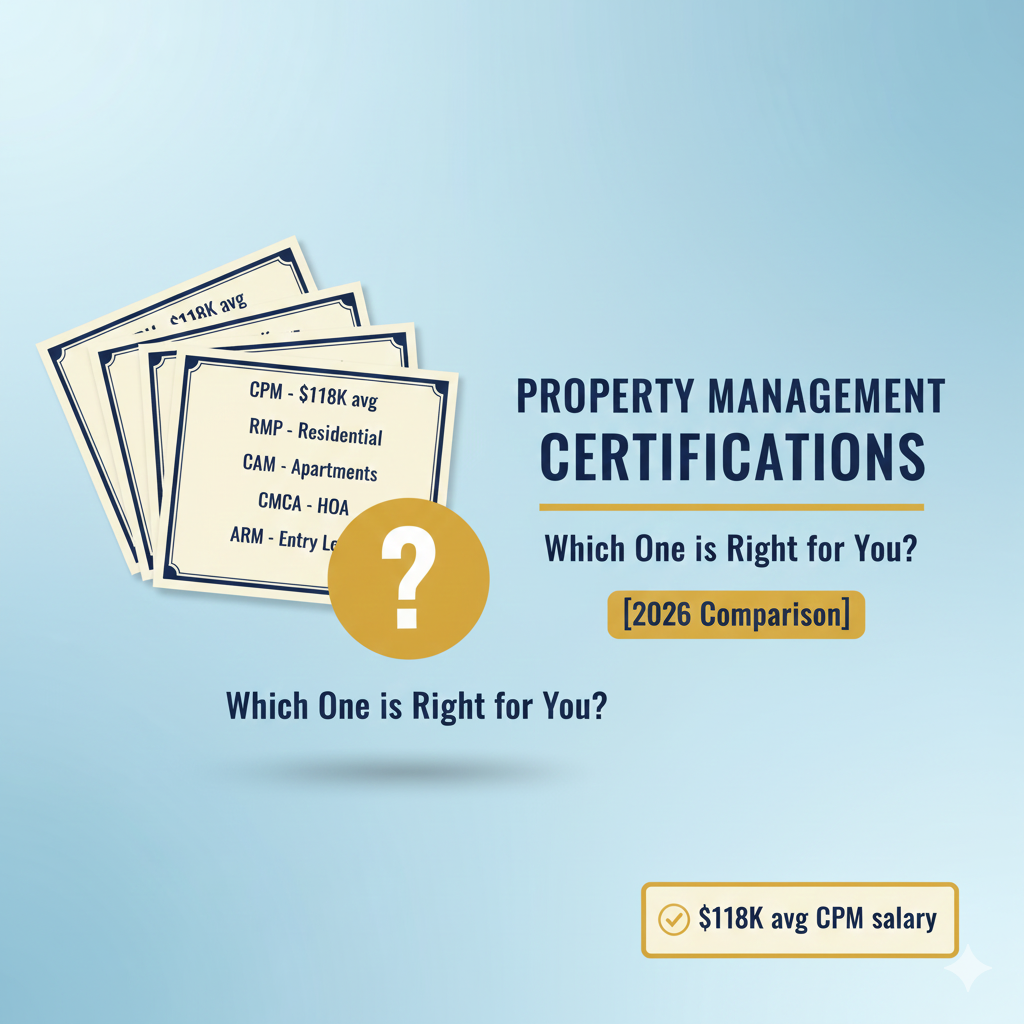
Choosing the right property management certification can increase your salary by 15-145% and open doors to senior positions. But with dozens of acronyms like CPM, RMP, ARM, CAM, and CMCA, which one should you pursue?
This guide cuts through the confusion with direct comparisons, clear requirements, and practical advice for choosing certifications that match your career goals.
Quick Facts:
- CPM holders earn $118,383 vs. $48,340 for non-certified managers
- CMCA certification increases income by 20%
- Most certifications require 1-5 years experience
- Costs range from $400-$5,000+
- Timeline: 3 months to 3 years depending on level
Licenses vs. Certifications: Know the Difference
State Licenses (Required by Law in Many States):
- Real estate broker’s license
- Property manager’s license
- Legally required to collect rent, negotiate leases, manage for others
- Check your state’s requirements first
Professional Certifications (Optional but Valuable):
- Voluntary credentials proving expertise
- Higher earning potential
- Competitive advantage
- Professional credibility
Bottom Line: Get your state license first if required. Then pursue certifications for career advancement.
The Big 5: Certification Organizations
IREM (Institute of Real Estate Management)
- Focus: All property types, international
- Key Certification: CPM (highest salary impact)
- Best For: Commercial properties, senior positions
NARPM (National Association of Residential Property Managers)
- Focus: Single-family, small residential
- Key Certifications: RMP, MPM
- Best For: Residential specialists
NAA (National Apartment Association)
- Focus: Apartments, multifamily
- Key Certifications: CAM, CAPS
- Best For: Apartment community managers
CAI/CAMICB (Community Associations Institute)
- Focus: HOAs, condos, community associations
- Key Certifications: CMCA, AMS, PCAM
- Best For: HOA managers
NAR (National Association of Realtors)
- Focus: Real estate professionals
- Best For: Agents adding property management
Essential Certifications: Quick Comparison
Certified Property Manager (CPM®) – The Gold Standard
- Organization: IREM
- Experience: 3 years
- Cost: $3,000-$5,000
- Timeline: 18-36 months
- Average Salary: $118,383
Requirements:
- Real estate broker’s license
- 7 core courses + ethics
- Pass 2 exams
- Management plan submission
Best For: Experienced managers seeking highest credentials, commercial properties, international recognition
Residential Management Professional (RMP®)
- Organization: NARPM
- Experience: 2 years, 100 units managed
- Cost: $2,000-$3,500
- Timeline: 12-24 months
- Salary Increase: 25-35%
Requirements:
- Real estate broker’s license
- 5-7 courses
- Pass comprehensive exam
Best For: Single-family home managers, small residential portfolios
Master Property Manager (MPM®)
- Organization: NARPM
- Experience: 5 years, 500 units managed + RMP
- Cost: $4,000-$6,000 total
- Timeline: 24-36 months
- Salary Increase: 35-50%
Requirements:
- RMP already earned
- Advanced coursework
- Pass MPM exam
Best For: Senior residential managers, company owners, those seeking CRMC company certification
Certified Apartment Manager (CAM)
- Organization: NAA
- Experience: 1 year onsite
- Cost: $1,000-$2,000
- Timeline: 6-12 months
- Salary Increase: 20-25%
Requirements:
- Complete coursework
- Pass exam within 12 months
Best For: Apartment community managers, multifamily properties
Certified Manager of Community Associations (CMCA®)
- Organization: CAMICB
- Experience: Varies (waived with 5+ years)
- Cost: $400-$800
- Timeline: 3-6 months
- Salary Increase: 20%
Requirements:
- Complete coursework (or experience waiver)
- Pass certification exam
Best For: HOA managers, condo associations, entry-level community management
Accredited Residential Manager (ARM®)
- Organization: IREM
- Experience: 12 months
- Cost: $1,500-$2,500
- Timeline: 6-12 months
- Salary Increase: 15-20%
Requirements:
- 4 courses + ethics
- Pass ARM exam
Best For: New property managers (1-3 years), stepping stone to CPM
Advanced Certifications
Association Management Specialist (AMS®)
- Organization: CAI
- Requires: CMCA + 3 years experience
- Timeline: 12-18 months
- Best For: Advanced HOA managers
Professional Community Association Manager (PCAM®)
- Organization: CAI
- Requires: AMS + 5+ years
- Timeline: 2-4 years
- Best For: Executive-level HOA management
Certified Apartment Portfolio Supervisor (CAPS)
- Organization: NAA
- Requires: CAM + supervisory experience
- Timeline: 6-12 months
- Best For: Multi-property supervisors
Company Certifications
Accredited Management Organization (AMO®)
- Organization: IREM
- Requires: CPM on executive team
- Cost: $2,000-$5,000+ annually
- Best For: Established companies seeking institutional clients
Certified Residential Management Company (CRMC™)
- Organization: NARPM
- Requires: MPM on staff + 500 unit-years + onsite audit
- Cost: $3,000-$6,000+
- Best For: Residential companies with 100+ units
Specialized Credentials (Quick List)
- CAMT (Apartment Maintenance) – NAA
- CALP (Apartment Leasing) – NAA
- SHCM (Housing Credit/LIHTC) – NAA
- IROP (Independent Owners) – NAA
- CSS (Support Specialists) – NARPM
How to Choose: Decision Tree
Step 1: What do you manage?
- Single-family homes → NARPM (RMP/MPM)
- Apartments → NAA (CAM/CAPS)
- Commercial → IREM (CPM/ARM)
- HOA/Condos → CAI (CMCA/AMS/PCAM)
- Mixed portfolio → IREM (CPM most versatile)
Step 2: Your experience level?
- 0-1 years → Get state license first, then ARM, CAM, or CMCA
- 1-3 years → RMP, ARM, or CMCA
- 3-5 years → CPM, MPM, or AMS
- 5+ years → MPM, PCAM, or company certifications
Step 3: Your budget?
- Under $1,000 → CMCA
- $1,000-$3,000 → ARM, CAM, RMP
- $3,000-$5,000 → CPM
- $5,000+ → Multiple certifications or company designations
Step 4: Your timeline?
- 3-6 months → CMCA, some NAA credentials
- 6-12 months → ARM, CAM
- 12-24 months → RMP
- 18-36 months → CPM
- 2-5 years → MPM, PCAM (require progression)
Certification Comparison Table
| Cert | Org | Experience | Timeline | Cost | Salary Impact | Best For |
|---|---|---|---|---|---|---|
| CPM | IREM | 3 years | 18-36mo | $3-5K | $118K avg | All types, senior |
| RMP | NARPM | 2yr, 100 units | 12-24mo | $2-3.5K | 25-35% ↑ | Single-family |
| MPM | NARPM | 5yr, 500 units | 24-36mo | $4-6K | 35-50% ↑ | Senior residential |
| ARM | IREM | 12 months | 6-12mo | $1.5-2.5K | 15-20% ↑ | Entry level |
| CAM | NAA | 1 year | 6-12mo | $1-2K | 20-25% ↑ | Apartments |
| CMCA | CAMICB | Varies | 3-6mo | $400-800 | 20% ↑ | HOA entry |
| AMS | CAI | 3yr + CMCA | 12-18mo | $1.5-2.5K | 25-30% ↑ | Advanced HOA |
| PCAM | CAI | 5yr + AMS | 24-48mo | $3.5-6K | 40-50% ↑ | Executive HOA |
Your Certification Roadmap
Years 0-2:
- Get state license (if required)
- Join professional organization
- Earn entry certification (ARM, CAM, or CMCA)
- Network locally
Years 2-5:
- Complete intermediate certification (RMP, CAM, AMS)
- Specialize in property type
- Build toward 500+ units managed
- Mentor newer managers
Years 5+:
- Achieve advanced certification (CPM, MPM, PCAM)
- Consider company certification
- Speak at industry events
- Give back through teaching/mentoring
Maintaining Certifications
Typical Requirements:
- Recertification every 1-3 years
- 8-30 continuing education hours per cycle
- Ethics training
- Active membership
Pro Tips:
- Track renewal dates in calendar
- Attend conferences for credits
- Use online webinars for flexibility
- Don’t wait until last minute
Technology + Certification = Success
Certifications prove knowledge. Technology enables execution. The best property managers combine both.
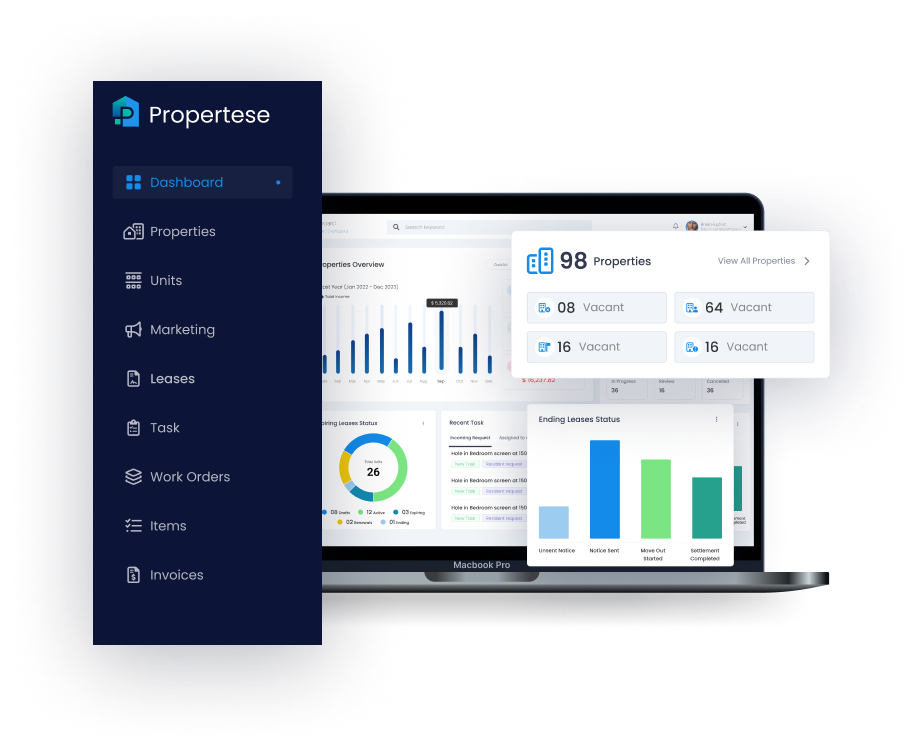
Propertese supports certified professionals across all specializations:
- CPM holders: Advanced financial reporting, portfolio analytics
- RMP/MPM professionals: Single-family tracking, owner portals
- CAM/CAPS specialists: Multifamily features, bulk processing
- CMCA/PCAM managers: HOA accounting, board portals, reserve tracking
Manage residential, commercial, affordable housing, or community associations with tools built for certified professionals.
FAQs
Q. Do I need certification to be a property manager?
Many states require a real estate broker’s license or property manager’s license (legal requirement). Professional certifications like CPM or RMP are voluntary but strongly recommended for higher pay and credibility.
Q. Which certification pays the most?
CPM holders earn an average of $118,383 vs. $48,340 for non-certified managers—a $70,000+ difference. MPM and PCAM also command significant premiums in their specializations.
Q. What’s the difference between CPM and RMP?
CPM (IREM) covers all property types with international recognition and highest salary impact. RMP (NARPM) focuses specifically on single-family/small residential. Choose CPM for versatility; RMP for residential specialization.
Q. How long does certification take?
Entry-level: 3-12 months (CMCA, CAM). Intermediate: 12-24 months (RMP, ARM). Advanced: 18-36 months (CPM). Master-level: 2-5 years (MPM, PCAM) including prerequisites.
Q. How much do certifications cost?
CMCA: $400-800. ARM/CAM: $1,000-2,500. RMP: $2,000-3,500. CPM: $3,000-5,000. Most pay for themselves within 1-2 years through salary increases.
Q. Can I get certified without experience?
Most require some experience. ARM needs 12 months (least). CAM needs 1 year. RMP needs 2 years. CPM needs 3 years. Start with state license and entry certifications, progress as you gain experience.
Q. Are certifications worth it?
Yes. They provide 15-145% salary increases, enhanced credibility, competitive advantage, professional development, networking, and legal knowledge. Most certified managers report ROI within 1-2 years.
Q. Do certifications expire?
Yes, most require recertification every 1-3 years through continuing education to ensure you stay current with industry changes and maintain professional standards.
Table of Contents
Stay Updated
Subscribe to get the latest news, industry trends, blog posts, and updates...