A strong property management marketing budget for 2026 starts with clarity: how much to invest, where to deploy it, and how to prove ROI all the way to occupied doors. For most property management firms, a practical benchmark is dedicating 10–15% of gross revenue to marketing, with up to 20% during aggressive growth phases. The right number for your business depends on portfolio goals, competition, and available systems to convert demand efficiently. This guide maps out how to audit 2025 results, build an integrated tech stack, allocate spend across core categories, launch disciplined pilots, monitor results, and communicate owner-ready ROI. Propertese’s end-to-end platform centralizes performance data, automates workflows, and integrates with leading ERPs and leasing systems, ensuring every dollar is tied to leasing KPIs and scaled with confidence. For a deeper dive into channel tactics, read our guide to digital marketing for property management.
Key takeaways:
- Set clear goals and budget guardrails around 10–15% of gross revenue, with up to 20% for aggressive growth.
- Build an integrated stack and measurement to tie every dollar to leads, tours, and leases.
- Balance near-term demand with long-term assets through a simple allocation model, and protect a 10–15% test fund.
- Use pilots, weekly iteration, and quarterly reviews to reallocate to what works.
- Build a property management marketing budget that owners understand and support.
Assess 2025 Marketing Performance
Start with a comprehensive audit of 2025 activity. Catalog every channel, campaign, vendor, and line item, including paid search, SEO content, social, listings/ILS, direct mail, referral programs, and pay-per-lead sources. Pull spend, impressions, clicks, calls/forms, qualified leads, tours, applications, and signed leases.
- Compare cost per lead and conversion rates by channel to spotlight where your best customers actually come from.
- Attribute every dollar to leasing KPIs (leads, tours, and signed leases) so you can justify budget and improve owner reporting. A disciplined approach that ties spend to funnel outcomes is central to modern planning.
- Adopt a quarterly review cadence to reallocate budget toward top performers and benchmark progress against targets; a steady operating rhythm improves decisions as performance data accrues.
Sample snapshot: top 2025 channels by efficiency
| Rank | Channel | Cost per Lead (CPL) | Lead-to-Lease Conversion |
|---|---|---|---|
| 1 | Local SEO | $42 | 9.5% |
| 2 | Google Ads | $68 | 7.2% |
| 3 | Listings/ILS | $75 | 5.9% |
Notes:
- Focus 2026 dollars on channels with low CPL and strong lead-to-lease rates.
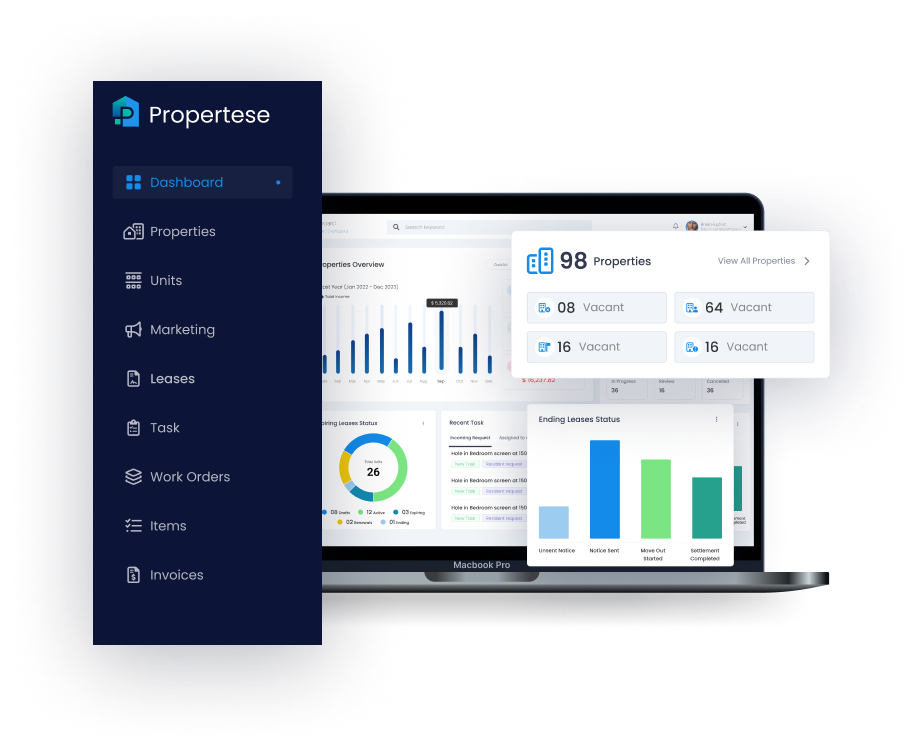
- Use Propertese dashboards to track lead source → tour → lease in real time and roll up results for owner packets. For KPI definitions, see our guide to property management KPIs you should be tracking.
Build an Integrated Marketing Tech Stack
A marketing tech stack is the integrated software you use to automate, execute, and track marketing, from capture to conversion. The goal is simple: centralize data, reduce manual work, and accelerate tours and leases.
Essential categories to cover:
- CRM and lead management (e.g., Propertese, Follow Up Boss, HubSpot; see our overview of property management CRM software)
- Website/IDX with strong SEO foundations (e.g., Placester, AgentFire)
- Call tracking and multi-touch attribution
- Paid media platforms (Google, Meta, YouTube)
- Video/virtual tours and staging (e.g., Matterport)
- AI automation (chatbots, assistants for copy and FAQs)
- Scheduling, call handling, and operations tools
Prioritize platforms with robust integrations so new leads flow instantly into your CRM with automated SMS/email sequences and tasking.
Estimated monthly costs for a core stack
| Category | Typical Monthly Cost (USD) | Notes |
|---|---|---|
| Website + hosting | $59–$300 | Entry plans start near $59 per month. |
| CRM/lead management | $50–$500 per user | Varies by seats and automation depth. |
| Call tracking/attribution | $50–$300 | Number pools and dynamic insertion drive accuracy. |
| Analytics/dashboarding | $0–$200 | GA4 is free; add-ons for BI/ETL vary. |
| Review/reputation management | $50–$250 | Automate requests and response workflows. |
| Scheduling/call center | $25–$300 | Self-serve booking and overflow coverage. |
| Virtual tours/video tools | $10–$150 | Equipment and hosting add-ons possible. |
| AI/chatbot | $20–$150 | Deflects FAQs and qualifies leads 24/7. |
For tool ideas, see the best marketing tools for property management companies.
Propertese connects these systems into unified leasing and finance workflows, eliminating swivel-chair data entry and providing teams with a single source of truth. An integrated stack makes your property management marketing budget work harder.
Allocate Budget Across Key Categories
As a starting rule, allocate 10–15% of gross revenue to marketing, with top performers investing up to 20% during growth phases. Structure the property management marketing budget into clear categories to balance near-term demand with long-term brand equity:
- Tech stack and subscriptions: 25–35%
- Paid media (search, social, video, ILS): 30–40%
- Creative and content (SEO, video, landing pages): 15–20%
- Reputation and reviews: 5–10%
- Measurement and analytics: 5%
- Contingency/experimentation: 10–15%
Sample monthly allocations by maturity
| Tier | Total Monthly Budget | Tech Stack | Paid Media | Creative & Content | Reputation | Measurement | Contingency |
|---|---|---|---|---|---|---|---|
| Starter | $5,000 | $1,500 | $1,800 | $800 | $300 | $200 | $400 |
| Growth | $15,000 | $4,500 | $5,400 | $2,400 | $1,200 | $750 | $750 |
| Established | $40,000 | $12,000 | $14,000 | $7,000 | $3,000 | $2,000 | $2,000 |
Reserve at least 10–15% (up to 20%) for testing and market shifts. A dedicated innovation fund protects momentum when conditions change and positions you to act on breakout opportunities. For campaign ideas that can fill units faster, explore creative rental property marketing ideas.
Launch Pilot Campaigns with Clear KPIs
Start small, learn fast, and scale what works. Focus pilots on two to three proven channels (e.g., local SEO, Google Ads, short-form video, or targeted listings).
- Define your objective and audience. Example: “Increase owner leads in ZIPs 30308–30310 by 25% in Q1.”
- Set KPIs: cost per lead, website conversion rate, leads-to-tours, tours-to-signed-leases, and ROAS.
- Build measurement: conversion tracking, call tracking, and CRM pipeline stages mapped to tours/leases.
- Launch with modest test budgets and track with GA4 and your CRM.
- Run for at least one full leasing cycle or 4–6 weeks to gather statistically useful data.
- Iterate weekly: pause low-performing ads, refine keywords/audiences, improve landing pages, and follow-ups.
- Scale winners; document learnings for the next pilot.
These steps help you allocate pilot spend inside your property management marketing budget with confidence.
Pro tip: Use Propertese automations to trigger same-day tour scheduling and nurture drips, enhancing lead-to-tour rates without increasing media spend. To improve funnel performance from first click to signed lease, see Converting Leads to Leases.
Monitor Performance and Reallocate Funds
Adopt a monthly health check and a deeper quarterly review to compare spend and outcomes by channel against benchmarks. Shift budget away from underperformers and quickly scale proven campaigns; flexibility is essential as search behavior and channel economics evolve.
- Use centralized dashboards to track CPL, conversion rate, tour-to-lease, and ROAS for clear, owner-grade decisions.
- Establish thresholds for action (e.g., pause if CPL > target by 30% for 2 weeks; scale +20% if ROAS > 3.0 for 4 weeks).
Budget reallocation tracker (template)
| Channel | Spend MTD | Leads | CPL | Lead→Tour | Tour→Lease | ROAS | Decision | Owner Notes |
|---|---|---|---|---|---|---|---|---|
| Google Ads | $6,200 | 92 | $67 | 34% | 22% | 3.4 | Scale +15% | Strong ROI in core ZIPs |
| Local SEO | $2,100 | 50 | $42 | 31% | 25% | — | Hold | Double down on review requests |
| Listings | $3,000 | 40 | $75 | 28% | 18% | 1.8 | Reduce -25% | Shift budget to search |
Propertese consolidates these KPIs and annotates spend changes, creating an audit trail owners and executives trust. Reallocate your property management marketing budget based on these guardrails to protect ROI.
Prepare Owner-Facing ROI Reports
Make it effortless for owners to see how marketing drives occupancy and revenue.
Core components to include:
- Lead volume and sources, cost per acquisition, and ROAS
- Funnel performance: impressions → inquiries → tours → applications → leases
- Portfolio impact: occupied doors, average days-to-lease, revenue per unit
- Budget vs. outcome narrative by channel
Tie each expense directly to leasing outcomes and KPIs like prospects reached, tours generated, and leases signed to prove value. Add clear visuals. A bar chart of CPL by channel and a monthly funnel diagram can make results obvious at a glance.
Sample owner commentary:
- “Q2 Google Ads drove 92 owner leads at $67 CPL, producing 18 signed management agreements. We reallocated 25% from underperforming listings to capture excess search demand.”
- “Local SEO plus a review push lifted map-pack visibility, increasing organic tours by 22% quarter over quarter.”
For deeper context on the numbers, see our primer on property management KPIs you should be tracking and our bookkeeping best practices that maximize your profits.
Maintain Flexibility for Market Volatility
Keep at least 10–15% of the budget in reserve to respond to unplanned opportunities or to rebalance when channels slip. Increase spend during peak leasing months, pivot away from rising CPLs, and test emergent surfaces like AI-powered search as the landscape shifts. Balance near-term wins with long-lived assets: SEO, reputation, and helpful content that compound over time and should continue alongside paid media.
Propertese supports agile changes with spend controls, pacing alerts, and real-time performance rollups across portfolios and geographies.
Frequently asked questions
How much should a small property management company spend on marketing?
Many small firms allocate 10–15% of gross revenue to marketing, with growth-focused teams investing up to 20% during expansion phases.
What is a reasonable budget for paid search campaigns?
A practical starting point is $1,000–$2,000 per month, then scale based on CPL, ROAS, and local competition.
What are the fastest ways to generate owner leads?
Paid search and pay-per-lead platforms deliver immediate volume; optimizing your Google Business Profile and local SEO builds durable, high-ROI demand.
How can I avoid wasting marketing budget?
Start with small test budgets, track every conversion, and reallocate to high-ROI channels through monthly and quarterly reviews.
What key metrics should I track to measure marketing success?
Monitor lead volume, cost per lead, website conversion rate, leads-to-tours, tours-to-leases, and ROAS to gauge efficiency and growth.
Conclusion
Your property management marketing budget is the engine that turns demand into occupied doors. Start with clear goals, build a connected stack, test and learn, and report ROI that owners trust. If you are ready to create or optimize your budget for 2026, contact us to see how Propertese can help.
Table of Contents
Stay Updated
Subscribe to get the latest news, industry trends, blog posts, and updates...