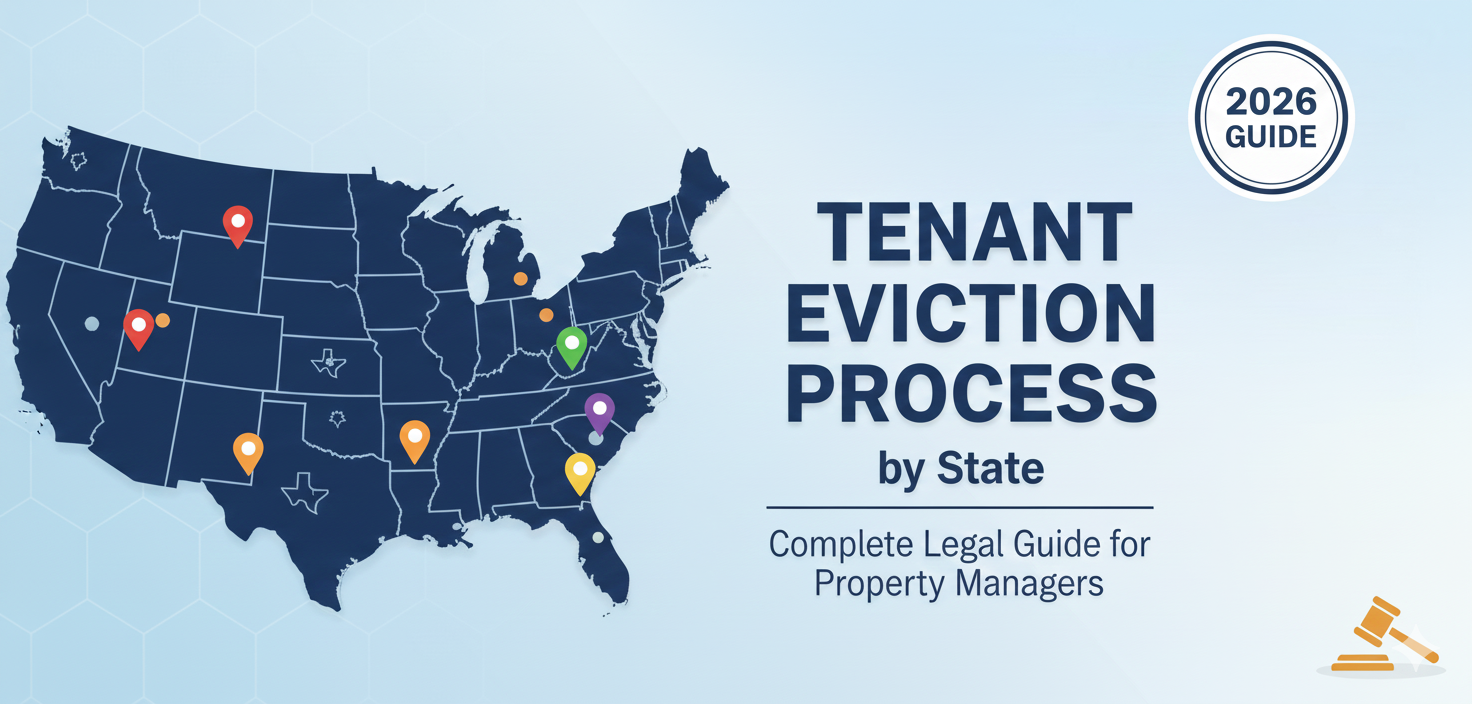
Eviction is one of the most legally complex and emotionally challenging aspects of property management. With eviction laws varying dramatically from state to state and even city to city, property managers must navigate a maze of notice requirements, court procedures, and tenant protections to legally regain possession of their rental properties.
This comprehensive guide breaks down the eviction process by state, providing property managers with the knowledge needed to handle evictions legally, efficiently, and ethically in 2025-26.
Critical Disclaimer: This guide provides general information about eviction processes across different states. Eviction laws change frequently and vary significantly by jurisdiction. Always consult with a qualified attorney in your state before initiating any eviction proceedings. This information should not be construed as legal advice.
Understanding the Eviction Process: What Property Managers Must Know
Eviction, legally known as unlawful detainer or forcible entry and detainer in many states, is the court-supervised process through which landlords legally remove tenants from rental properties. This process exists to balance property rights with tenant protections, ensuring no one loses their home without due process.
Why Proper Eviction Procedures Matter
The consequences of improperly handled evictions extend far beyond inconvenience:
Legal Consequences:
- Case dismissal requiring you to start over
- Financial penalties and fines
- Tenant lawsuits for wrongful eviction
- Damage to your professional reputation
Financial Impact:
- Extended vacancy periods during legal delays
- Attorney fees ranging from $500-$10,000+
- Potential damages owed to tenants
- Lost rental income during prolonged disputes
Tenant Impact:
- Eviction records affecting future housing opportunities
- Credit score damage
- Financial hardship and potential homelessness
- Emotional distress and family disruption
Understanding your state’s specific requirements isn’t just good practice, it’s essential for protecting your business and treating tenants fairly.
Common Grounds for Eviction Across States
While specific requirements vary, most states recognize these legal grounds for eviction:
1. Nonpayment of Rent
Nonpayment of rent remains the most common eviction reason nationwide. However, grace periods, notice requirements, and “pay or quit” timeframes vary significantly:
- 3-day notice states: California, Florida
- 5-day notice states: Illinois, Washington
- 7-day notice states: Several states for residential properties
- 14-day notice states: Minnesota, some circumstances
Some states allow partial rent acceptance without waiving eviction rights, while others (like Cook County, Illinois) consider any rent acceptance as waiving the landlord’s right to proceed with eviction for that period.
2. Lease Violations
Lease violations encompass unauthorized occupants, pets, property damage, noise disturbances, or other breaches of lease terms. Most states require:
- Written notice specifying the violation
- Opportunity to cure (fix) the problem within 3-10 days
- Right to proceed with eviction if uncured
3. Illegal Activity
Tenants engaging in illegal activities, drug manufacturing, violence, weapons violations—can typically be evicted with shorter notice periods or, in some cases, immediately after proper notice.
4. Lease Expiration or No-Cause Termination
For month-to-month tenancies or expired leases, landlords can typically terminate without cause by providing proper notice:
- 30-day notice: Common for tenancies under one year
- 60-day notice: Required in California and other states for longer tenancies
- 90-120 day notice: Required in some jurisdictions for long-term tenants
Important: Many jurisdictions now require “just cause” for eviction, even for month-to-month tenancies. California’s AB 1482, New York’s Housing Stability and Tenant Protection Act, and various local ordinances restrict no-cause evictions significantly.
The Universal Eviction Process: 7 Core Steps
While details vary by state, most eviction processes follow this general framework:
Step 1: Establish Legal Grounds
Document the specific, legal reason for eviction. Vague complaints or personal disputes don’t constitute legal grounds. You need concrete evidence of:
- Specific dates rent wasn’t paid
- Documented lease violations with dates and details
- Police reports for illegal activity
- Photos or inspection reports for property damage
Comprehensive document management systems help you maintain the detailed records courts require.
Step 2: Serve Proper Written Notice
Written notice is mandatory in all states before filing eviction lawsuits. The notice must:
- State the specific reason for eviction
- Provide the legal timeframe to remedy or vacate
- Include required legal language per state law
- Be properly served using approved methods
Service methods typically include:
- Personal delivery to the tenant
- Delivery to another adult at the residence
- Posting at the property AND mailing
- Certified mail with return receipt
Never skip or rush this step. Improper notice is the #1 reason eviction cases get dismissed.
Step 3: File the Eviction Lawsuit
If tenants don’t comply with the notice, file an unlawful detainer or eviction complaint with the appropriate court (usually county or justice court). Required documents typically include:
- Completed eviction complaint form
- Copy of the lease agreement
- Copy of the termination notice
- Proof of service of the notice
- Filing fee ($100-$400 depending on jurisdiction)
Many courts now offer or require e-filing. Familiarize yourself with your local court’s electronic filing system.
Step 4: Serve the Tenant with Court Papers
After filing, the tenant must receive official court summons and complaint, typically served by:
- County sheriff
- Professional process server
- Certified mail (in some jurisdictions)
Tenants receive a specific timeframe to respond, typically 5-10 days, though California’s AB 2347 extended this to 10 business days as of January 2025.
Step 5: Attend the Court Hearing
Both parties present their cases before a judge. Property managers should bring:
- All documentation (lease, notices, communications)
- Photos or videos of violations or damage
- Rent payment ledgers
- Witness statements if applicable
- Professional appearance and demeanor
Tenant defenses might include:
- Improper notice
- Retaliation claims
- Habitability issues
- Discrimination allegations
- Payment records disputing nonpayment
Courts typically rule quickly in eviction cases, often issuing judgment the same day or within days.
Step 6: Obtain Writ of Possession
If you win, the court issues a judgment for possession. To actually remove the tenant, you must obtain a writ of possession or writ of restitution, which authorizes law enforcement to remove the tenant if they don’t leave voluntarily.
Step 7: Sheriff Enforcement
Only law enforcement can physically remove tenants. The sheriff or constable will:
- Post a final notice (typically 24-48 hours)
- Return to physically remove the tenant if still present
- Supervise removal of tenant’s belongings
- Return possession to the landlord
Self-help evictions, changing locks, removing belongings, shutting off utilities, are illegal in every state and can result in significant penalties.
Efficient maintenance and work order management helps prevent situations that lead to evictions by addressing tenant concerns promptly.
State-Specific Eviction Requirements: Key Jurisdictions
California Eviction Process
Legal Framework: California Civil Code §§ 1940-1954.1; Code of Civil Procedure §§ 1159-1179a
Key Requirements:
- Just cause required: AB 1482 (Tenant Protection Act) requires just cause for eviction after 12 months of tenancy
- Notice periods:
- 3-day notice for nonpayment or lease violations
- 30-60 day notice for no-fault evictions (depending on tenancy length)
- Rent caps: Annual increases capped at 5% + inflation, maximum 10%
- Relocation assistance: Required for some no-fault evictions in certain cities
2025 Updates:
- AB 2347: Extended tenant response time from 5 to 10 business days (effective January 1, 2025)
- SB 567: Strengthened penalties for fraudulent no-fault evictions
Timeline: 30-45 days for uncontested cases; 2-6 months for contested evictions
Local Variations: Los Angeles, San Francisco, Oakland, and other cities have additional rent control and eviction restrictions.
Resources: California eviction laws
New York Eviction Process
Legal Framework: Real Property Actions and Proceedings Law (RPAPL) Articles 7 and 7-A
Key Requirements:
- Good Cause Eviction Law: Effective April 20, 2024, applies to many unregulated units in NYC
- Notice periods:
- 14-day notice for nonpayment
- 10-day notice to cure for lease violations
- 30-90 day notice for lease termination (based on tenancy length)
- Rent increase limits: Increases above local rent standard can be challenged under Good Cause
Key Protections:
- Rent-stabilized and rent-controlled tenants have extensive protections
- Strong anti-retaliation provisions
- Strict procedural requirements
Timeline: 3-6 months minimum in NYC; can extend to 12+ months for contested cases
Local Variations: NYC has the strongest tenant protections; upstate New York follows different procedures.
Resources: New York Housing Court
Texas Eviction Process
Legal Framework: Texas Property Code Chapter 24; Texas Rules of Civil Procedure
Key Requirements:
- Notice periods:
- 3-day notice for nonpayment (unless lease specifies different)
- 3-day notice for lease violations
- 30-day notice for month-to-month termination
- No grace period: Rent is due on the date specified in the lease
- Fast process: Texas has one of the quickest eviction processes
2025-2026 Updates:
- SB 38: Taking effect January 1, 2026, streamlines eviction of unauthorized occupants (squatters) with 10-21 day court rulings
Timeline: 3-6 weeks from notice to removal for straightforward cases
Court: Justice of the Peace Courts handle evictions
Resources: Texas Law Help
Florida Eviction Process
Legal Framework: Florida Statutes Chapter 83
Key Requirements:
- Notice periods:
- 3-day notice for nonpayment
- 7-day notice to cure for lease violations
- 7-day unconditional notice for severe violations
- 15-day notice for month-to-month termination
- No grace period: Unless specified in lease
2025 Updates:
- HB 615: Effective July 1, 2025, allows electronic notice delivery via email if both parties agreed in writing
- Note: Electronic delivery doesn’t apply to court documents (complaints, summons, writs)
Timeline: 3-8 weeks for most cases
Court: County Court handles evictions
Resources: Florida Courts Eviction Guide
Illinois Eviction Process
Legal Framework: 735 ILCS 5/9-101 et seq.
Key Requirements:
- Notice periods:
- 5-day notice for nonpayment
- 10-day notice for lease violations
- 30-day notice for month-to-month termination (state law)
- Full payment required: Only full rent payment waives eviction right under state law
Chicago Specific (RLTO):
- 10-day notice for lease violations (vs. state’s general approach)
- Extended termination notice (30-120 days based on tenancy length under Fair Notice Ordinance)
- Accepting partial rent waives eviction right for that period
- Mandatory RLTO summary must be provided to tenants
Cook County Specific (RTLO):
- Similar protections to Chicago RLTO
- Extended notice requirements
- “Pay and stay” provisions
Timeline: 4-8 weeks typical; longer in Chicago/Cook County
Resources: Illinois Legal Aid
Washington Eviction Process
Legal Framework: RCW 59.12 and 59.18
Key Requirements:
- Notice periods:
- 14-day notice for nonpayment
- 10-day notice for lease violations (curable)
- 60-day notice for no-cause termination (month-to-month)
- Just cause cities: Seattle and other cities require just cause even for month-to-month tenancies
Timeline: 4-8 weeks
Resources: Washington Residential Landlord-Tenant Act
Eviction Costs: What Property Managers Should Budget
Eviction expenses vary significantly by state and complexity:
Typical Cost Breakdown
Filing Fees: $100-$400
- California: $240-$435
- Texas: $100-$300
- Florida: $185-$400
- New York: $45-$250
Service of Process: $50-$150 per tenant
Attorney Fees: $500-$5,000+
- Simple, uncontested: $500-$1,500
- Contested cases: $2,000-$10,000+
Writ of Possession: $50-$150
Sheriff Enforcement: $50-$300
Lock Changes: $75-$300
Property Cleanup: $200-$2,000+
Lost Rent: Varies by property (often the largest cost)
Total Range: $1,500-$15,000+ per eviction
Understanding property management KPIs helps you track eviction costs and identify patterns to prevent future issues.
Preventing Evictions: Proactive Property Management
The best eviction is the one you never have to file. Implement these strategies:
Thorough Tenant Screening
Comprehensive tenant screening dramatically reduces eviction risk. Review our complete tenant screening checklist to implement best practices.
Clear Lease Agreements
Well-drafted lease agreements set clear expectations. Learn how to write a lease agreement that protects your interests while remaining fair.
Proactive Communication
Open communication prevents small issues from becoming eviction-worthy problems. Implement effective communication strategies throughout the tenancy.
Flexible Payment Options
Offering flexible rent payment options can help tenants avoid falling behind.
Automated Rent Collection
Automated rent collection systems reduce late payments and improve cash flow.
Early Intervention
Address payment issues immediately. A conversation at day 3 is easier than an eviction at day 30.
Legal Compliance and Fair Housing in Evictions
Federal Fair Housing Act
The Fair Housing Act prohibits discrimination in evictions based on:
- Race
- Color
- National origin
- Religion
- Sex
- Familial status
- Disability
State and Local Protected Classes
Many states add protected classes:
- Source of income (California, New York, others)
- Sexual orientation and gender identity
- Veteran status
- Age
Anti-Retaliation Protections
You cannot evict tenants in retaliation for:
- Reporting code violations
- Joining tenant organizations
- Requesting repairs
- Exercising legal rights
Timing matters: Evictions filed within 90-180 days (varies by state) of protected activities create presumption of retaliation.
Documenting Non-Discriminatory Reasons
Always document legitimate business reasons for evictions:
- Specific dates and amounts of unpaid rent
- Detailed lease violation documentation
- Objective, factual descriptions
- Consistent application of policies
Technology Solutions for Managing Evictions
Modern property management platforms help you handle evictions more efficiently while maintaining legal compliance.
Automated Notice Generation
Generate legally compliant notices automatically based on your state and local requirements.
Documentation Management
Centralized document management systems maintain complete eviction records including:
- Lease agreements
- Payment histories
- Notice copies
- Service documentation
- Court filings
- Correspondence
Communication Tracking
Email communication systems create automatic audit trails of all tenant interactions.
Financial Tracking
Property management accounting systems maintain detailed rent ledgers essential for court proceedings.
Compliance Management
Systems that track changing regulations help ensure your processes remain compliant with evolving laws.
When to Hire an Attorney for Evictions
While some landlords handle simple evictions independently, legal representation is advisable when:
Attorney Recommended:
- Tenant contests the eviction
- Claims of discrimination or retaliation arise
- Property is in jurisdiction with complex local laws (NYC, San Francisco, etc.)
- Eviction involves illegal activity
- Tenant has legal representation
- High-value property or significant back rent
- You’re unfamiliar with the legal process
Attorney Essential:
- Corporate or LLC property ownership (many states require attorney representation)
- Complex title or ownership issues
- Tenant raises habitability defenses
- Multiple tenants with different lease terms
- Commercial property evictions
- Federally subsidized housing
Handling Post-Eviction Issues
Abandoned Property
States have specific procedures for handling tenant belongings left behind:
Common requirements:
- Written notice to tenant of abandoned items
- Storage period (typically 15-30 days)
- Itemized inventory
- Specified disposal methods
- Potential deductions from security deposit
Security Deposit Disputes
Return or account for security deposits within state-mandated timeframes:
- California: 21 days
- Texas: 30 days
- Florida: 15-60 days depending on deductions
- New York: 14 days
Learn how to communicate security deposit policies effectively to prevent disputes.
Judgment Collection
Winning an eviction doesn’t guarantee collecting back rent. Options include:
- Wage garnishment
- Bank account levies
- Credit reporting
- Collection agencies
Many landlords find judgment collection difficult and expensive, emphasizing the importance of thorough tenant screening.
Special Eviction Circumstances
Subsidized Housing
Section 8 and other subsidized housing programs have additional requirements:
- Longer notice periods (often 30 days minimum)
- Notification to housing authority
- Specific just cause requirements
- Due process protections
Domestic Violence Situations
Many states provide domestic violence protections:
- Victims cannot be evicted for incidents they didn’t cause
- Special lease termination rights
- Locks change requests
- Confidentiality protections
Military Members
The Servicemembers Civil Relief Act (SCRA) provides protections:
- Stay of proceedings during active duty
- Limit on rental rate increases
- Special lease termination rights
- Court appointment of attorney
Foreclosure Situations
Tenants in foreclosed properties have rights under the Protecting Tenants at Foreclosure Act and various state laws.
Streamline Your Eviction Process with Propertese
Managing evictions legally and efficiently requires organization, documentation, and compliance with constantly evolving regulations. Propertese provides property managers with comprehensive tools to handle every aspect of the eviction process:
- Automated Notice Generation: Create state-specific, legally compliant eviction notices
- Centralized Documentation: Maintain complete records of all tenant interactions, payments, and violations
- Payment Tracking: Detailed rent ledgers showing exact payment history
- Communication Management: Document all tenant communications automatically
- Court-Ready Reports: Generate comprehensive reports for legal proceedings
- Compliance Tracking: Stay updated on changing eviction regulations in your markets
Whether you manage residential, commercial, affordable housing, or community associations, Propertese adapts to your specific compliance requirements.
Contact us today to learn how Propertese can help you manage the eviction process more efficiently while reducing legal risk.
Eviction Process FAQs
Q. How long does the eviction process take?
Eviction timelines vary dramatically by state and circumstances. Uncontested evictions typically take 3-8 weeks in states like Texas and Florida, while contested evictions in tenant-friendly jurisdictions like New York City or San Francisco can extend 3-12 months. Factors affecting timeline include notice periods (3-60 days), tenant response time (5-10 days), court scheduling (2-4 weeks), and appeals (additional 1-6 months).
Q. Can I evict a tenant without a lease?
Yes, but you must still follow your state’s legal eviction process. Tenants without written leases are typically considered month-to-month tenants and require proper termination notice (usually 30-60 days). You cannot simply remove them or change locks, formal eviction proceedings are required if they don’t leave voluntarily after proper notice.
Q. What are self-help evictions and why are they illegal?
Self-help evictions are any attempts to force tenants out without court process, including changing locks, removing belongings, shutting off utilities, or physically removing tenants. These actions are illegal in every state and can result in substantial penalties including tenant lawsuits for wrongful eviction, damages of 2-3 months’ rent or actual damages (whichever is greater), attorney fees, and criminal penalties in some jurisdictions.
Q. Can I accept rent after serving an eviction notice?
This depends on your state and the type of notice served. In some states, accepting any rent payment waives your right to proceed with eviction for that period. Other states allow partial rent acceptance without waiving eviction rights. Illinois state law requires full payment to waive eviction, but Cook County and Chicago ordinances differ. Always check your specific state law and consider consulting an attorney before accepting any payment after serving notice.
Q. How much does it cost to evict a tenant?
Total eviction costs typically range from $1,500 to $15,000+ depending on complexity. Basic costs include court filing fees ($100-$400), service of process ($50-$150), attorney fees ($500-$10,000), writ of possession ($50-$150), sheriff enforcement ($50-$300), and lock changes ($75-$300). Lost rent during the process often represents the largest cost. Contested evictions with attorney representation in expensive markets can exceed $15,000.
Q. What happens if a tenant contests the eviction?
When tenants contest evictions, the case proceeds to a full court hearing where both parties present evidence. Common tenant defenses include improper notice, retaliation claims, habitability issues, discrimination allegations, and payment disputes. Contested evictions significantly extend timelines (often adding 30-90 days minimum) and typically require attorney representation. Courts will rule based on evidence presented, and either party may have appeal rights depending on the jurisdiction.
Q. Can I evict a tenant for not paying utilities?
Generally, you can only evict for lease violations specifically outlined in your lease agreement. If your lease states tenants must maintain utilities and they fail to do so, this constitutes a lease violation. You must serve appropriate notice (typically 10-30 days to cure depending on state) giving tenants opportunity to restore utilities before proceeding with eviction. You cannot shut off utilities yourself—this constitutes illegal self-help eviction.
Q. Do eviction moratoriums still exist?
The federal eviction moratorium ended in August 2021. However, some states and localities maintain targeted protections during emergencies (natural disasters, public health crises, etc.). California, New York, and other states have ongoing tenant protection laws that functionally limit evictions. Always check current state and local regulations. Some jurisdictions require landlords to apply for rental assistance before filing eviction for nonpayment.
Q. How do I evict a tenant who is causing property damage?
Property damage typically qualifies as a lease violation. Document damage thoroughly with dated photos, inspection reports, and contractor estimates. Serve appropriate notice for lease violation (typically 3-10 days depending on state), specifying the damage and required remedy. For severe or intentional destruction, some states allow immediate notice to quit without cure opportunity. Always follow your state’s specific procedures for lease violation evictions.
Q. Can tenants be evicted during winter months?
There are no federal prohibitions on winter evictions. While some states historically had “winter eviction bans,” most have been eliminated or significantly limited. However, some jurisdictions provide extended timelines or hardship considerations during extreme weather. Massachusetts allows tenants to request extensions if eviction isn’t their fault and they cannot find suitable housing. Always check your specific state and local regulations, as some areas provide temporary cold-weather protections for vulnerable populations.
Table of Contents
Stay Updated
Subscribe to get the latest news, industry trends, blog posts, and updates...