Rental income accounting isn’t just bookkeeping; it’s the foundation of a profitable property management business. Get it wrong, and you’re looking at tax penalties, cash flow problems, and unhappy property owners. Get it right, and you have clear visibility into every dollar flowing through your properties.
Most property managers struggle with the same accounting challenges: choosing the right method, tracking income properly, classifying expenses correctly, and staying compliant. The difference between successful managers and struggling ones often comes down to following proven accounting practices.
In this guide, you’ll learn 8 essential tips that cover:
- Choosing the right accounting method for your business
- Building a proper chart of accounts structure
- Recording income and managing security deposits correctly
- Classifying expenses and leveraging depreciation
- Maintaining clean books with proper documentation
- Ensuring tax compliance and accurate reporting
- Leveraging technology to automate and scale
- Avoiding the most common accounting mistakes
Let’s dive into the specific tips that will transform your rental income accounting.
Tip 1: Choose the Right Accounting Method for Your Business
Your accounting method determines when you record income and expenses, affecting tax obligations and financial reports.
Cash basis: Records income when received, expenses when paid. Simpler and reflects actual bank balance. The IRS generally permits cash basis for rental real estate. Best for fewer than 20 units and simple ownership structures.
Accrual basis: Records income when earned, expenses when incurred. More accurate financial performance but requires sophisticated bookkeeping. Best for larger portfolios and when lenders require GAAP statements.
Pro tip: Many managers use cash basis for taxes but maintain accrual reports for performance tracking. Switching methods later requires IRS approval via Form 3115.
Tip 2: Build a Proper Chart of Accounts Structure
A well-structured chart of accounts is your financial roadmap. It categorizes every transaction so you can track income sources, control expenses, and generate meaningful reports. Setting up the right structure saves countless hours down the road.
Income Accounts (4000-4999)
Rental Income:
- 4010: Base Rent
- 4020: Late Fees
- 4030: NSF/Returned Check Fees
- 4040: Pet Rent (monthly recurring)
- 4050: Pet Fees (one-time, non-refundable)
Ancillary Income:
- 4100: Application Fees
- 4110: Parking Income
- 4120: Laundry/Vending Income
- 4130: Storage Unit Income
- 4200: Lease Break Fees
- 4300: Forfeited Security Deposits
Separate these categories for clear visibility into revenue streams. You want to know exactly how much comes from base rent versus fees and services.
Expense Accounts (5000-5999)
Operating Expenses:
- 5010: Repairs & Maintenance (deductible)
- 5020: Landscaping/Grounds
- 5030: Pest Control
- 5040: Utilities (water, electric, gas, trash)
- 5100: Property Insurance
- 5110: Property Taxes
- 5120: HOA Fees
- 5200: Property Management Fees
- 5300: Legal & Professional Fees
- 5400: Advertising/Marketing
- 5500: Licenses & Permits
Administrative Expenses:
- 5600: Office Expenses
- 5610: Software/Technology
- 5620: Bank Fees
- 5630: Accounting/Bookkeeping
Note the distinction: Operating expenses are property-specific. Administrative expenses support your overall business. Keep these separate for accurate property-level NOI calculations.
Asset and Liability Accounts
Assets (1000-1999):
- 1010: Operating Bank Account
- 1020: Security Deposit Trust Account
- 1100: Accounts Receivable – Rent
- 1500: Buildings (depreciable basis)
- 1510: Accumulated Depreciation
- 1600: Appliances & Equipment
Liabilities (2000-2999):
- 2010: Accounts Payable
- 2100: Security Deposits Held (liability, not income)
- 2200: Prepaid Rent
- 2500: Mortgage Payable
The structure matters. Group similar accounts together, use consistent numbering, and maintain the same categories across all properties you manage.
Tip 3: Record Income Correctly (Including Security Deposits)
Base Rent:
- Cash basis: Record when payment clears
- Accrual basis: Record on first of month, create accounts receivable for unpaid amounts
- Document: Lease agreement, receipts, rent roll, bank statements
Late Fees: Record separately from rent to track enforcement and identify problem tenants. Must be specified in lease; many states limit amounts.
Pet Income:
- Pet deposits (refundable): Liability account, never income
- Pet fees (non-refundable): Income when received
- Pet rent (monthly): Recurring income each month
Application Fees: Income when received (verify state caps and restrictions).
Ancillary Revenue: Laundry, parking, storage recorded as income when received (cash) or earned (accrual). Keep separate categories for clear revenue visibility.
Security Deposits – The Critical Rule:
Security deposits are liabilities, never income when received. Only when legally forfeited do you move any portion to income.
Proper entries:
- Move-in: Debit Trust Account, Credit Security Deposits Liability
- Return: Debit Liability, Credit Trust Account
- Damages: Document with photos/invoices, reduce liability, record repair expense
State compliance: Requirements vary, separate trust accounts, interest payments, and return timelines (14-60 days). Understanding state requirements and managing trust accounts properly protects you legally.
Tip 4: Classify Expenses Correctly (Repairs vs. Capital Improvements)
This distinction determines whether you deduct an expense immediately or depreciate it over many years. Get it wrong, and you either overstate current deductions (IRS problem) or lose immediate tax benefits.
Repairs (Immediately Deductible)
Repairs maintain the property in ordinary operating condition without adding significant value or prolonging its useful life.
Examples:
- Patching drywall holes
- Fixing leaks
- Replacing broken windows
- Repairing (not replacing) HVAC components
- Repainting with same quality/color
- Unclogging drains
- Fixing portions of roof
Record these to expense account 5010 (Repairs & Maintenance).
Capital Improvements (Must Depreciate)
Capital improvements add value, substantially prolong useful life, or adapt property to new use.
Examples:
- Complete roof replacement
- New HVAC system installation
- Room additions
- Kitchen/bathroom renovations
- New flooring throughout property
- Installing security systems
- Major landscaping projects
Record these as fixed assets (account 1600) and depreciate over appropriate periods.
The Gray Area
- Appliance replacement: Same model after breakdown typically qualifies as repair. Upgrading to significantly better appliance might be capital improvement.
- HVAC work: Repairing existing system is deductible. Replacing major component extending life beyond original expectation is capital.
- IRS Safe Harbor: Items costing $2,500 or less per invoice can often be expensed immediately. This simplifies many borderline decisions.
The IRS provides detailed guidance in Publication 527. When uncertain, consult a tax professional and document your reasoning.
Tip 5: Leverage Depreciation to Maximize Tax Benefits
Residential rental buildings depreciate over 27.5 years straight-line. Land never depreciates.
Basic calculation example: Purchase: $400,000 | Land: $80,000 | Depreciable basis: $320,000
Annual depreciation: $320,000 ÷ 27.5 = $11,636
Component depreciation accelerates deductions:
- 5-year: Appliances, carpeting, furniture
- 7-year: Office equipment
- 15-year: Parking lots, fences, landscaping, pools
Cost segregation studies identify these components professionally. Most beneficial for properties over $500,000. Maintain detailed records: asset description, cost, placed-in-service date, useful life, annual depreciation, and supporting invoices.
Tip 6: Maintain Clean Books with Proper Documentation
Separate bank accounts: Operating account, trust account for security deposits, reserve account for capital improvements. Managing bank accounts properly prevents commingling issues and ensures compliance.
Monthly reconciliation: Reconcile every account monthly. Investigate all discrepancies immediately. Complete within 10 days of month-end.
Documentation: Save every receipt. Photograph before thermal ink fades. Store digitally: YYYY-MM-DD_Property_Vendor_Amount. Cloud storage with backup beats physical files, but keep critical documents in both formats.
Tip 7: Ensure Tax Compliance and Accurate Financial Reporting
Tax Compliance
Form 1099 Requirements: Issue Form 1099-NEC to individuals/unincorporated businesses paid $600+ for services (repair contractors, landscapers, accountants, attorneys—even if incorporated).
Exceptions: Corporations generally don’t need 1099s (except attorneys). Credit card payments are reported by processors on Form 1099-K.
Process:
- Collect Form W-9 before first payment
- Track vendor payments year-round
- Mail recipient copies by January 31
- File with IRS by January 31
Missing deadlines triggers penalties from $60 to $310 per form.
Deductible expenses: Property management fees, repairs, insurance, property taxes, utilities, advertising, legal fees, travel to properties. Track expenses properly throughout the year.
Not deductible: Mortgage principal, capital improvements (depreciate instead), personal expenses.
Financial Reporting
Generate these monthly:
- Profit & Loss: Income and expenses by category. Run by property and consolidated. Calculate NOI (Income minus Operating Expenses), operating expense ratio, cash-on-cash return.
- Rent Roll: Tenant name, rent amount, lease dates, security deposit, current balance, lease status. Shows occupancy trends and upcoming expirations for portfolio management.
- Cash Flow Statement: Beginning balance + cash received – cash paid = ending balance. Shows liquidity separate from profitability.
- Owner Statements: Property-specific P&L, rent collection summary, major expenses with backup, cash distributions, upcoming capital needs. Streamlined reporting builds owner trust and retention.
Tip 8: Leverage Technology to Automate and Scale
Manual accounting doesn’t scale. Property management software transforms how you handle financials.
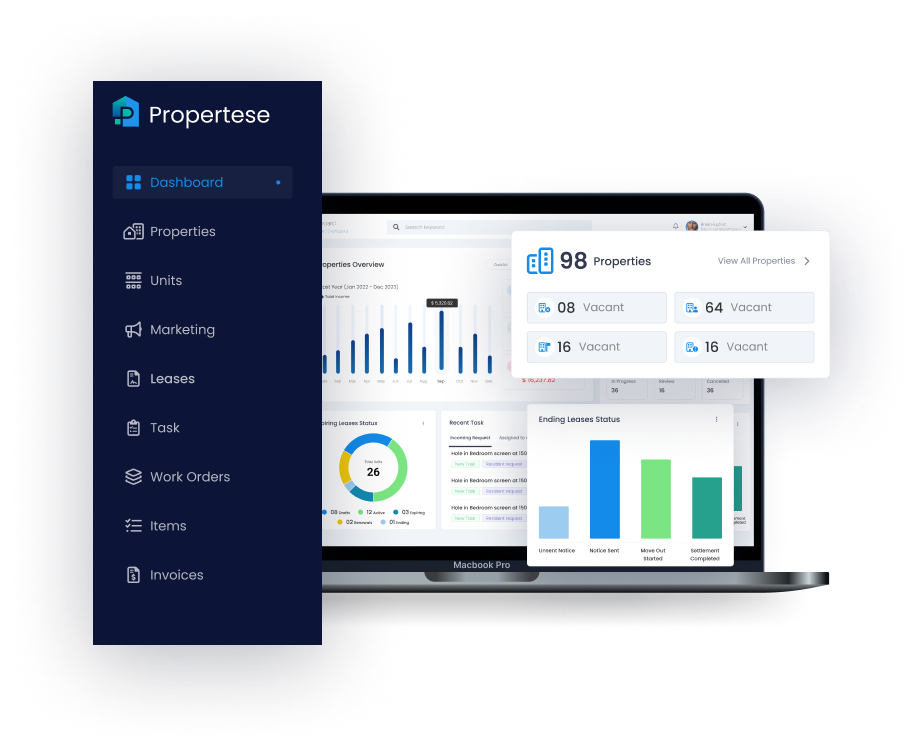
Propertese automates critical accounting functions:
- Automated rent collection: Online rent payments sync automatically to your accounting records. No manual entry, no missed payments, no reconciliation headaches.
- Integrated financial tracking: Every transaction, rent payments, vendor bills, owner distributions, updates your general ledger automatically.
- Real-time reporting: Access financial dashboards showing occupancy, rent collection rates, expense trends, and NOI across your portfolio. Make decisions based on current data, not last month’s reports.
- Trust account management: Separate tracking for security deposits with automated reconciliation ensures compliance and eliminates commingling risks.
- ERP integration: Seamless connection with NetSuite and Xero means your property data flows directly into enterprise financial systems without manual export/import.
- Expense categorization: Built-in chart of accounts structure guides consistent coding. Track expenses efficiently without spending hours on manual categorization.
- Owner portal: Property owners access their financial reports, see payment history, and review documentation anytime, reducing your admin burden.
The difference between manual and automated accounting isn’t just time saved. It’s accuracy, compliance, scalability, and the confidence to make data-driven decisions.
Avoiding Common Accounting Mistakes
These tips help you avoid the most frequent errors:
- Mixing personal and business funds: Never deposit rental income to personal accounts. Separate everything, it protects liability protection and simplifies taxes. (See Tip 6)
- Improper security deposit handling: Recording deposits as income or commingling with operating funds creates legal problems. Trust account compliance is mandatory. (See Tip 3)
- Inconsistent expense classification: Create a capitalization policy distinguishing repairs from improvements and apply it consistently. (See Tip 4)
- Skipping monthly reconciliations: Undetected errors compound. Reconcile all accounts monthly without exception. (See Tip 6)
- Missing documentation: Bank statements don’t prove business purpose. Save every receipt and document every transaction for audit protection. (See Tip 6)
Final Thoughts: Master These 8 Tips for Accounting Success
Rental income accounting drives every aspect of property management success. These 8 tips provide the foundation for accurate records, tax compliance, and profitable decision-making:
- Choose the right accounting method
- Build a proper chart of accounts
- Record income and security deposits correctly
- Classify expenses properly
- Leverage depreciation strategically
- Maintain clean books with documentation
- Ensure tax compliance and reporting
- Use technology to automate and scale
Property managers who master these fundamentals spend less time on bookkeeping and more time growing their business. Comprehensive property management solutions bring accounting, operations, and reporting together in one platform.
Contact Propertese today to simplify your rental income accounting and automate your financial management.
Table of Contents
Stay Updated
Subscribe to get the latest news, industry trends, blog posts, and updates...