If you’re managing rental properties, you’ve probably experienced that sinking feeling when April rolls around, and you’re scrambling to find receipts, categorize expenses, and figure out what forms you actually need.
The truth is, most property managers and landlords make tax reporting harder than it needs to be. Not because the rules are impossibly complex (though they’re not simple), but because they don’t have systems in place throughout the year.
This guide walks you through everything you need to know about property management tax reporting in plain English. No confusing jargon. No overwhelming lists of obscure tax code sections. Just practical, actionable guidance you can actually use.
Who Actually Needs This Guide?
This isn’t just for professional property managers running portfolios with hundreds of units. You’ll find value here if you’re:
- A landlord with one or two rental properties trying to figure out Schedule E
- A property manager handling multiple owners’ properties and dealing with 1099 forms
- A real estate investor optimizing tax strategies across a portfolio
- An Airbnb host wondering why your taxes feel so complicated
- Someone who just bought their first rental property and has no idea where to start
The common thread? You collect rent, pay expenses, and need to report it all correctly to the IRS without overpaying or triggering an audit.
What Makes Property Management Tax Reporting So Tricky?
A few things consistently trip people up. Understanding these upfront helps you avoid the most common problems.
The first headache is expense classification. Did you make a repair or an improvement? This isn’t semantic; it determines whether you deduct the full amount this year or spread it over decades through depreciation. Replace a broken window? That’s a repair. Replace all the windows with energy-efficient upgrades? That’s an improvement. The line gets blurry fast.
Then there’s depreciation itself. Your rental property is wearing out, and the IRS lets you deduct that wear and tear. But tracking basis, calculating annual depreciation, and understanding that you’ll pay some of it back when you sell requires careful recordkeeping that most people don’t maintain.
Add in passive activity loss rules (which might prevent you from deducting rental losses against your salary), information return deadlines (miss filing a 1099 and face penalties), and the reality that most property owners mix personal and business expenses, and you’ve got a recipe for problems.
What Tax Forms Do Property Managers Actually Need?
Let’s start with the basics. Depending on your situation, you’ll deal with some combination of these:
Schedule E (Form 1040) is where you report your rental income and expenses. This is the main form for most landlords. You list each property, show total income, deduct your expenses, calculate depreciation, and end up with net rental income or loss. That number flows to your main tax return.
Form 4562 handles depreciation. You file this when you place new property in service or make improvements that need to be depreciated. It’s also where you claim Section 179 deductions or bonus depreciation on qualifying assets like appliances.
Forms 1099-NEC and 1099-MISC are information returns you file when paying contractors, property managers, or other service providers. Generally, if you pay someone $600 or more during the year for services and they’re not incorporated, you need to issue a 1099. The deadlines are strict—1099-NEC is due January 31, and missing it brings penalties.
Form 8582 comes into play when you have rental losses and need to figure out how much you can actually deduct this year versus how much gets suspended for future years. Passive activity loss rules can limit your current deductions.
If you’re using property management software that integrates with your accounting, many of these forms can be generated automatically from your transaction data throughout the year.
How Do You Actually Track Rental Income?
Income seems straightforward: tenants pay rent, you report it. But rental income includes more than monthly rent checks.
You need to report regular rent payments, obviously. But also late fees, pet deposits that become non-refundable, parking fees, laundry income, application fees, and lease cancellation payments. If your tenant pays one of your expenses (like directly paying the utility company), that’s income to you (though you can then deduct the expense).
Advance rent creates confusion. If a tenant pays last month’s rent upfront when they move in, you report that as income in the year you receive it, not the year it covers. The IRS doesn’t care about your accounting method or what period the rent applies to. Cash received equals income reported.
Security deposits work differently. If you collect a refundable security deposit, it’s not income when you receive it. It only becomes income in the year you actually keep it for unpaid rent or damages. Keep separate security deposit records showing when deposits were received, what happened to them, and when any portion was retained.
For multiple properties, the key is keeping everything separated. One property’s income shouldn’t be mixed with another’s bank account. When everything flows into one account, you’ll spend hours at year-end trying to allocate income correctly. Proper expense tracking saves enormous time during tax preparation.
What Rental Expenses Can You Actually Deduct?
The IRS lets you deduct “ordinary and necessary” expenses for managing and maintaining rental property. In practice, that covers most of what you’d expect.
Mortgage interest and property taxes are typically your largest deductions. Insurance premiums for property, liability, and flood coverage are fully deductible. Utilities you pay (if you cover them rather than the tenant) are deductible. Property management fees, leasing commissions, legal and accounting fees related to the rental activity are all deductible.
Advertising costs to find tenants, whether that’s listing fees on rental sites or yard signs, are fully deductible. Cleaning between tenants, routine maintenance, snow removal, landscaping, and pest control all qualify.
Travel to and from your properties for management activities is deductible. According to IRS Publication 527, you can use either the standard mileage rate or track actual vehicle expenses. Keep detailed mileage logs showing the date, destination, purpose, and miles driven for every trip.
Repairs keep your property in good operating condition without adding substantial value. Fixing a leaky faucet, patching roof damage, repainting in the same color, replacing a broken appliance with a similar model, these are currently deductible repairs.
Improvements are different. If you add value to the property, prolong its useful life, or adapt it to a new use, you’ve made an improvement that must be capitalized and depreciated over time rather than deducted immediately. Installing a new roof, remodeling a kitchen, adding central air conditioning, or upgrading from carpet to hardwood floors are all improvements.
The distinction matters enormously. A $5,000 repair reduces this year’s taxable income by $5,000. A $5,000 improvement spread over 27.5 years reduces it by roughly $182 per year.
Software subscriptions for property management, bank fees, locksmith services, office supplies, and tenant screening costs are often overlooked but fully deductible. If you’re tracking everything properly with automated systems, you won’t miss these smaller deductions that add up.
How Does Rental Property Depreciation Actually Work?
Depreciation is one of the most valuable tax benefits in real estate. The concept is simple: your building is slowly wearing out, and the IRS lets you deduct that wear and tear even though you’re not actually spending cash.
Residential rental property depreciates over 27.5 years using straight-line depreciation. You divide your building’s value (not including land, as land doesn’t depreciate) by 27.5 and deduct that amount annually.
Buy a rental property for $275,000 where the land is worth $50,000? Your depreciable basis is $225,000. Divide that by 27.5, and you get roughly $8,182 you can deduct each year for depreciation.
When you eventually sell the property, depreciation gets “recaptured” and taxed at rates up to 25%. You’ll pay tax on depreciation you claimed or should have claimed, even if you forgot to take it.
Certain property components depreciate faster than the building itself. Appliances, carpeting, and furniture have shorter depreciation periods (typically 5-7 years). This is where cost segregation studies come in. For larger properties, engineering-based studies can identify components that qualify for accelerated depreciation, creating larger deductions in the early years.
Section 179 and bonus depreciation offer additional ways to accelerate deductions on qualifying property like appliances and equipment, though the rules and percentages change frequently. According to IRS Publication 946, bonus depreciation is phasing down in 2025.
The key to depreciation is meticulous recordkeeping. You need to track your original basis, all improvements that increase basis, and annual depreciation taken. When you sell the property, this information determines your taxable gain.
When Should You Hire a Tax Professional?
Consider hiring a CPA or Enrolled Agent specializing in real estate if you own multiple properties, especially across different states. Multi-state filing creates complexity most general tax preparers don’t handle well. You’re also better off with professional help if you’re making significant improvements requiring capitalization decisions, if you’re considering advanced strategies like 1031 exchanges or cost segregation studies, or if you’re trying to qualify as a real estate professional to escape passive loss limitations.
If you’ve bought or sold property during the year, professional guidance helps you report the transaction correctly and optimize the tax treatment. Entity structures like partnerships and S corporations add complexity that warrants professional assistance. And if you’re being audited or have received an IRS notice, professional representation is usually worth the cost.
For simple situations, one or two rental properties with straightforward income and expenses quality tax software combined with good recordkeeping throughout the year might be sufficient.
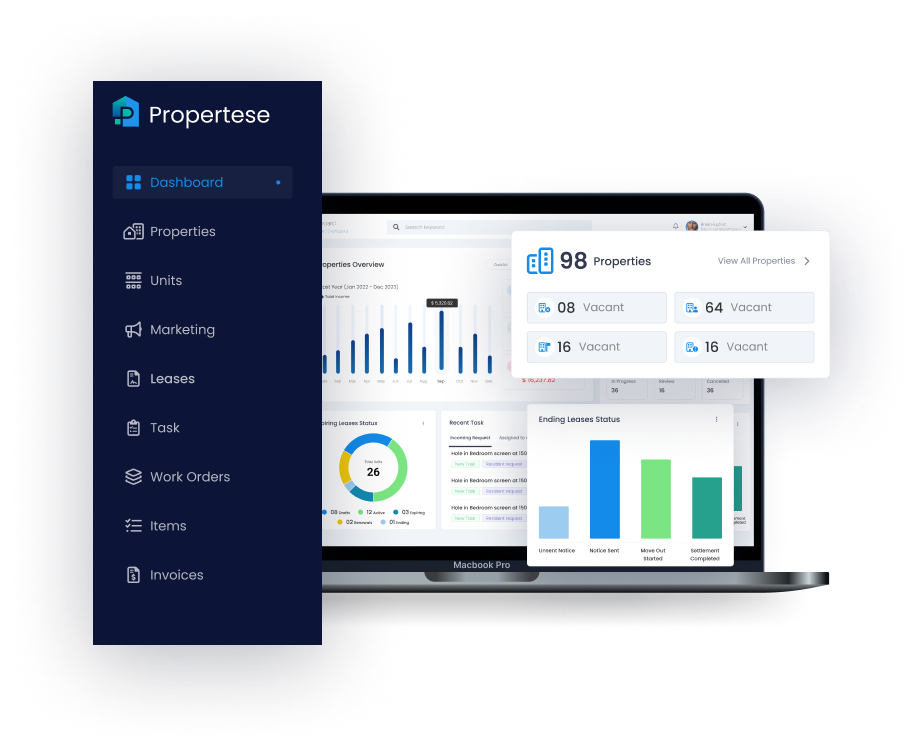
Many property managers find the sweet spot is using integrated property management and accounting software like Propertese to track everything during the year, then having a CPA review and file the returns. You get the efficiency of technology with the expertise of a professional reviewing your specific situation.
When hiring a tax professional, look for someone with specific rental property experience. Ask how many rental property clients they serve, whether they handle passive activity loss rules regularly, and if they provide year-round planning advice or just tax season preparation.
What Records Should You Keep and For How Long?
The IRS generally recommends keeping tax records for three years from when you filed the return. But for rental property, that’s not nearly long enough for some documents.
Keep property acquisition documents, improvement records, and depreciation schedules for as long as you own the property, plus at least three years after you sell it. You need this to prove your basis when calculating gain on sale.
Income and expense records, receipts, bank statements, invoices, and contracts should be kept for at least three years. If you substantially underreported income (by more than 25%), the IRS has six years to audit, so consider longer retention.
Lease agreements, security deposit ledgers, and tenant records should be retained according to your state’s landlord-tenant requirements, which vary. Some states mandate specific retention periods.
Electronic recordkeeping is perfectly acceptable to the IRS as long as records are readable, can be retrieved when needed, and are backed up securely. According to IRS Publication 552, you can scan paper receipts and store them digitally.
Create a system where you scan or photograph every receipt immediately. Organize files by property and tax year. Back everything up to cloud storage. When tax season arrives, you’ll have everything organized and accessible rather than digging through shoeboxes of faded receipts.
If you’re using document management tools, much of this organization happens automatically as you upload documents throughout the year.
How Do Monthly and Year-End Tax Procedures Differ?
Tax compliance isn’t a once-a-year task. Break it into manageable monthly and quarterly routines.
Every month, reconcile your bank accounts to your property ledgers. Record all income and expenses. Scan and file receipts. Update your mileage log. This takes maybe two hours monthly and ensures nothing gets missed.
Quarterly, calculate your estimated tax liability and make required payments if you expect to owe more than $1,000. Review your profit and loss statements for each property. Check that you’re on track with your budget and projections.
As November and December approach, meet with your tax advisor to review the year and identify beneficial expenses to make before year-end. If you’re planning equipment purchases or repairs, timing them strategically can optimize your tax position.
January brings critical deadlines. Forms 1099-NEC for contractor payments are due January 31 to both the contractor and the IRS. Missing this deadline brings penalties that start at $50 per form and go up from there depending on how late you are.
Complete your bank reconciliations, finalize your books for the prior year, and prepare organized documentation for your tax preparer or software. When everything’s been tracked monthly, year-end closing is straightforward rather than weeks of stress.
The property managers who handle tax season smoothly are the ones who maintain organized systems throughout the year rather than scrambling when deadlines approach.
What Are the Most Common Tax Reporting Mistakes?
Certain mistakes show up repeatedly. Knowing what they are helps you avoid them.
Mixing personal and business expenses is the biggest issue. Using the same bank account or credit card for personal purchases and rental property expenses creates chaos. Open dedicated accounts for each rental property. Never pay personal expenses from rental accounts.
Misclassifying repairs as improvements, or vice versa, costs money either through disallowed deductions or missed opportunities. When in doubt about a large expense, ask a tax professional before deducting it.
Failing to report all income is risky because the IRS receives copies of Forms 1099 showing income paid to you. If you don’t report income shown on information returns, automated matching systems will catch the discrepancy.
Inadequate mileage documentation leaves deductions on the table. The IRS wants contemporaneous records so you can’t reconstruct a mileage log at year-end. Use a mileage app or keep a logbook in your vehicle and update it regularly.
Not issuing required Forms 1099 to contractors brings penalties. Collect W-9 forms from every vendor before issuing their first payment. Set up calendar reminders for the January 31 deadline.
Using Schedule C instead of Schedule E for rental income subjects you to self-employment tax unnecessarily. Rental income generally goes on Schedule E unless you’re providing substantial services that make it a business rather than a rental activity.
Failing to track property basis causes problems when you sell. Keep a permanent file for each property with purchase documents, improvement receipts, and depreciation schedules. You’ll need this information years from now.
What Special Situations Require Extra Attention?
Some property management scenarios add complexity beyond standard rental situations.
Multi-state properties require filing nonresident tax returns in each state where you own property, reporting income and expenses for properties in that state. Your home state typically gives you credit for taxes paid to other states, but you may still owe additional tax. State tax compliance gets complicated fast, and professional help is usually worthwhile.
Short-term vacation rentals through Airbnb or VRBO face different rules than traditional rentals. If you rent for fewer than 15 days annually and use the property personally for at least 14 days, you don’t report the rental income at all. This “Masters exception” is valuable but has specific requirements. If you rent more than 14 days and also use it personally, you must allocate expenses between rental and personal use, which limits deductions. Properties rented for average periods of 7 days or less might not be passive activities, potentially allowing losses to offset other income but also possibly triggering self-employment tax.
1031 exchanges let you defer capital gains and depreciation recapture by reinvesting proceeds into another rental property. The rules are strict—you must identify replacement properties within 45 days and close within 180 days of selling your original property. You can’t touch the proceeds; they must go through a qualified intermediary. According to IRC Section 1031, getting it wrong means the entire gain becomes taxable. This is definitely professional-help territory.
Foreign ownership of U.S. rental property requires withholding 15% of the gross sales price when the property is sold (FIRPTA withholding), and foreign owners file different forms (Form 1040-NR) with limited deductions. Estate tax issues also arise since U.S. real property owned by nonresident aliens faces much lower estate tax exemptions.

Conclusion
The property managers who handle taxes well aren’t necessarily more knowledgeable about obscure tax code sections. They’re the ones who established good processes, use the right tools, and stay organized. When you build proper systems, tax compliance becomes a manageable part of running your rental business rather than an annual crisis.
Propertese helps property managers stay organized year-round with tools designed for tax compliance:
✓ Track income and expenses by property automatically
✓ Generate Schedule E-ready reports at tax time
✓ Manage vendor information and 1099 preparation
✓ Store documents and receipts in one secure location
✓ Access financial reports and depreciation tracking
Stop scrambling at tax time. See how Propertese works for your portfolio.