Property management forms and templates are standardized documents used to collect, organize, and control information across the property lifecycle—from leasing and tenant screening to maintenance, financials, and compliance. A complete, legally compliant library reduces risk, ensures consistency, and saves time when referencing past interactions and decisions. Expectations are now firmly digital: fillable, state-specific templates and e-signature-ready documents help teams keep pace with evolving regulations and tenant experience standards. This guide organizes the essential forms you’ll use most often, with practical tips to customize, automate, and maintain them. All templates referenced are designed for free download and digital use, and they integrate seamlessly into modern property management software for scalable, defensible operations.
Key takeaways:
- Build a complete, state-specific, e-sign-ready library to reduce risk and save time.
- Use fillable, digital templates with audit trails to improve accuracy and defensibility.
- Centralize forms in software to automate workflows, version control, and secure storage.
- Standardize core documents while allowing property- and jurisdiction-specific customization.
Essential Property Management Document Categories
The right forms underpin every stage of operations. A well-structured library improves execution, audit readiness, and team alignment.
- Lease Agreements and Property Management Agreements
- Intake and Screening Forms
- Financial Ledgers
- Maintenance and Inspection Checklists
- Legal Notices and Eviction Packets
- Owner Reporting and Handover Documents
Category overview and common templates:
| Category | Purpose | Key templates and terms |
|---|---|---|
| Lease Agreements & PMAs | Define legal terms, duties, and risk allocation | Residential/commercial lease, addenda, property management agreement template |
| Intake & Screening | Assess tenant fit and risk | Rental application form, tenant screening form, prescreen questionnaire |
| Financial Ledgers | Track payments, charges, and security deposits | Rent ledger, security deposit ledger, owner distribution log |
| Maintenance & Inspections | Plan and document upkeep and safety | Inspection checklist, maintenance checklist, work order |
| Legal Notices & Eviction | Enforce lease and statutory remedies | Late rent notice, violation/cure notice, eviction notice template, eviction packet |
| Owner Reporting & Handover | Communicate performance and transition cleanly | Monthly owner report, owner statement, handover checklist |
Lease Agreements and Property Management Agreements
A lease agreement is a binding contract outlining the obligations of tenants and landlords, including rent, term, use, and remedies. A property management agreement defines manager duties, compensation, spending authority, and risk allocation; it should also support digital execution with e-signature and a clear audit trail under ESIGN/UETA. Tailor both for local law and business requirements, and include scope of services, fee schedules, fair housing adherence, mandatory disclosures, insurance and indemnities, approval thresholds, termination and handover procedures, and record-keeping standards.
Tenant Screening and Rental Application Forms
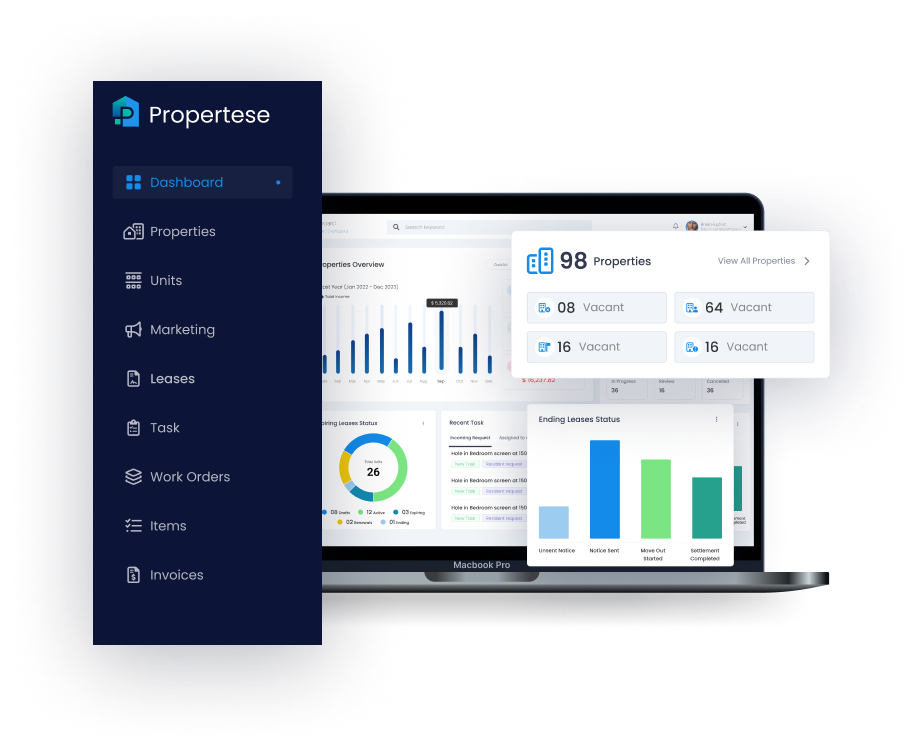
A rental application form standardizes how you gather identity, rental history, income, and consent to run screenings. Templates modeled on prescreen questionnaires help collect consistent, decision-ready information. Embedding screening in property management software, such as Propertese, improves workflow automation, transparency of decisions, and compliance with changing rules.
Typical fields to include:
- Applicant and co-occupant details
- Employment and income verification
- Rental history and references
- Digital consent for credit, criminal, and eviction background checks
Rent and Security Deposit Ledgers
A rent ledger provides an ongoing record of rent charges, payments, fees, and balances for each tenancy. A security deposit ledger documents initial collection, permitted deductions, and the return. Maintaining accurate, searchable ledgers makes you audit-ready and reduces disputes—especially when you need to quickly reference prior transactions and communications.
Simple rent ledger format:
| Date | Charge | Payment | Balance | Notes |
|---|---|---|---|---|
| 2026-02-01 | 1,800.00 | 0.00 | 1,800.00 | Rent due |
Maintenance and Inspection Checklists
A maintenance checklist standardizes recurring tasks, frequencies, and responsibility assignments to keep properties safe and compliant. Digital inspection tools create transparency and traceability across teams, vendors, and owners. Track work orders, approvals, completed repairs, and inspection outcomes in one system with time-stamped certifications and optional e-sign acknowledgments. For high-stakes events, align your approach with a property management emergency response plan. For routine concerns, apply best practices for how to handle tenant complaints with templates.
Notices, Cure Letters, and Eviction Packets
A cure notice formally instructs a tenant to fix a lease violation within a specified time before further action proceeds. An eviction packet contains the precise, jurisdiction-specific sequence of notices and filings required to remove a tenant. Because rules are technical and time-sensitive, use up-to-date, localized templates—many free lease PDFs and notices lack current disclosures or enforceable language, risking invalidation of your action. For compliant rent adjustments, see the rent increase letters with legal requirements and templates by state.
Common forms:
- Late rent notice and demand for payment
- Lease violation and demand for compliance (cure)
- Notice to vacate/quit and final court packet
Owner Reporting and Handover Checklists
Owner reporting templates present standardized monthly or on-demand financials and KPIs, improving trust and reducing ad-hoc requests. A handover checklist ensures nothing is missed when onboarding a new portfolio or terminating management: data exports, ledgers, keys, security deposits, vendor lists, warranties, and open issues. Automate report cycles and include a structured sign-off for transitions to ensure continuity and clear accountability.
Legal Compliance and Best Practices for Property Management Forms
Compliance protects your business, reduces disputes, and creates consistent tenant experiences. As regulations multiply, more rental owners cite compliance as a primary reason to hire professional managers.
Ensuring State-Specific and Up-to-Date Templates
Using generic or outdated forms is a material legal risk. Many free online lease PDFs lack recent state-specific disclosures and updated legal language, leading to unenforceable documents. Schedule annual legal reviews, refresh templates after law changes, and maintain jurisdiction- and property-type variants with documented version control.
Incorporating Electronic Signatures and Audit Trails
Electronic signatures are legally recognized under ESIGN/UETA when you retain a complete audit trail. Best practice is to finalize all agreements and key notices via a platform that captures signer identity, timestamps, IP/device data, and preserves unaltered executed copies—along with monthly audit reports. This makes enforcement more defensible and workflows faster.
Defining Scope, Fees, and Compliance Requirements in Agreements
Your property management agreement should clearly state management scope and authority, fee structures, insurance requirements, compliance guardrails (fair housing, safety, data privacy), approval thresholds, and termination/handover procedures. Incorporate disclosure requirements and record-keeping standards so audits are routine, not disruptive. Use standardized templates to simplify renewals and amendments across the portfolio.
Integrating Forms and Templates with Property Management Software
Property managers must adapt processes to technology, tenant expectations, and evolving regulations for 2025 and beyond. Digitizing your forms library delivers centralized access, real-time collaboration, integrated workflows, and secure archives—capabilities natively supported in Propertese’s contract management module.
Benefits of Digital and Fillable Form Formats
Fillable forms are digital documents completed and submitted electronically, improving accuracy and reducing manual entry. API-connected templates streamline onboarding, screening, leasing, and compliance updates, aligning with trendlines toward automation and data integrity.
Paper vs. digital templates:
| Aspect | Paper | Digital/fillable |
|---|---|---|
| Turnaround time | Slow; in-person or mail | Instant; e-sign and automated routing |
| Data accuracy | Manual entry errors | Validation rules and required fields |
| Compliance updates | Hard to track | Template versioning and jurisdiction tags |
| Searchability | File cabinets | Full-text, filterable search |
| E-signature | Not native | ESIGN/UETA compliant |
| Audit trail | Limited | Time-stamped logs and immutable copies |
Automating Workflows and Record-Keeping
Embed templates inside automated workflows to trigger reminders, approvals, e-sign requests, and archive policies as deals progress. Technology boosts service quality as portfolios scale faster than headcount. Common automations include:
- Lease renewals with notice windows, escalations, and counterparty e-sign
- Move-in/move-out inspections with photo capture and itemized charges
- Receipt filing to the correct tenancy and ledger on form submission
For prospect outreach and follow-ups during leasing cycles, see crafting the perfect pitch with leasing email templates.
Version Control and Secure Document Storage
Version control tracks changes to templates over time and preserves prior iterations for reference and risk management. Use property management software with encrypted storage, granular user roles, access logs, and offsite backups to protect sensitive files. Strong audit logs and fast searchability support internal QA, lender reviews, and legal discovery. Propertese adds permissioned access and roles to keep sensitive documents restricted to authorized users.
Customization and Optimization of Property Management Templates
Your goal is consistency without rigidity—standardize everywhere you can, customize where the law or asset strategy requires. Technology alone isn’t a silver bullet; value depends on correct setup, staff training, and continuous optimization, as adoption playbooks for 2025 emphasize.
Balancing Standardization with Property-Specific Needs
Start with a master template for each form type, then expose modifiable sections for:
- Jurisdiction-specific clauses and disclosures
- Property class variables (e.g., pet policies, utility billing, amenity access)
- Operational addenda (parking, storage, HOA rules)
Be cautious with generic downloads; they often miss property-specific rules and state law updates, increasing enforcement risk.
Training Teams on New Digital Workflows
Adopt a structured rollout:
- Live demo sessions of the end-to-end digital process
- Hands-on exercises using real scenarios
- Quick-reference guides and annotated templates
- Feedback loops and periodic refresher training
Appoint compliance champions to monitor usage, update playbooks, and reinforce standards—implementation requires ongoing tuning.
Scheduling Legal Reviews and Template Updates
Set annual legal/compliance reviews, and trigger ad-hoc updates after material law changes. Keep a centralized log of review dates, owners, and pending updates. Industry kits recommend having local counsel review forms before use and to provide jurisdiction-specific legal information.
Best Practices for Maintaining a Complete Template Library
- Curate a comprehensive, legally reviewed library covering intake, tenancy, financials, maintenance, disputes, and exit stages so teams always use the right document.
- Track version history, schedule periodic reviews, and use software to automate updates, retention, and jurisdiction tagging in line with regulatory standards and evolving guidance.
- Assign clear ownership for library maintenance, and integrate templates directly into workflows across your property management systems, such as Propertese, so every team member can find and use the latest version.
Frequently Asked Questions
What is a property management form or template?
A property management form or template is a standardized digital or paper document used to collect and organize information for tasks such as leasing, maintenance, and compliance.
Why are standardized real estate forms important for property managers?
They ensure consistency, minimize errors, support legal compliance, and make it easier to document interactions and defend against disputes.
What types of information do rental application forms typically collect?
They capture contact details, employment and income, rental history, references, and authorization for credit or background checks.
Can property management forms be customized for different property types?
Yes. Templates can be tailored for residential, commercial, or association needs with property-specific fields and clauses.
How do digital forms help with compliance and record-keeping?
Digital forms enable secure storage, audit trails, and quick updates when regulations change, strengthening defensibility and efficiency.
Table of Contents
Stay Updated
Subscribe to get the latest news, industry trends, blog posts, and updates...