Key Takeaways
- Running five separate tools means five different versions of the same data, and every month someone has to reconcile them before anything useful can be reported.
- The cost of disconnected systems almost never shows up on a report because it shows up as days of close time and errors that take longer to find than to fix.
- Most property management teams decide to consolidate after one specific moment: a failed audit, a missed report, or the person who managed everything leaves.
- One platform where lease management, accounting, maintenance, payments, and CRM all share the same data means there is nothing to reconcile between them.
- Moving from five tools to one is an operations decision where the technology follows the business need, not the other way around.
Ask any property manager how many software tools their team logs into every day. The answer is almost never one.
There is the lease management system, the accounting tool, the maintenance platform, the payments portal, and sometimes a separate CRM. Each one was chosen to solve a real problem. Each one does its job reasonably well. But when the month-end close arrives, someone has to pull data from all of them, match the numbers, find the gaps, and produce a report that gets questioned by someone working from a different system.
That process does not exist because the team is disorganized. It exists because the tools were never connected. And every property management company grows into it without quite noticing until the close takes two weeks instead of four days.
This post covers what that situation actually costs, where it breaks first, what real teams describe as the moment they knew something had to change, and what happens when everything runs on one platform instead of five.
Why Do Most Property Management Teams Rely on Multiple Disconnected Tools?
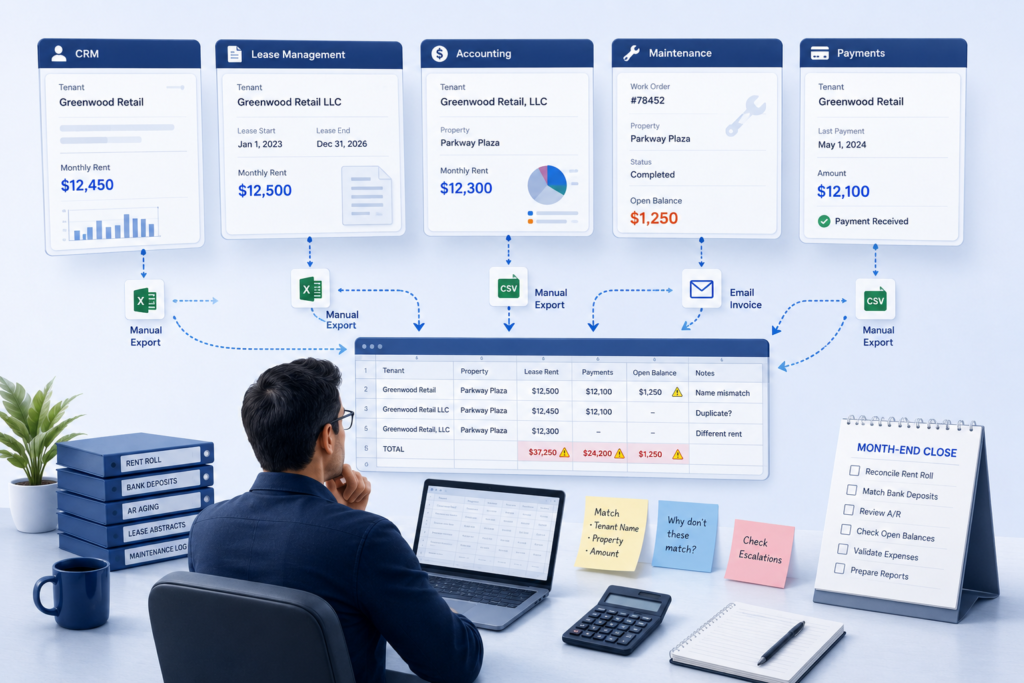
Property management teams end up with multiple tools because they added software one problem at a time, and each addition made sense on its own.
Here is the typical progression:
- Year 1: A spreadsheet tracks the rent roll. A basic accounting tool handles the books.
- Year 2: The team adds a lease management platform because the spreadsheet cannot handle escalations.
- Year 3: A maintenance ticketing tool comes in because work orders are getting lost in email.
- Year 4: A payments portal gets set up because the bank integration on the accounting tool was easier that way.
- Year 5: Someone builds a reporting workaround in Excel because none of the tools produce the investor report in the right format.
Nobody made a bad decision. Every tool was added for a real reason. But they were chosen to solve individual problems, not to work as a connected system. And now the team logs into five different platforms every day, re-enters the same data across multiple systems, and spends the first week of every month close reconciling numbers that have drifted apart across systems.
What Does It Actually Cost When Your Property Tools Do Not Share Data?
The cost of running disconnected tools almost never shows up as a line item. It shows up as hours that disappear every month into work that adds no value to the portfolio.
Here is where that time goes:
Re-entering the same data
When a new lease is signed, someone enters it in the lease management system. Then in the accounting tool and in the payments portal. Three separate entries for one event, each a chance for a number to drift from the others.
Reconciling at month-end
When lease management, accounting, and payments each have their own records, the close requires pulling all three and matching them line by line. For a portfolio with multiple entities, this typically runs seven to fourteen days. Most of that time is not analysis. It is matching numbers that have drifted between systems.
Producing reports from exports
When an investor or lender asks for a portfolio view, someone has to export data from each tool, reformat it, and combine it. The report that goes out reflects data from several different moments in time, because each tool was last updated at a different point.
Finding the person who knows how it all works
In most teams, one person knows how the tools connect and where the workarounds are. When that person is out or leaves, the rest of the team is left trying to reconstruct a process nobody documented.
According to McKinsey’s research on digital adoption in finance, organizations running on fragmented tools consistently report that moving data manually between systems consumes a significant share of finance team capacity. In property management, that fragmentation has a specific pattern: five tools, five versions of the data, and a team spending more time moving information than using it.
Where Do Disconnected Systems Cause Real Financial Problems?
The biggest financial problems from disconnected tools do not come from the tools themselves. They come from the gaps between them.
1. Maintenance Costs Posted to the Wrong Place
A work order is raised in the maintenance platform, the vendor finishes the job, the invoice arrives by email, and someone in accounts payable manually matches it to the work order before posting it to the accounting system under the right property and cost category.
That matching step is where property-level cost data goes wrong. Wrong category, property, and period. Each error is small. Across hundreds of work orders a month, they add up to financial statements that do not accurately reflect where money was spent.
When maintenance requests and vendor invoices connect directly to the accounts payable process, work orders flow automatically into the financial records the moment a job closes. The manual matching step disappears.
2. Approvals Leave No Paper Trail
When lease approvals, vendor payments, and spending decisions happen over email, there is no record in any system of who authorized what and when. The approval happened; it lives in an inbox, and it does not exist in the financial records.
During an audit or an investor review, this matters. The question is not whether the approval happened. It is whether the system can prove it. Moving approval decisions into a connected workflow means every approval is timestamped, linked to the transaction, and traceable without searching through email archives.
3. NOI Does Not Match Between Systems
One of the most common financial discrepancies in property management is NOI calculated differently in the lease management system versus the accounting tool. One pulls from the rent roll and the other pulls from actual postings, and when they disagree, investors and lenders ask questions that take days to answer.
Understanding how NOI should flow through a connected system makes the source of these discrepancies clear. The guide on how NOI is calculated in property management covers where the numbers diverge when the data lives in separate tools.
4. Rent Payments Lag the Ledger
When rent is collected through a payments portal and posted to the accounting system through a nightly batch file, there is always a gap. The cash has been received, but the ledger has not been updated, and for a portfolio with hundreds of tenants, this gap creates daily reconciliation work that only goes away when the two systems become one.
When rent collection connects directly to the general ledger, payments post automatically to the correct tenant, period, and entity. The daily reconciliation disappears.
What Changes When Everything Runs on One Real Estate ERP?
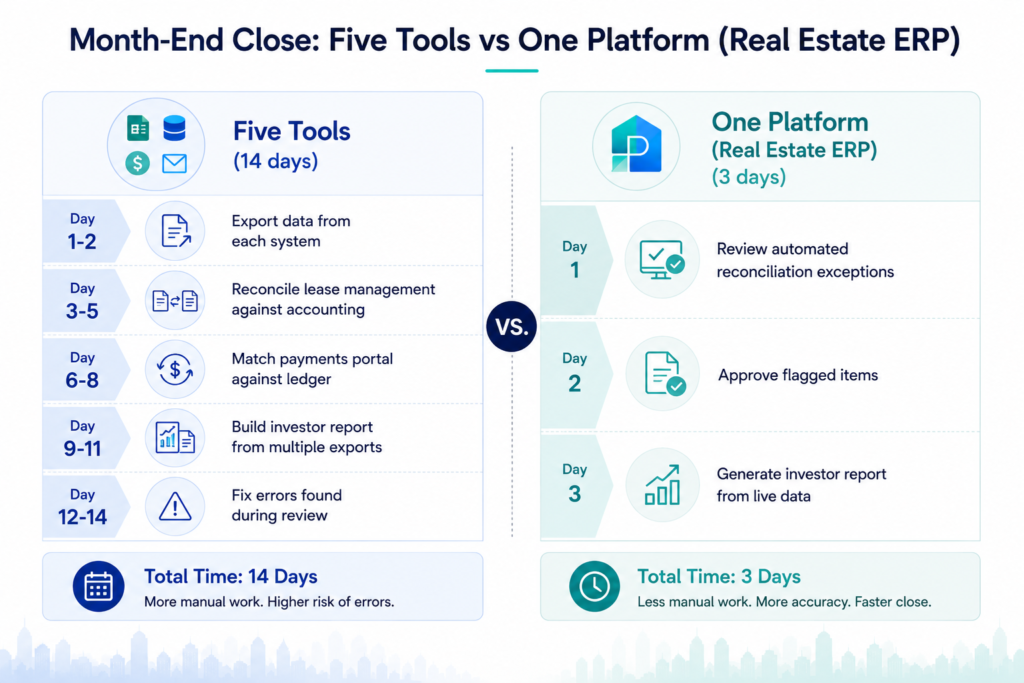
When lease management, accounting, maintenance, payments, and CRM all run on the same data layer, the reconciliation step does not get faster. It disappears entirely. There is nothing to reconcile between systems because there is only one system.
Here is what that changes in practice:
| Task | Five separate tools | One platform (Real Estate ERP) |
| New lease signed | Entry in three separate tools | Rent roll, ASC 842 entry, and payment schedule created at once |
| Maintenance job completed | Invoice matched manually to work order | Cost posts to correct property and entity automatically |
| Month-end close | 7 to 14 days of reconciliation | Review of automated results |
| Investor report | Assembled from multiple exports | Generated from live data |
| New entity added | New accounts set up across each tool | Single entity added to connected platform |
For multi-entity portfolios specifically, this matters at a different scale. When each entity has its own books and reports, consolidation in a five-tool stack is a project. On one platform, it is a report.
The Greendale case study covers a real portfolio that made this move: consolidated reporting, faster close cycles, and investor reporting that comes directly from the platform rather than assembled from exports.
How Do You Know When It Is Time to Consolidate Your Property Management Tools?
Most teams do not decide to consolidate because the tools are bad. They decide after one specific moment that makes the problem impossible to ignore.
The most common triggers:
- Month-end close ran past the twelfth business day for the third month in a row.
- An investor received two reports with different figures for the same property.
- A lender audit required pulling documentation from four different systems over two weeks.
- The person who managed all the tool integrations gave notice.
- A lease amendment was entered in two of the three systems and the discrepancy showed up six months later.
If two or more of these have happened in the last twelve months, the current setup is creating risk that grows with every property added to the portfolio.
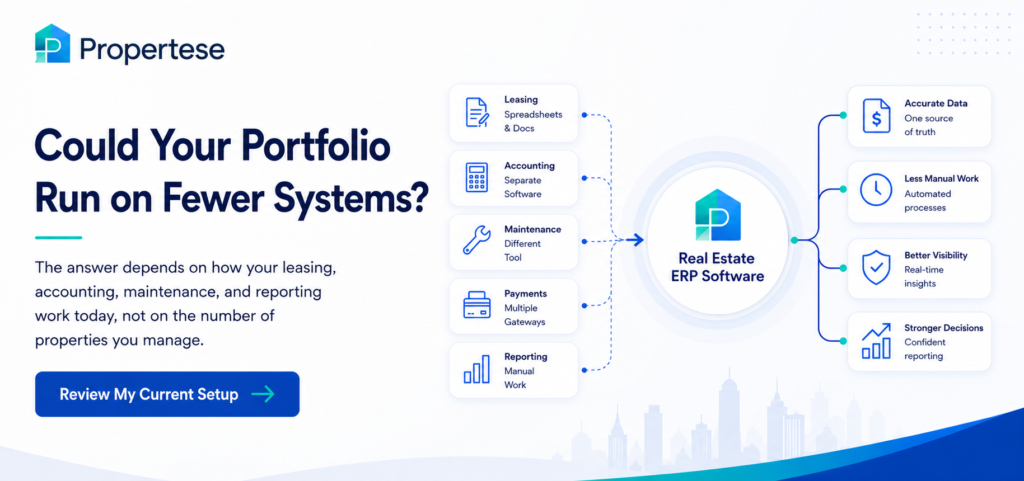
How Does One Platform Replace Separate Tools for Lease Management, Accounting, Maintenance, Payments, and CRM?
A real estate ERP replaces the entire stack by handling each function within the same data layer, not by being a slightly better version of each individual tool.
Here is how each function maps across:
1. Lease management
In a separate tool, lease events update the lease system but require a manual step to reach the accounting records. On one platform, a signed lease creates the rent roll entry, the ASC 842 calculation, and the payment schedule at the same time with no separate entry required.
2. Accounting
A standalone accounting tool receives data from other systems on a delay, through exports or batch files. A real estate ERP built on enterprise financial infrastructure handles multi-entity accounting, ASC 842 compliance, and investor reporting natively. Every lease event, maintenance cost, and payment posts to the correct entity and account as it happens.
3. Maintenance
In a separate platform, maintenance costs require manual matching to invoices before they can be posted to the accounting system. When units, properties, and their associated costs all are in the same connected layer, completed work orders flow directly into accounts payable without a manual step.
4. Payments
A separate payments portal sends data to the accounting system through a nightly batch file. On one platform, every rent payment posts to the correct tenant ledger and period in real time. No morning reconciliation. No gap between cash received and ledger updated.
5. CRM
A standalone CRM keeps leasing pipeline and tenant communications in a separate system from the financial records. On one platform, a prospect who becomes a tenant creates the lease record and the financial configuration together. The conversation history connects to the file without a manual transfer.
Frequently Asked Questions
Why do property management companies use so many different software tools?
Each tool was added to solve a specific problem as the portfolio grew. The lease management platform came when the spreadsheet could not handle escalations. The maintenance tool came when work orders were getting lost in email. No single decision created the fragmentation. Five separate decisions made over five years together did.
What is the hidden cost of running on multiple disconnected tools?
The cost shows up as time spent reconciling data between systems that were never designed to share it. For a mid-market portfolio at month-end close, this typically runs seven to fourteen days. Most of that time produces no analysis and adds no value. It exists only because the tools do not share data.
What breaks first when property management tools are disconnected?
Month-end close. The reconciliation between the lease management system, accounting tool, and payments portal is where the most manual work concentrates. It is also where most errors enter the financial records.
How does a single platform change month-end close?
It removes most of the reconciliation. When lease management, payments, and accounting share the same data layer, there is nothing to match between systems. The close becomes a review, not an assembly process.
Is it difficult to move from five tools to one platform?
The migration requires planning, data cleaning, and a structured cutover. The difficulty depends on how much data needs to move and how complex the current tool connections are. Most mid-market portfolios complete the transition in ten to sixteen months.
Conclusion
Every property management company that runs on five tools started with one. The stack grew because the business grew, which is the natural path. The question is whether the current setup is still working for the business or whether the business has grown past it.
When month-end close takes longer than it should, when investor reports require manual assembly, when the team spends the first week of every month reconciling instead of reporting, the tools are the constraint. Moving to one platform removes the work that only exists because the data is spread across five of them.
Talk to Propertese about what one connected platform looks like for a portfolio at your stage.