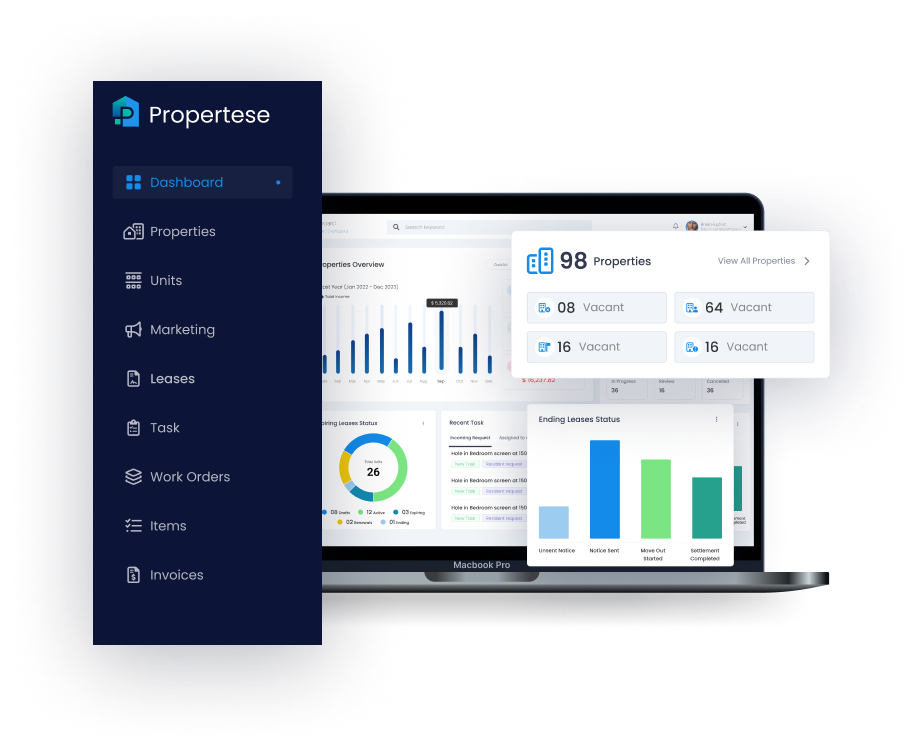
The best property management technology today goes far beyond simple rent collection or maintenance tracking. It delivers centralized insight, automates complex workflows, and enhances the experience for tenants and owners alike. As real estate operations grow larger and more data-driven, mid to large portfolio managers turn to cloud-based real estate ERP like Propertese to gain efficiency, transparency, and control. This article explores how property management technology has evolved, the trends that define its future, and strategies to adopt these tools to drive performance and ROI.
Key takeaways:
- Property management technology unifies leasing, maintenance, and finance data for clear decisions
- ERP integration removes manual reconciliation and improves audit precision
- AI and automation reduce downtime and free staff time for higher-value work
- Immersive tools and IoT create a better tenant experience and safer operations
- A phased rollout with strong data governance raises adoption success
Evolution of property management technology
Property management has transformed from a paper-led, reactive process into a proactive, technology-enabled discipline. Early systems focused on lease storage and rent logs; now, cloud-based and mobile-first platforms unify leasing, maintenance, and finances in real time.
The market reflects this shift. It was valued at $5.53 billion in 2023 and is projected to nearly triple to $13.97 billion by 2033. This growth is driven by automation, data analytics, and tenant experience tools that turn portfolios into assets that improve all the time. Teams that understand this evolution can stay competitive when they align their operations to modern technology capabilities rather than legacy manual workflows. Platforms such as Propertese exemplify this modern approach through unified visibility and ERP integration that simplify portfolio control.
Key technology trends shaping the industry
Today’s property technology, or PropTech, ecosystem encompasses multiple innovations that improve accuracy, efficiency, and decision-making.
| Trend | Description | Sample benefit |
|---|---|---|
| Artificial intelligence (AI) | Learns from lease, maintenance, and market data to optimize decisions | Enables predictive maintenance scheduling |
| Cloud platforms | Store and process data securely across devices | Enables remote access and updates |
| Automation | Streamlines repetitive admin and financial workflows | Reduces processing time and human errors |
| Immersive technologies | Tools like VR, AR, and digital twins simulate real properties | Cuts showing times by up to 40% |
| Blockchain | Creates secure transaction logs for contracts and payments | Enhances auditability |
| IoT and 5G | Connects sensors, locks, and meters to live data systems | Enables real time performance insights |
These innovations work collectively to make properties smarter, sustainable, and more responsive to tenants and owners. Propertese integrates several of these advances into one platform to support efficient, data-driven property operations. For demand growth, many teams add focused outreach with marketing tools for property management companies.
Impact of AI and automation on property management
AI and automation change how property managers operate. These systems handle routine communications, pricing, and reports while they predict maintenance before costly issues arise. Adoption has surged. It rose from 20% to 58% among property managers in one year.
A typical automated workflow follows this cycle:
- AI predicts a potential maintenance issue with sensor data
- The platform schedules a technician and sends digital notifications
- Work updates are automatically logged and tracked
- Final reports feed into analytics dashboards for continuous optimization
The result is faster resolution, reduced downtime, and more time for staff to focus on strategic, value-added activity. Propertese applies automation across lease, maintenance, and financial workflows, which gives property teams consistent precision and fewer manual errors. For a deeper view, see the benefits of automation in property management.
Integration and centralization in property management platforms
Integrated, centralized platforms have become essential to scale property operations. A centralized property management system unifies data sources like leasing, accounting, maintenance, and tenant relations into a single source of truth.
Key integrations now include ERP software such as NetSuite and Xero, digital signature tools, and tenant portals. Centralization produces measurable benefits:
| Centralized platform | Separate systems |
|---|---|
| Unified dashboards with live updates | Disconnected data silos |
| Seamless ERP and financial sync | Manual reconciliation |
| Faster decisions and reporting | Increased administrative overhead |
Integration ensures that decision makers always see the full portfolio picture, which drives faster and more accurate responses. Propertese stands out for its deep ERP integration, which connects front-end property data directly with financial systems for real-time, audit-ready reporting. Finance leaders can also review real estate accounting software features and benefits.
Immersive technologies and on-site innovations
Virtual tours and AR and VR models let prospects explore spaces remotely. This can reduce time spent on physical showings by up to 40%. Digital twins provide real-time asset performance data to support predictive maintenance and sustainability checks.
On-site, IoT sensors track temperature and occupancy, while smart locks and wearables improve safety and communication for maintenance teams. The combined impact is a more responsive, data-enabled property environment that aligns with modern tenant expectations. Integrated through platforms like Propertese, these innovations deliver real-time context from the field to management dashboards. Teams that need stronger field visibility can review property management inspection software options.
Overcoming adoption challenges and risks
Adoption of new technology presents hurdles, such as system complexity, resistance to change, and inconsistent data quality. Strong data governance, which defines how information is collected, maintained, and secured, is crucial.
To mitigate risk, organizations should:
- Pilot new systems with clear success criteria
- Train staff comprehensively on both tools and processes
- Clean and standardize data before migration
- Built-in privacy and regulatory compliance measures
- Roll out in phases with performance checks
This structured approach increases adoption success and long-term ROI. With guided implementation support and user education, Propertese helps teams transition smoothly to unified digital management.
Strategic benefits of modern property management technology
Modern solutions deliver quantifiable results. Predictive maintenance can reduce emergency repairs by up to 40%, while cloud-based platforms accelerate tenant communication and the lease process.
Top-level benefits include:
- Increased operational efficiency and reduced costs
- Higher tenant satisfaction and retention
- Real-time visibility across the business
- Faster lease renewals and regulatory compliance
- Enhanced asset value through data-backed decisions
When deployed correctly, these technologies become a growth enabler rather than just a management tool. Propertese users often find that integrated dashboards and automated processes provide the insight and scalability needed for sustained portfolio growth.
Best practices for implementing property management systems
The best property management systems succeed through careful plans, strong engagement, and continuous optimization.
A reliable implementation roadmap includes:
- Assess business goals and workflow pain points
- Evaluate platform scalability and integration capability
- Pilot before full rollout
- Ensure staff education and cross-department communication
- Integrate with ERP and accounting systems for unified reporting
- Monitor user adoption and ROI performance
Role-based access controls ensure that each team member has the appropriate permissions. This keeps operations secure and efficient over time. Propertese supports these best practices with configurable workflows, secure access, and continuous optimization tools.
The future outlook of property management technology
In the years ahead, property management will become increasingly intelligent and interconnected. Greater AI adoption, stronger data governance, immersive tenant experiences, and continued cloud expansion will shape the decade ahead.
With the software market projected to reach $13.97 billion by 2033, firms that remain agile and that invest in skills, scalability, and compliance will lead the next generation of digital real estate management. Propertese is positioned to support that evolution with adaptive, ERP-integrated technology built for long-term operational control.
Frequently asked questions
What are the essential features to look for in property management technology?
Key features to prioritize include integrated leasing and maintenance, automated rent collection, robust reporting, mobile access, and seamless ERP and accounting integrations. Propertese combines all of these capabilities in one unified system.
How does automation improve operational efficiency in property management?
Automation streamlines repetitive tasks like rent reminders, maintenance requests, and the invoice process, which frees up staff time and reduces human error. Propertese automates these functions end-to-end for consistent accuracy.
What challenges should property managers anticipate when adopting new technology?
Common challenges include data migration, system integration, staff education, and ensuring security and compliance throughout the transition. Propertese supports users through each phase with expert setup and data management tools.
How can property technology enhance tenant experience?
Property technology empowers tenants with self-service portals, faster maintenance response, digital payments, and virtual tours, all of which contribute to increased satisfaction and retention. The Propertese Tenant Portal delivers these features through a simple, mobile-friendly interface.
What role does integration with ERP systems play in property management platforms?
ERP integration automatically syncs financials, lease data, and reporting, which provides real-time portfolio insights and eliminates manual reconciliation. Propertese’s deep NetSuite and Xero integrations ensure accounting precision and visibility across every property.
Conclusion
Property teams that want clear insight, faster decisions, and a better tenant experience can start with a focused plan and the right platform. If you need a simple path to unify operations and finance, explore how Propertese can support your goals and help you scale with confidence.
Table of Contents
Stay Updated
Subscribe to get the latest news, industry trends, blog posts, and updates...