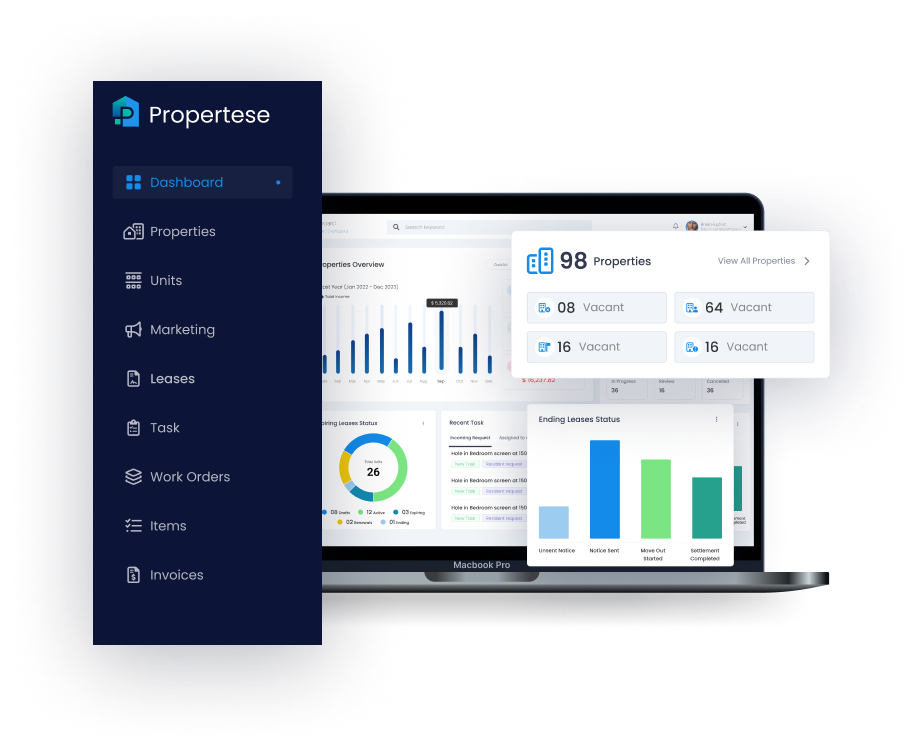
Property management software prices in 2026 vary widely by portfolio size, features, and vendor model. Whether you oversee a few dozen doors or thousands of units, know how pricing works to gain better cost control and scale. This guide covers current pricing models, average monthly costs, features that affect them, and how to calculate total ownership costs. It helps you select a platform like Propertese that aligns value with clear ROI. For a deeper look at fee structures, visit our complete pricing guide for 2026.
Key takeaways:
- Property management software prices scale with unit count and feature depth.
- Transparent models give clearer budgets for small and large portfolios.
- Add-ons, setup, and support can raise the total cost beyond the base plan.
- Strong integrations and automation can offset higher rates through time savings.
Property management software pricing models
Property management software is typically sold under one of three frameworks: per unit pricing, flat or tiered monthly plans, and custom enterprise quotes. The per-unit model remains the market standard for portfolios beyond a few dozen properties, generally priced between $1 and $5 per unit per month in 2026. Property management software prices also reflect the level of support and integration in each model.
| Pricing model | Definition | Typical use case |
|---|---|---|
| Per unit pricing | Charges are based on the number of managed units, which makes costs scale directly with portfolio size. | Mid to large portfolios seeking flexible scalability. |
| Flat or tiered pricing | A fixed monthly rate, regardless of unit count, best for small portfolios or limited feature setups. | Independent landlords or small firms. |
| Custom enterprise quotes | Tailored packages with negotiated integrations, setup, and support SLAs. | Enterprise managers needing full Enterprise Resource Planning ERP connections. |
Advantages of per-unit pricing: predictable scaling, transparent budgeting.
Disadvantages: rising expense as the portfolio grows.
Flat or tiered plans offer simplicity but can feel restrictive once units exceed included thresholds.
Propertese provides both per-unit and enterprise options, which offer scalability from small portfolios to large property groups directly integrated with ERP systems like NetSuite and Xero.
Average property management software costs by portfolio size
Your total cost depends heavily on portfolio size, the number of doors, properties, or units managed in one contract. Property management software prices also change as your portfolio expands.
| Portfolio size | Average monthly spend | Notes |
|---|---|---|
| 1 to 50 units | $100 to $300 | Often subject to minimum monthly fees even with a few units. |
| 50 to 250 units | $150 to $600 | Ideal for small management companies. |
| 250 to 1000 units | $500 to $3000 | Larger portfolios benefit from volume pricing. |
| 1000 plus units | Custom | Deep integrations and enterprise SLAs usually apply. |
For example, at a typical $2.50 per unit rate, manage 300 units at around $750 per month.
Residential and small commercial portfolios tend to pay near market averages, while association or affordable housing managers often require feature bundles that push pricing higher. With Propertese, a custom configuration can consolidate these needs into one unified system to control costs more effectively.
Key features that influence software prices
Property management software prices depend on size and feature depth. More automation, integration, and accounting capability tend to raise the per-unit rate.
Main pricing drivers include:
- Accounting depth: Modules for trust accounting, bank feed integration, and full Generally Accepted Accounting Principles GAAP workflows.
- Automation and AI: Smart communications, approval routing, and predictive dashboards.
- Integration scope: Connections to accounting suites such as QuickBooks and Xero, ERP frameworks, and listing syndication.
- Vendor ecosystem: Embedded services such as tenant screening and payment processing.
Higher-end platforms charge more for these capabilities, which vendors justify with reduced manual labor and improved financial accuracy.
| Feature area | Typical plan level |
|---|---|
| Basic accounting, payment tracking | Entry tier |
| Advanced automation, online applications | Mid tier |
| Full ERP integrations, AI based insights | Enterprise |
Propertese falls in the enterprise category, which combines full ERP integration with configurable automation and reporting tools that remove duplicate workflows.
Common hidden fees and additional costs
Beyond the base subscription, several optional or variable costs can affect your total spend. Property management software prices do not always include these extra items:
- Setup fees: One-time charges of $500 to $3000 for migration and training.
- Add-on modules: Extra costs for online payments, screening, or marketing.
- Premium support: Dedicated account management or extended hours charged monthly.
- Transaction or processing fees: Percentage-based costs per rent payment or listing.
Entry packages marketed as free often include these transaction charges or lock key features behind paywalls, which prompts many landlords to upgrade as needs expand. Propertese includes structured setup and support options designed to minimize these unpredictable add-ons. For tips to cut maintenance costs without loss of quality, see our guide on how to reduce rental property maintenance costs without sacrificing quality.
Comparing the pricing plans of leading property management software
Here is a snapshot of 2026 pricing among leading vendors, which shows how they differ by model and feature set:
| Vendor/Plan | Per unit price | Minimum monthly | Notable features |
|---|---|---|---|
| Propertese | Quote based | Custom | ERP integrated property, lease, and maintenance management |
| AppFolio Core | $1.40/unit | 50 units | Automation, bank feeds, integrations |
| AppFolio Max | $5.00/unit | 50 units | AI tools, advanced reporting |
| Buildium | From $62/mo | None | Listing syndication, staff training |
| Yardi Breeze | $1/unit | $100 | Residential and commercial modules |
| TurboTenant | Free | None | Simplified tools for small landlords |
Enterprise-level providers such as Yardi Voyager or MRI Software use quote-based pricing that accounts for infrastructure, data migration, and account services. Comparing these helps identify the best value relative to your operational scale. Propertese distinguishes itself by delivering the same enterprise-grade integration and automation through one unified platform rather than multiple disconnected systems.
How to calculate the total cost of ownership
To estimate total property management software cost, calculate both direct and indirect expenses:
- Base subscription: Monthly per unit or flat fee.
- Add-on modules: Payments, screening, marketing.
- Setup and training: Data migration and initial training costs.
- Administrative time: Staff hours for integration and upkeep.
Total cost of ownership TCO represents all expenses tied to the setup and use of the platform. For example, a $2.50 per unit cost for 300 units equals $750 per month, excluding integration or staff time, which you should include for an accurate ROI assessment.
Evaluate cost versus efficiency gains, such as fewer administrative hours or better rent collection, to get a more complete ROI picture. A platform like Propertese can further strengthen ROI through unified data and automated financial workflows.
Steps to choose the right property management software
Choosing the right platform involves aligning portfolio needs with practical economics and feature priorities.
- Define your property scope and critical workflows.
- List required integrations such as accounting, payments, or marketing channels.
- Estimate the total cost using base, setup, and add-on pricing.
- Shortlist 3 to 5 vendors and test with your data.
- Negotiate for free setup or capped fees.
- Measure ROI in the first year based on administrative time saved and improved cash flow.
Integration means you connect your property management system PMS to your financial or marketing tools. Setup refers to migration and initial training. SLAs or service level agreements define vendor performance expectations. Reassess configurations after rollout to gain further efficiency. Propertese supports this process with configurable dashboards and accessible training resources that simplify adoption.
Frequently asked questions about property management software prices
What are the main pricing models for property management software?
The main models are per unit, flat or tiered monthly, and custom enterprise quotes, with most mid-sized portfolios paying per unit. Propertese offers all three approaches to fit varied portfolio sizes. Property management software prices reflect these different approaches.
How much does property management software cost for 100 units?
Most 100-unit portfolios spend $150 to $600 per month, based on included modules and support. Property management software prices at this size often sit near the middle of that range.
Are there hidden fees or setup costs?
Yes. Many platforms charge setup or onboarding fees plus optional add-ons for tenant screening, online payments, or premium support. Propertese provides transparent pricing that clarifies these costs from the start.
Is property management software available for free?
Free tiers exist, but they often cap functionality and add transaction fees for key features such as rent collection.
Can I reduce costs by choosing only basic features?
Yes, limit features to a lower price, though it can reduce automation benefits and scale as your portfolio grows. Propertese allows gradual upgrades, so you pay only for the capabilities you need.
Conclusion
Property management software prices matter most when you match features and integrations to the real needs of your portfolio. Use this guide to compare models, total cost, and ROI so you can choose a platform that fits your scale today and supports future growth. If you want enterprise-level automation and clear pricing with fewer surprises, explore Propertese and see how the platform can align value with measurable results.
Table of Contents
Stay Updated
Subscribe to get the latest news, industry trends, blog posts, and updates...