Key Takeaways
- Spend less time closing books every month by having financial data, leases, and property records all updated in one place automatically.
- Manage multiple legal entities without extra logins or extra systems by keeping every subsidiary under one platform.
- Stop missing lease compliance deadlines by letting the software post ASC 842 and IFRS 16 entries to the ledger automatically.
- Get investor and audit reports ready without building them from scratch because the reporting layer draws from live data rather than exported spreadsheets.
- Grow the portfolio without growing the back-office workload since adding a new property or entity does not create a new set of manual tasks.
Real estate portfolios rarely get messy on purpose.
It usually starts simply. One tool handles rent collection because it was the easiest option at the time. A separate accounting system stays in place because nobody wants to migrate something that already works. A lease tracker gets added later because the other two tools do not capture lease terms properly.
Each decision makes sense on its own. But a few years later, the team is spending more time moving data between systems than actually managing properties. Month-end close stretches from five days to eleven. Owner reporting takes half a day of manual assembly. And when an auditor asks a specific question, the answer lives somewhere in an email chain from three months ago.
Industry analysis from ERP Research found that the shift toward lease accounting standards like ASC 842 and IFRS 16 was one of the main reasons real estate companies started replacing disconnected tools with a single platform (source). Once lease obligations had to appear on the balance sheet, tracking them in a spreadsheet became too risky.
This post covers what real estate operations management software actually is, how it solves these problems, and what to look for before making a decision.
What Is Real Estate Operations Management Software?
Real estate operations management software is a single platform that keeps financial records, leases, property data, and compliance information in one place, so teams do not have to move data between separate tools to get a complete picture.
Every part of the operation, rent payments, lease amendments, maintenance costs, and financial reports, updates automatically in the same system. When something changes on the ground, it shows up in the financials straight away, without anyone having to transfer it manually.
What Is the Difference Between ERP and Property Management Software?
These two terms get used as if they mean the same thing, but they cover different ground.
Property management software handles the day-to-day work of running buildings. It collects rent, logs maintenance requests, and tracks tenant communication. It is built for the people managing the properties.
Real estate ERP software does all of that and adds a complete financial layer underneath. That means a general ledger, multi-entity accounting, compliance tracking, and financial reports that an investor or auditor can rely on.
The simplest way to separate the two:
- Property management software handles the operations side
- Real estate ERP software handles operations plus the full financial backbone
Many growing portfolios start with property management software and work well with it for years. The limits tend to show up on the accounting side when the team starts managing multiple entities, reporting to outside investors, or preparing for audits. That is when the conversation about ERP usually starts.
Why Do Disconnected Property Systems Slow a Team Down?
Growing real estate businesses almost always end up running on several separate tools at the same time. Rent collection in one system, accounting in another, lease tracking in a spreadsheet. For a small portfolio, this is manageable. As the portfolio grows, the cost of keeping those systems in sync starts to add up.
Consider a team managing twenty apartment buildings across three legal entities. The rent data sits in a property management platform. The accounting team works in a separate general ledger. Lease renewals are tracked in a shared spreadsheet that multiple people edit, sometimes at the same time with no version control.
Each of these choices was reasonable when it was made. The problem is what happens at month-end. Someone has to pull data from all three places, check that the numbers agree, and investigate every mismatch before anyone can sign off. By the time the books are closed, some of the source data has already changed.
The bigger issue is timing. When a lease amendment or a maintenance cost happens in one system but takes days to appear correctly in the financial records, decisions get made using numbers that are already out of date.
How Does a Single Platform Change Day-to-Day Operations?
When property data, lease information, and financial records all sit in the same system, updates happen automatically rather than manually.
A lease change posts to the financial records as soon as it is saved. A new entity joins the portfolio without needing a separate login, a separate training session, or a separate system. A rent payment hits the bank account and lands in the correct ledger entry at the same time.
Propertese clients report measurable results from this shift:
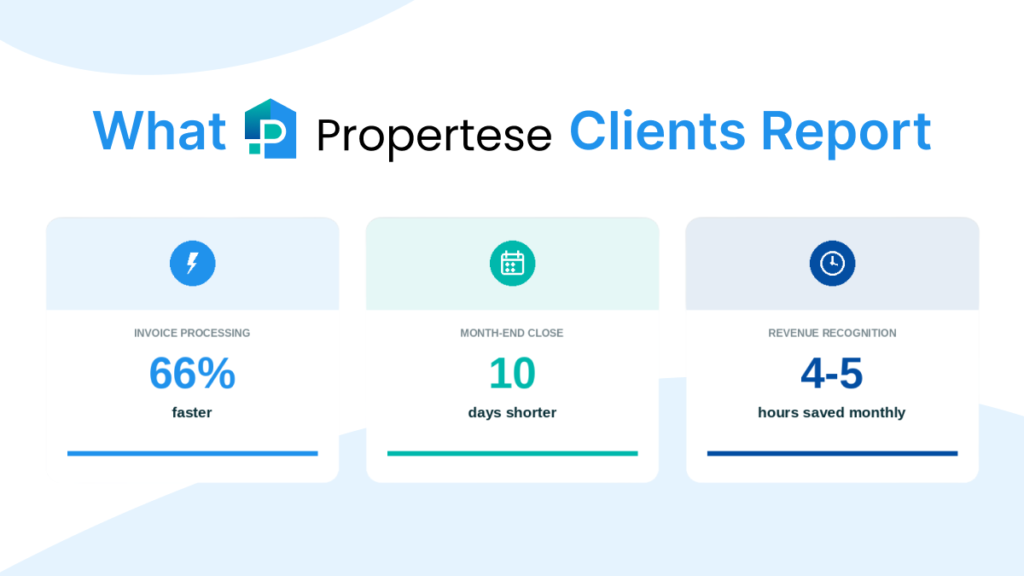
For teams facing audits or investor reviews, the difference is just as clear. When the audit trail is part of the same platform as the transactions, tracing any entry back to its source takes seconds rather than hours of searching through exports and emails.
What Does Real Estate ERP Software Actually Include?
The features that matter most depend on how the portfolio is structured and what problems the team is actually dealing with. Below is a breakdown of the core capabilities and who benefits most from each one.
A General Ledger Built for Real Estate
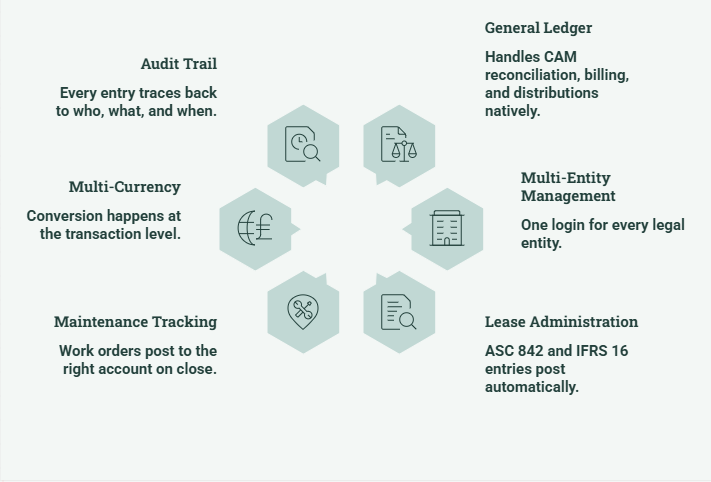
Every transaction in the portfolio eventually needs to post somewhere. That somewhere should be a general ledger that handles real estate-specific entries natively, things like CAM reconciliation, tenant billing, and owner distributions, without requiring manual journal entries to make the numbers work.
Propertese gets this depth through the NetSuite integration, which brings enterprise-grade accounting infrastructure directly into the platform. This is what makes faster invoice processing and shorter month-end closes possible for clients.
Managing Multiple Entities Without Multiple Systems
Most growing portfolios operate through more than one legal entity. Each entity needs its own set of books. But managing those books should not require a separate login or a separate software instance for each one.
Propertese handles this through subsidiary management, where every entity sits under one login with its own accurate records and a consolidated view across all of them. Investment firms and REIT-style operators tend to feel this gap first.
Lease Administration That Stays Compliant
Storing a lease end date and sending a renewal reminder is the basic level. The real standard is whether the platform handles lease accounting under ASC 842 and IFRS 16 natively, so that modifications, renewals, and terminations post automatically to the general ledger without a manual step.
Understanding how lease terms translate into financial entries is worth reading before evaluating any platform. The breakdown of net effective rent versus face rent shows how much financial exposure sits in details that look similar on the surface but carry very different accounting implications. Propertese manages leasing and rental accounting so these entries post correctly without manual intervention.
Maintenance Costs That Post to the Right Account
Every work order is a financial event. A completed repair job should post to the correct property account automatically when the work order is closed, rather than sitting in a queue waiting for someone on the finance team to match the invoice.
Getting the workflow right from the start makes a real difference. This guide on setting up a maintenance request portal covers the steps, approval flows, and automation that keep both the operations and finance sides accurate at the same time.
Multi-Currency Support at the Transaction Level
For portfolios with properties in different countries, currency conversion needs to happen when the transaction is recorded, not when the report is generated. Converting at month-end during reporting creates gaps in the numbers that show up mid-period and are harder to trace back to their source.
A Full Audit Trail for Every Entry
Every financial entry should trace back to who created it, who approved it, and when. During normal operations, this rarely comes up. During an audit or an investor review, it matters immediately. Platforms that can answer that question directly from the system remove a significant source of risk for teams managing affordable housing, community associations, or any portfolio with regular external oversight.
Is Real Estate ERP the Right Fit for Every Portfolio?
Not for every portfolio at every stage, and it is worth being direct about that.
A portfolio with two properties, one entity, and a simple accounting setup can run well on property management software plus a basic accounting tool for years. Adding ERP before the complexity requires it creates overhead that does not pay off yet.
The decision becomes clearer when a portfolio starts dealing with specific situations. Think about a business owner who runs a single coffee shop with no problem. Now imagine that same owner suddenly managing ten locations across three cities, each with separate ownership structures and different investors expecting monthly financial reports. The systems that worked for one shop simply cannot keep up with ten. The operation has grown past what they were built for.
Real estate portfolios work the same way. ERP becomes the right choice when:
- The portfolio operates through more than one legal entity
- Investors or lenders expect financial reports on a regular schedule
- Month-end close is consistently running longer than it should
- The team is spending significant hours moving data between systems manually
If none of those apply yet, the current setup is likely doing its job. The useful question is how fast the portfolio is growing and how long before those situations start to appear.
How Do You Move From Spreadsheets to ERP?
The most effective approach is to start with the specific function that is causing the most friction right now, rather than trying to move everything at once.
If month-end close is the main problem, the financial management layer deserves the first focus. If lease renewals are being missed, lease administration comes first. If investor reporting is taking too long to assemble, reporting and multi-entity management are where to start.
One step that consistently makes migrations go faster is cleaning up existing data before the move begins. Records with duplicate entries, inconsistent naming, or lease history that only exists in an old spreadsheet will slow down the migration and produce unreliable results on the new platform. Addressing that first saves more time than it costs.
Frequently Asked Questions
What is real estate operations management software?
It is a single platform that manages financial records, leases, property data, and compliance information together. Teams use it to replace separate tools for accounting, property management, and lease tracking.
Is real estate ERP the same as property management software?
No. Property management software covers day-to-day operations like rent collection and maintenance. Real estate ERP adds a full financial layer on top, including the general ledger, multi-entity accounting, and compliance tracking.
How many properties does a portfolio need before ERP makes sense?
Property count is not the right measure. A better signal is whether the portfolio operates through multiple entities, has investor reporting obligations, or has a month-end close that regularly runs longer than it should.
Does real estate ERP handle ASC 842 and IFRS 16?
A platform built for real estate should post lease accounting entries directly to the general ledger when a lease event occurs. If the platform requires a manual journal entry for every modification or renewal, it is not handling the standard natively.
How long does migration from spreadsheets take?
It depends on how clean the existing data is. Portfolios with well-organised records migrate faster. The most common delay is messy historical data that needs to be cleaned before it can be imported accurately.
Talk to Propertese
Real estate operations management software is not something that gets added to an existing stack. It replaces the stack.
If month-end close, investor reporting, or audit preparation are taking more time than they should, that is worth a direct conversation. Talk to the Propertese team about where the portfolio stands today.