
Benefits of Implementing a Real Estate ERP Software
Key Takeaways
- Teams switch to ERP because something in their current setup is already costing them time or money
- When every transaction flows into one place, reporting and compliance become much simpler
- Managing multiple legal entities is where most standalone tools stop keeping up
- The more the portfolio grows, the less extra work each new entity creates
- A single-entity portfolio with simple accounting may not need ERP yet, and that is fine
Most finance teams that reach out to us do not start by asking about software. They start by describing a problem.
Month-end close that used to take five days now takes eleven. An investor asked for consolidated financials across three entities, and it took two people the better part of a day to build the report from scratch. A lease modification posted correctly in the property management platform but never reached the general ledger, and nobody caught it for six weeks.
These are not isolated incidents. They are what happens when a real estate portfolio grows past the tools that were set up to manage it.
Real estate ERP software is a single platform that manages a portfolio’s financial records, lease accounting, entity structure, and compliance trail in one place. It replaces the disconnected tools most growing teams rely on, so data flows automatically rather than being moved by hand.
The benefits of real estate ERP software are the direct answers to the problems above. According to JLL’s 2026 Global Real Estate Outlook, sixty percent of investors across all types still do not have a unified technology strategy for their real estate functions (source). ERP is that unified layer. The six benefits below explain exactly what changes when it is in place.
What Is Real Estate ERP Software?
Real estate ERP software is a platform that connects a portfolio’s financial records, lease data, entity structure, and compliance tracking into one system. Instead of running separate tools for accounting, property management, and lease administration, everything updates automatically in the same place.
The key difference between ERP and standard property management software is the financial layer. Property management tools handle daily operations like rent collection and maintenance. ERP adds a general ledger, multi-entity accounting, audit trails, and investor-grade reporting on top of those operations. Most growing portfolios start with property management software and add ERP when the accounting complexity outgrows what the PM tool was originally scoped to cover.
Most ERP benefits mean nothing until they connect to something the team is actually dealing with. Saying “better reporting” or “faster close” does not help anyone understand what will actually change on a Monday morning.
Every section in this post starts with a specific problem first. The benefit is what changes once that problem is solved. If the problem does not apply to the portfolio right now, the benefit probably does not either.
Benefit 1: One Financial Record for Every Transaction
The Problem Right Now
When lease data, rent payments, accounts payable, and the general ledger each run through a separate tool, the finance team becomes the connection between all of them. Every month-end close starts the same way: pulling figures from multiple platforms, reconciling them by hand, and tracking down every mismatch before anyone can sign off on the numbers.
Our clients told us this reconciliation step alone was consuming four to five hours of senior staff time every single month before they made the switch. Over the course of a year, that is fifty to sixty hours spent on a task that should take twenty minutes.
How ERP Solves This
ERP connects every property transaction directly to the general ledger, so the same data that records a rent payment also updates the financial records automatically.
A rent payment, a lease amendment, or a vendor invoice posts to the financial records as part of the same workflow that created it. There is no export step and no re-entry. What the property system shows and what the accounting system shows are always the same thing.
Based on data from Propertese clients across 300-plus properties and 9,500-plus units, invoice processing runs sixty-six percent faster once approvals move off paper and email chains. This comes through the NetSuite integration, where the general ledger, accounts receivable, accounts payable, and revenue recognition all run on the same infrastructure.
This is the foundational benefit. Every other advantage in this post depends on having a single, accurate financial record underneath it.
Benefit 2: Multi-Entity Management
The Problem Right Now
Growing real estate portfolios almost always end up operating through more than one legal entity. Different ownership structures, separate fund vehicles, properties in different jurisdictions. In most standalone property management setups, each entity means a separate set of books. Sometimes a separate login. Occasionally a separate software instance.
The back-office cost of managing that structure grows with every entity added. Intercompany transactions have to be tracked manually across systems. That is one of the most common sources of reporting errors we see in growing portfolios, and it gets worse with scale, not better.
How ERP Solves This
ERP manages every legal entity from a single login, with each entity keeping its own books and rolling up into one consolidated view automatically.
Adding a new subsidiary becomes a configuration step rather than a systems project. Intercompany transactions post correctly without manual tracking across separate systems.
For portfolios operating through more than one legal entity, subsidiary management in Propertese keeps each entity’s books separate while rolling everything up into one consolidated view from a single login.
For those managing capital across multiple investment vehicles, investment management builds on that same structure, covering fund-level reporting and investor distributions across entities. Multi-entity support is also one of the clearest dividing lines between platforms that scale and ones that plateau, worth keeping in mind when comparing property management options.
Benefit 3: Lease Accounting
The Problem Right Now
ASC 842 and IFRS 16 require lease obligations to appear on the balance sheet. Right-of-use assets and lease liabilities have to be calculated, posted, and updated every time a lease is modified, renewed, or terminated early.
For a portfolio with dozens or hundreds of leases, tracking this in a spreadsheet alongside a Property Management tool is technically possible. It is also fragile. A missed update on a lease modification creates a compliance gap that often does not appear until an auditor finds it.
We have worked with portfolios where the spreadsheet tracking ASC 842 entries was last updated by someone who left the company eight months earlier. Nobody noticed because nothing broke visibly. The numbers on the balance sheet were wrong the entire time.
How ERP Solves This
ERP posts lease accounting entries to the general ledger automatically when a lease event occurs, so modifications, renewals, and terminations never require a separate manual step.
A renewal triggers the recalculation and updates the entries automatically. A modification adjusts the right-of-use asset and liability balances without anyone creating a journal entry by hand.
This does not remove the accounting team from the process. It moves them from building entries from scratch to reviewing entries the system already produced. That is a better use of their time and a more reliable process.
Understanding how lease terms affect financial outcomes is worth reading before any platform evaluation. The breakdown of net effective rent versus face rent shows how much financial exposure lives in the details of how lease terms are recorded, which is exactly where manual tracking creates risk. Propertese handles this through leasing and rental management that connects lease events directly to the ledger.
Benefit 4: Reporting
The Problem Right Now
Most property management tools include some kind of reporting. The reports are built around individual properties. Occupancy, rent rolls, maintenance status. For day-to-day management, that is usually enough.
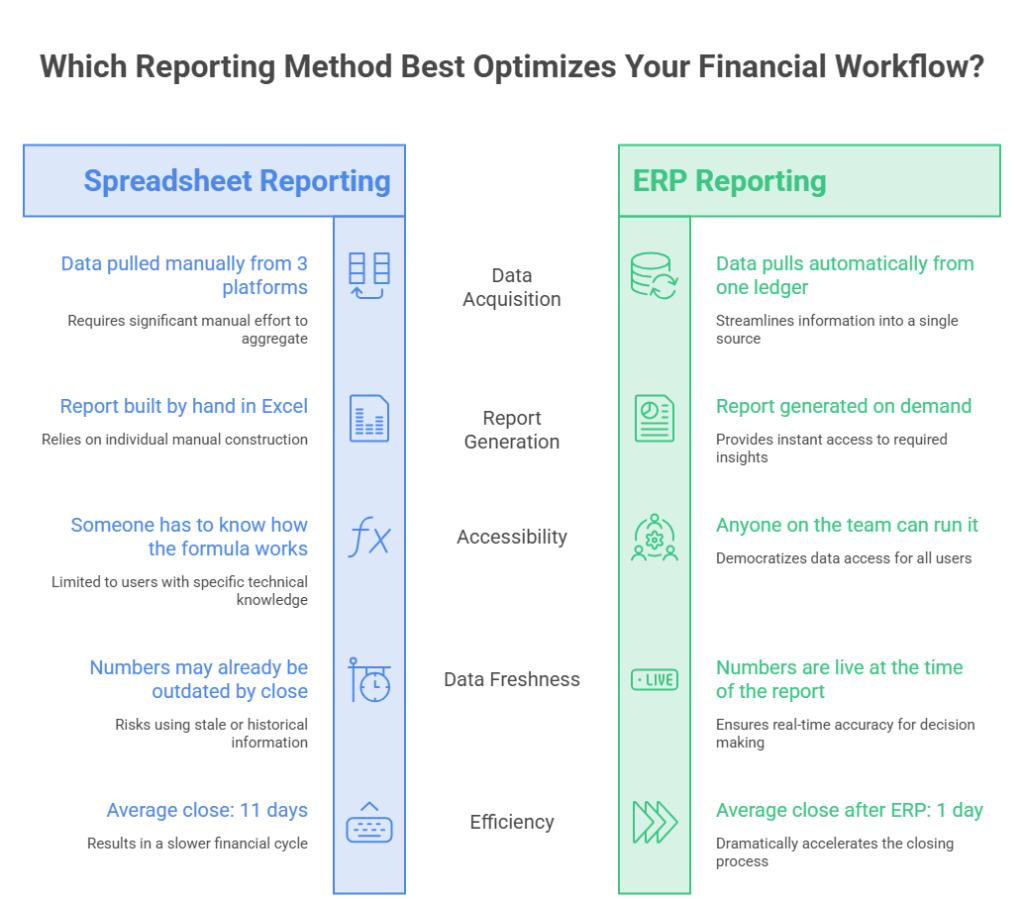
The problem starts when a CFO or investor asks for an income statement segmented by entity, property, and fund at the same time. The Property Management tool runs out of road. Someone exports the data, opens a spreadsheet, and builds the report by hand. It takes hours. By the time it is finished, some of the source data has already changed.
One of our clients described their month-end reporting process as a relay race where the baton gets dropped at every handoff. Three exports, two spreadsheets, one person who understands the formula. When that person went on leave, the report arrived two days late.
How ERP Solves This
ERP pulls financial reports directly from the live general ledger, so income statements, balance sheets, and cash flow reports come out segmented by entity, property, and fund without an assembly step.
This is one of the most measurable real estate ERP software benefits because the change shows up immediately. Based on data from Propertese clients, month-end close shortened by an average of ten days after this change. For teams reporting to investors on a fixed schedule, that difference determines whether the deadline is met comfortably or under pressure.
Clean, current data also improves the quality of financial decisions beyond month-end reporting. If the team does vacancy and absorption analysis as part of underwriting or portfolio review, this post on absorption rate and vacancy underwriting is worth reading. The quality of that analysis depends entirely on how reliable the underlying numbers are.
Benefit 5: Audit Trail
The Problem Right Now
A basic activity log that records who logged in and when is not the same as an audit trail. Auditors want the full chain. Who created the financial entry. Who approved it. What changed along the way. What the original source transaction was.
Affordable housing operators, community associations, and portfolios with lender or investor oversight requirements tend to discover this gap first. It usually shows up at the worst moment. An auditor is in the room, they ask about a specific transaction from fourteen months ago, and the answer is somewhere across three email threads and a retired spreadsheet.
How ERP Solves This
ERP maintains a complete audit trail for every financial entry, recording who created it, who approved it, and when, so any transaction can be traced back to its source in seconds.
When an auditor asks why a specific number appears on the balance sheet, the answer comes from the system directly rather than from email threads and spreadsheets.
This benefit is invisible during normal operations. It only matters the moment it is needed. That is precisely the reason it cannot be an afterthought when evaluating platforms.
Benefit 6: Growth
The Problem Right Now
In most growing real estate businesses, every new property or entity added to the portfolio creates more back-office work. More reconciliations, more manual data movement, more time spent on reporting. The operations team grows alongside the portfolio. The cost of managing the business scales at roughly the same rate as the business itself.
That ceiling shows up gradually. The team gets busier. Month-end close gets longer. Hiring more people becomes the default answer to a problem that is really about systems, not headcount.
How ERP Solves This
ERP centralizes the financial infrastructure so that adding a new property or entity does not create proportionally more back-office work.
Among the real estate ERP advantages that take time to appear rather than showing up immediately, this one compounds the most. The tenth entity runs through the same system as the first, with the same reporting and the same consolidation process.
Based on Propertese’s own operational data, the platform has processed over 10,500 leases across 300-plus properties and 9,500-plus units through a single platform instance. The back-office cost curve does not follow the same slope as the portfolio.
Frequently Asked Questions
How fast do teams see results after going live with real estate ERP?
The first results most teams notice are faster invoice processing and a shorter month-end close. Both tend to appear within the first few reporting cycles after go-live. Longer-term benefits like reduced back-office scaling costs become visible over quarters rather than weeks.
What does real estate ERP software actually do?
Real estate ERP software connects property operations, lease accounting, and financial management into one platform. It replaces separate tools for accounting, property management, and lease tracking so data updates automatically rather than being moved by hand between systems.
When is real estate ERP worth the investment?
The clearest signals are multiple legal entities, investor or lender reporting on a fixed schedule, or a month-end close that consistently runs longer than it should. A single-entity portfolio with simple books and no investor reporting obligations works well with PM software plus QuickBooks or Xero. The case for ERP gets stronger as entity structure and reporting complexity increase.
How long does a real estate ERP implementation take?
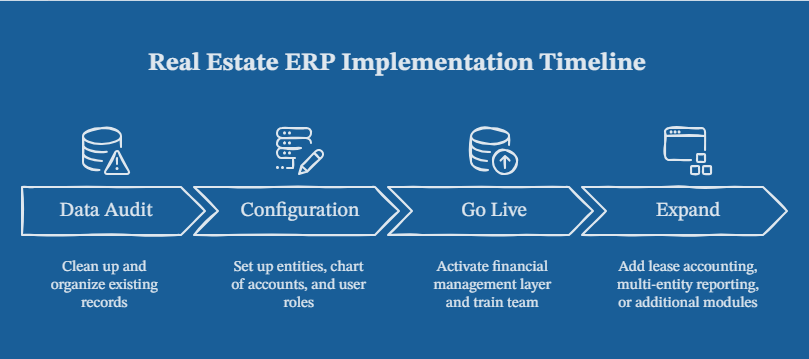
It depends on data quality going in. Teams with organised, consistent records move faster. The most common cause of delays is messy historical data, such as duplicate records, inconsistent naming, or lease history that only exists in spreadsheets. A data clean-up pass before migration consistently saves more time than it costs. Many teams implement in stages, starting with financial management and adding lease accounting or multi-entity consolidation as needed.
What is the biggest risk of switching to real estate ERP?
Data quality going in. Migrations that start with messy records or financial history tracked only in spreadsheets take longer and produce unreliable initial results. A data clean-up pass before migration consistently saves more time than it costs.
How does real estate ERP compare to property management software?
The core difference is the financial layer. Property management software handles rent, maintenance, and tenant communication well. ERP adds the general ledger, multi-entity accounting, and audit-grade reporting on top. For a full breakdown, the ERP vs property management software comparison covers when each makes sense and where they overlap.
How much does real estate ERP cost?
Cost depends on portfolio size, the number of entities, and which modules are needed. Propertese is priced based on the specific structure of the portfolio rather than a flat per-unit or per-seat model. The most accurate starting point is a direct conversation about the portfolio rather than a published price list.
What is the best real estate ERP platform?
The right platform depends on two things: whether it covers both the property operations side and the financial backbone, and whether it handles the entity structure of the specific portfolio. General-purpose ERP systems cover accounting but miss real estate-specific functions. Real estate-specific platforms vary widely on financial depth. Propertese is built around the combination of both, with the NetSuite integration providing the financial infrastructure and the platform handling the property layer on top.
What to Do Next
The benefits of real estate ERP software are specific, not universal. Each one answers a specific problem. If the portfolio is not experiencing the problem yet, the benefit is not relevant yet either.
If month-end close, multi-entity accounting, investor reporting, or audit readiness are creating friction that the current setup cannot address, those are worth a direct conversation with someone who can look at the specific portfolio rather than a generic one.
Talk to Propertese about whether the benefits above apply to the way the portfolio actually operates today.