Automated real estate investing systems redefine how property portfolios are valued, acquired, and managed. With artificial intelligence and automation in every stage of the investment process, these platforms deliver faster insights, lower costs, and greater decision accuracy. Yet they also introduce new risks tied to data reliability, transparency, and security. This article examines how automation works across the real estate lifecycle, its advantages, limitations, and what firms can do to balance technology with human expertise for sustainable, accountable growth.
Key takeaways:
- Automated real estate investing systems speed up analysis and deals and cut cost.
- Data quality and clear governance shape results and reduce risk.
- Hybrid human and AI reviews keep clarity, trust, and control.
- Secure cloud design and strict access control protect sensitive data.
What are automated real estate investing systems?
Automated real estate investing systems are technologies that use data analytics, ML, and workflow automation to evaluate, manage, and transact real estate investments with minimal manual intervention. They combine algorithmic intelligence with economic, geographic, and property level data to accelerate valuations, simplify portfolio oversight, and expand market visibility.
Common types include Automated Valuation Models (AVMs) for property price, predictive acquisition models, and process automation tools that execute contracts and fund transfers securely. They process diverse inputs such as satellite imagery, transaction histories, and environmental indicators. These systems help investors identify opportunities in hours instead of weeks, while they keep consistent governance.
Key benefits of automated real estate investing systems
Automation drives measurable gains in efficiency, accuracy, and cost control. AI driven systems can automate many real estate tasks and unlock new levels of productivity and informed decision making.
| Benefit | Description |
|---|---|
| Efficiency and cost reduction | Automation streamlines due diligence, documentation, and transaction workflows, save time and minimize errors. |
| Faster, data driven decisions | Predictive analytics process thousands of variables and allow rapid tests of multiple market scenarios. |
| Risk and compliance control | Continuous portfolio analytics enhance oversight and reduce exposure to regulatory or operational lapses. |
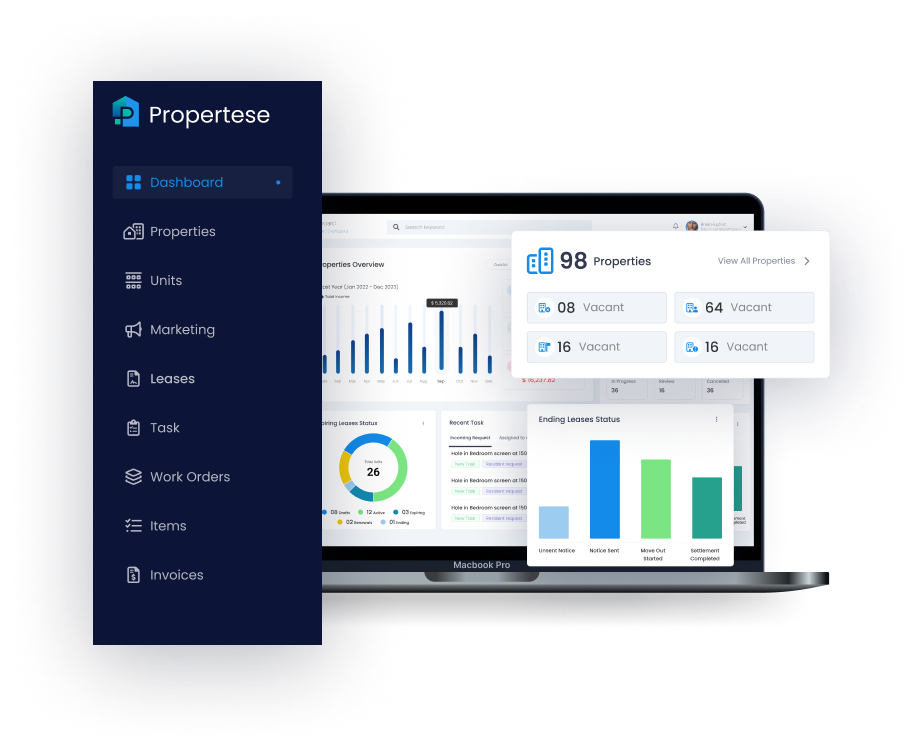
Organizations that use automation gain deeper insights through integrated analytics, transactional automation, and predictive price, which leads to smarter capital allocation and higher investor confidence. Platforms like Propertese embed these capabilities directly into unified property management and ERP environments and ensure consistency from valuation through reports.
Efficiency and scale improvements in portfolio management
With automation for administrative workflows, property firms can manage substantially larger portfolios at a lower cost. AI now cuts document time by a large margin, abstracts lease data, handles maintenance requests, and monitors rent collections.
| Task | Traditional processing | Automated system |
|---|---|---|
| Lease abstraction | Days per batch | Minutes per batch |
| Rent collection | Manual checks and reconciliations | Automated deposits and real time tracking |
| Maintenance workflows | Manual scheduling and updates | AI driven priority and reports |
When repetitive tasks are automated, managers can focus on strategic portfolio growth to improve service quality and scalability without proportional staff increases. Propertese supports these outcomes through fully integrated lease and maintenance automation modules. For a practical guide to automate property management tasks, see our post on automate property management tasks.
Enhanced decision-making with predictive models
Predictive models use historical and real time data to forecast value shifts, rental demand, and risk exposure. They can simulate market changes, such as policy or interest rate shifts, and adjust acquisition or divestment time.
These tools enable investors to evolve from reactive strategies to anticipatory ones, to enhance returns and reduce downside risk. With generative AI, scenario plans now include thousands of variables and provide actionable insights at a scale no manual analysis can match.
Continuous monitoring and risk management
Automation transforms risk management from periodic review to continuous, data driven analysis. Dashboards alert investors to anomalies in tenant performance, lease expirations, or environmental risks.
Typical lifecycle flow:
- Data intake from lease and market platforms
- Real time analysis through predictive risk models
- Automatic score of portfolio exposures
- Alert creation and escalation to asset managers
Continuous alerts, anomaly detection, and compliance audits allow potential issues to be addressed before they impact performance. Propertese’s role based access and automated alerts ensure this visibility across every asset class.
Investor reporting and communication enhancements
Automation strengthens transparency and engagement among investors, owners, and managers. Dynamic dashboards replace static reports and give stakeholders live access to key financial and operational metrics.
Examples of automated communication tools:
- Personalized capital call and distribution statements
- Quarterly performance updates generated automatically
- Interactive charts that compare forecast versus actual results
This real time transparency builds trust and gives limited partners greater confidence in the portfolio data that drive investment outcomes. Propertese’s customizable investor portals further streamline this communication. For detail on cash flow clarity, read our guide to automate rental income tracking.
Risks and limitations of automated investing systems
Despite the gains in speed and precision, automated systems depend on high quality data, proper model setup, and consistent human oversight. Inaccurate datasets or algorithmic bias can amplify risk, especially during market volatility.
Overreliance on automation can create “black box” outcomes, where decisions lack clarity. To avoid this, governance frameworks should include human checkpoints and regular model validation to ensure resilience and accountability.
Data quality and model reliability concerns
Model reliability measures how consistently algorithms produce accurate outcomes given available data. Outdated, incomplete, or biased information can compromise predictive systems, especially during market shocks.
Hybrid valuation approaches, that combine automated assessments with expert analysis, deliver more stability across conditions. This balance between AI and professional review mirrors Propertese’s philosophy: automation for scale, human insight for precision.
Transparency, governance, and ethical considerations
Strong governance keeps automated decisions traceable and compliant. Investors increasingly demand explainable AI and robust audit trails.
Best practices include:
- Role based access and permissions
- Routine audits and version logs
- Secure care of sensitive data within virtual environments
- Scheduled reviews for bias mitigation and documentation quality
These controls maintain trust in both automated outputs and the professionals who interpret them. Propertese embeds these governance standards directly into its property and portfolio management tools.
Security and confidentiality challenges
As real estate operations move to the cloud, cybersecurity and data privacy are top concerns. Many real estate leaders cite digital risk as a rising issue.
Upload of tenant, lease, or investor information should occur only within encrypted, access controlled systems. Enterprise grade encryption, data segregation, and continuous oversight are essential to prevent breaches and preserve compliance. Propertese’s cloud architecture adheres to these standards and ensure secure information flow across all modules.
Labor market and systemic impacts
Automation reshapes the real estate labor landscape. Tasks from underwriting to report creation could shift to automated tools over time. While this boosts productivity, it also drives demand for new skills in analytics, compliance, and systems administration.
Administrative roles may shrink, but positions that involve interpretation, review, and system governance will expand and keep human expertise at the center of technology adoption.
Current trends and industry debates
As AI adoption accelerates, industry discussions focus on balance between innovation and responsibility.
| Trend | Counter Trend |
|---|---|
| Rapid automation adoption | Rising calls for stronger regulation and auditability |
| Fully automated valuations | Preference for hybrid human and AI reviews |
| Sectoral expansion (brokerage, lodging, property services) | Slower progress in complex or regulated markets |
The interplay between speed and transparency will influence how automation continues to mature across property segments.
Balancing automation with human expertise
The most effective real estate strategies combine automated precision with informed human oversight. AI manages data intensive tasks, while professionals interpret context, ethics, and strategic direction. Human judgment preserves trust and ensures technology complements rather than replaces expertise.
Propertese embodies this approach. It automates lease, financial, and operations workflows, and it keeps decision authority with experienced managers. For deeper detail on portfolio control and workflows, explore Propertese real estate investment management.
Sector-specific opportunities and challenges
Automation’s benefits vary by asset type. Residential portfolios gain most from AVMs and automated lease, while commercial properties often require hybrid valuation due to more complex leases.
| Sector | Automation ROI | Common challenges |
|---|---|---|
| Residential | High | Data consistency and integration |
| Commercial | Moderate | Complex valuation logic |
| Multifamily and associations | High | Maintenance automation adoption |
| Affordable housing | Moderate | Compliance and reporting infrastructure |
ROI increases when automation runs on unified data and ERP integrated systems, a core advantage of Propertese’s connected platform.
The future outlook for automated real estate investing
Automation will continue to drive operational excellence and transparency across real estate. As firms adopt robust data governance, hybrid models, and audit ready infrastructure, technology will become the foundation for scalable, compliant growth.
Future success will depend on secure architecture, explainable AI, and cross trained professionals. Propertese’s vision centers on that alignment and integrate automation, analytics, and accountability so investors maintain real time, reliable control over every asset.
To put this vision into practice, unify data and controls with Propertese. Automated real estate investing systems inside Propertese can help your team raise speed, insight, and confidence with clear human oversight.
Frequently asked questions about automated real estate investing systems
How does AI accelerate investment decisions?
AI compresses deal analysis from days to hours. It automates screening and models multiple investment scenarios. It helps investors target the best opportunities faster.
What cost savings can automation deliver?
Automation can reduce costs in a large range, often with payback within a year. Platforms like Propertese make these savings sustainable through unified workflows and system integration.
How do automated systems improve risk management?
Automation monitors portfolios, flags anomalies, and detects fraud. These controls enable proactive decisions and protect investor returns.
What data security measures are essential?
Encrypted document storage, permission based access, and strong authentication protect sensitive lease and investor data within platforms such as Propertese.
Can AI replace human judgment in real estate investing?
No. AI augments but never replaces the judgment and experience of real estate professionals. Propertese keeps this balance with automation plus clear human oversight.
Table of Contents
Stay Updated
Subscribe to get the latest news, industry trends, blog posts, and updates...