Key Takeaways
- Mid-market operators realistically see break-even at 24 months, not 6 to 12.
- Software licensing is only 20 to 30% of the real cost. Staff time, integrations, and data migration make up the rest.
- Lease event management is the single highest-impact ROI driver. Missing escalations on a $10M rent roll costs up to $800,000 a year.
- ROI most often fails because of unused modules, spreadsheet reversion, and integrations that never stabilize.
- Build the model from your own operational baseline, not a vendor’s projected savings.
Every CFO evaluating property management ERP software is really asking three questions.
- What will this cost in total, including everything the vendor’s proposal leaves out?
- When will it start paying back?
- How do we know if it actually worked?
Those questions deserve straight answers. This post covers the real cost structure, the quantifiable savings, and a realistic property management ERP software ROI timeline, plus a step-by-step model for building a business case that holds up in a boardroom.
Who this is for: This framework is built for mid-market and enterprise real estate portfolios. The ROI drivers, cost structure, and payback timeline at the ERP level are fundamentally different from those of basic property management tools.
The global property management software market was valued at $26.55 billion in 2025 and is projected to reach $52.21 billion by 2032, growing at a CAGR of 10.1%. Organizations that skip pre-implementation ROI analysis are significantly less likely to see expected returns. Those that build it carefully, using their own operational baseline rather than vendor projections, consistently achieve better outcomes.
How Do You Calculate Property Management ERP Software ROI?
Basic property management tools can pay back in months. ERP-level implementations take longer because the scope is fundamentally different: multi-entity accounting, lease compliance, and investor reporting carry more cost and deliver proportionally larger returns over time.
Here is the core formula, followed by what to plug into it from your own operations.
The ROI Formula
ROI = (Total Annual Savings − Annual Ongoing Cost) ÷ Total First-Year Investment × 100
Year 1 ROI will almost always be negative. The formula becomes meaningful at 24 months when upfront costs are absorbed and savings begin to compound.
What Goes Into Each Variable
Total annual savings:
- Labor hours saved on month-end close × fully loaded hourly rate
- CAM reconciliation recovery (typically 1 to 3% of annual CAM pool)
- Lease escalations prevented × average escalation value
- AP processing time saved × hourly rate
- Audit preparation hours saved × hourly rate
Total first-year investment:
- Vendor quote for software and implementation
- Internal staff time at fully loaded rates (often 30 to 50% of controller and accounting team for 6 to 12 months)
- Third-party integrations
- Training and post-go-live support
Annual ongoing cost:
- Software licensing
- Support contracts
- System administration
Why Is ERP ROI Hard to Measure in Real Estate?
The Attribution Problem
ERP ROI is difficult to isolate in real estate. Suppose a multifamily operator improves NOI margins by 8% over two years after implementation. What caused the improvement?
Possible contributors:
- Favorable market rent growth
- Improved occupancy
- Staff changes
- Operational restructuring
- The ERP itself
The ERP rarely works in isolation. A portfolio owner who cuts close time from 18 days to 8 days cannot cleanly credit that to the software alone. The new controller, the chart of accounts redesign, and the workflow changes all played a role.
ROI Figures Vary Depending on What Is Being Counted
ROI claims in this space differ significantly depending on:
- Which benefits are included (labor only vs. revenue recovery vs. scalability)
- Whether internal staff time is factored into cost
- How implementation quality affected outcomes
The most reliable approach is to ask for references from operators with a similar portfolio size and verify what they actually measured before and after go-live. That is the foundation of any credible ROI of property management software evaluation.
What Does a Real Estate ERP Actually Cost?
Most organizations undercount implementation cost by 40 to 60%. They price the software license and the vendor quote, and stop there.
Software Licensing
Annual licensing for mid-market portfolios typically runs $150,000 to $750,000. Enterprise portfolios and REITs can see $500,000 to several million annually. Software licensing is usually the smallest component of total first-year cost.
Implementation Services
Implementation consulting typically represents 30 to 45% of total first-year project cost, according to Panorama Consulting Group’s ERP benchmarking research across thousands of mid-market deployments. An ERP that is not properly implemented does not deliver ROI.
Vendor proposals frequently present implementation services as optional. They are not optional.
Internal Staff Time
The largest cost almost no vendor includes in their proposal:
- Controller: 40 to 80% of working time during implementation
- Property accounting teams: 30 to 70%
- Operations: 20 to 50%
For a team of six people averaging $75,000 in fully loaded annual cost, that represents $135,000 to $225,000 in absorbed capacity over the implementation period. It appears nowhere in the vendor quote.
Data Migration
Property management data is notoriously messy:
- Inconsistent naming conventions
- Duplicate vendor records
- Historical CAM pools tracked only in spreadsheets
- Lease modifications spread across paper files
A clean migration for a 3,000-unit portfolio with five years of history typically requires four to eight weeks of dedicated effort.
Third-Party Integrations
Integrating a property management ERP with an existing general ledger, maintenance system, or investor reporting portal typically costs $15,000 to $50,000 per integration in professional services, plus ongoing maintenance.
What to Budget
A realistic first-year total cost for a mid-market operator with 1,000 to 3,000 units falls in the $150,000 to $400,000 range when all costs are included. Build your model from that number, not from the vendor’s proposal line items.
What Are the Quantifiable ROI Drivers?
These are the areas where property management ERP benefits translate into documented, measurable savings when conditions are right.
| ROI Driver | Realistic Improvement | Annual Value Example | Source |
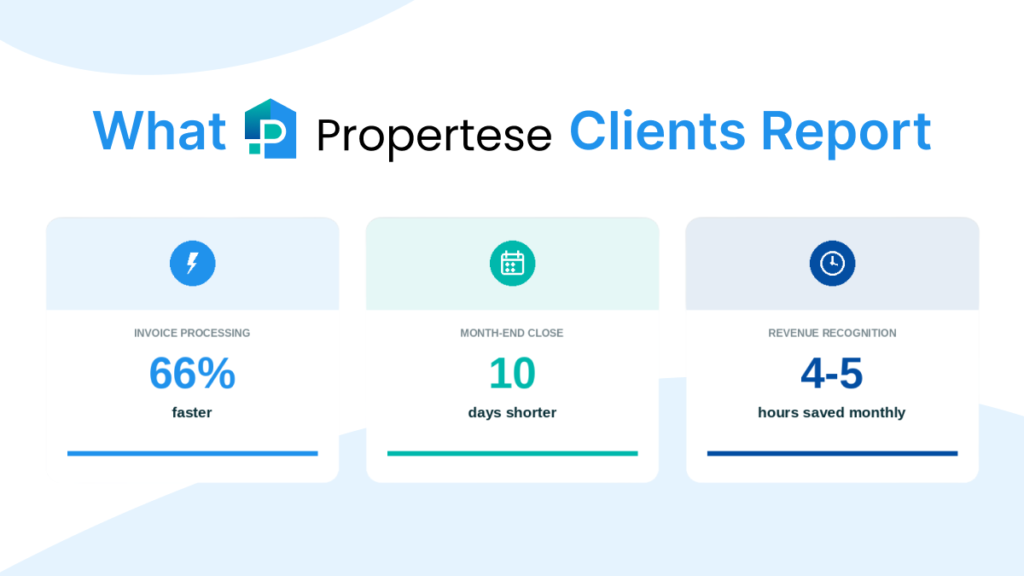
| Month-end close | 10 days shorter on average | Your close hours × your hourly rate × (days saved ÷ total close days) | Propertese client data |
| CAM reconciliation recovery | 1 to 3% of CAM billings | $20K to $60K on $2M pool | Industry practitioner data |
| Lease escalation prevention | Prevents 3 to 8% miss rate | Up to $800K/year on $10M rent roll | Industry practitioner data |
| AP automation | Processing time and duplicates materially reduced | $5K to $25K in duplicates prevented | Industry practitioner consensus |
| Audit preparation | 30 to 50% reduction in prep hours | 80 to 150 hours saved per audit cycle | Industry practitioner data |
| Reporting cycle | Materially faster for most organizations | Hours to days saved per cycle | Industry practitioner consensus |
1. Month-End Close Reduction
Research from Deloitte’s Finance Benchmark Survey finds that companies using ERP with integrated automation report 35% faster month-end close. In real estate specifically, the impact is often greater because consolidating multiple entities eliminates a significant manual reconciliation layer that does not exist in single-entity businesses.
A portfolio accounting team closing 15 to 20 entities manually frequently takes 12 to 15 business days. Well-implemented ERP teams consistently report 5 to 8 day close cycles. That freed capacity rarely translates to headcount reduction. It translates to capacity to scale without proportionally adding accounting staff.
2. CAM Reconciliation Accuracy
Under-billing in CAM reconciliations is common when expense pools are tracked in spreadsheets. ERP-driven CAM reconciliation typically recovers 1 to 3% of total CAM billings previously missed or disputed. On a $2 million annual CAM pool, that is $20,000 to $60,000 per year in additional revenue.
For how Propertese handles CAM natively across commercial property management portfolios, the feature is built directly into the platform rather than managed through manual exports.
3. Lease Administration and Missed Escalations
Portfolios without automated lease event management miss 3 to 8% of scheduled rent escalations annually. On a $10 million rent roll, a 3% miss rate represents $300,000 in uncollected revenue per year.
4. Accounts Payable Automation
AP automation is one of the fastest property management automation ROI wins because manual invoice processing time is easy to measure before go-live and easy to confirm after. Organizations that audit AP records after ERP implementation consistently discover historical duplicate payment rates of 0.1 to 0.5% of total disbursements. On $5 million annual vendor spend, that is $5,000 to $25,000 in recoverable overpayments.
The approval workflows in Propertese route vendor bills through the same platform as lease events and rent payments, which eliminates the email-chain approval process that causes most delays.
5. Audit Preparation Time
Mid-market operators preparing for annual audits without a unified system typically dedicate 2 to 4 weeks of senior accounting staff time to documentation. With ERP-grade audit trails, that time reduces significantly because every entry is already traceable without manual reconstruction.
Affordable housing operators benefit most here, given regular compliance reviews. The affordable housing property management page covers the specific compliance requirements.
What ROI Benefits Cannot Be Put in Dollars?
These outcomes are real but resist clean dollar conversion. They belong in the business case as reasons to accept a longer payback period, not as revenue in the ROI numerator.
- Audit defensibility: A portfolio processing transactions across multiple systems cannot produce a clean audit trail on demand. Reconstructing it under audit pressure is consistently expensive and disruptive.
- Investor confidence: Institutional investors increasingly expect reporting in specific formats on fixed timelines. Operators who cannot deliver this systematically face slower fundraising cycles and higher cost of capital.
- Scalability without proportional headcount growth: Adding 500 units to a portfolio without adding a property accountant is a real economic benefit. It is a future benefit, not a current-year savings figure.
- Lender covenant compliance: ERP-produced debt service coverage ratio reports, occupancy certifications, and reserve account documentation reduce the risk of technical covenant violations from manual reporting errors.
For teams managing complex portfolios across multiple assets, the portfolio management use case covers how consolidated visibility across entities is handled without manual assembly.
What Is a Realistic ERP ROI Timeline?
First 12 Months: Net-Negative
This is the normal experience, not an outlier.
- The team is learning the system
- Configuration gaps are being discovered
- Data quality issues are being resolved
- Many teams are still running old and new systems in parallel
Productivity is below pre-implementation levels. Software cost is fully running. ROI is negative.
Mid-Market Operators (1,000 to 10,000 Units)
- Typical payback: 24 to 42 months
- Inflection point: When CAM, lease administration, and reporting modules are fully activated, usually 12 to 18 months post-go-live
- What accelerates it: Clean data going in, high module adoption, no parallel spreadsheet processes by month 12
Understanding how financial metrics compound at the asset level matters here. The cap rate calculation guide shows how ERP-quality financial data improves the accuracy of those calculations directly.
Enterprise REITs and Institutional Operators (10,000+ Units)
- Typical payback: 36 to 60 months
- Why it takes longer: Multi-phase rollouts covering operations, then financial consolidation, then analytics
- What accelerates it: Phased module adoption with clear business case review at each phase
Where Does ERP ROI Consistently Fall Short?
Modules Licensed but Never Used
Operators license full platform suites during contract negotiation, then go live on accounting and maintenance while everything else stays unused. The ROI model credited every module. The actual ROI only comes from the ones adopted.
Staff Reverting to Spreadsheets
The accounting manager who spent ten years building month-end close in Excel does not abandon it because a new system went live. She runs both in parallel to verify, and six months later the spreadsheet is still the source of truth.
Fixing this requires:
- Clear policy on which system is the authoritative source
- Management accountability for non-adoption
- Consequences for running parallel processes
Most organizations underinvest in all three.
Integrations That Never Work Properly
When integrations between the ERP and the general ledger, maintenance platform, or investor reporting system do not work reliably, staff build workarounds. Manual exports. Dual entry. Weekly reconciliation spreadsheets. These are invisible in the ROI model but very visible in day-to-day operations.
Implementations That Never Fully Stabilize
Some ERP implementations never reach the stable operating state that ROI projections assume. Data quality problems persist. Key staff turn over mid-implementation, taking institutional knowledge with them. The system processes transactions but never becomes the trusted source of record.
| Step | What to Do | Why It Matters |
|---|---|---|
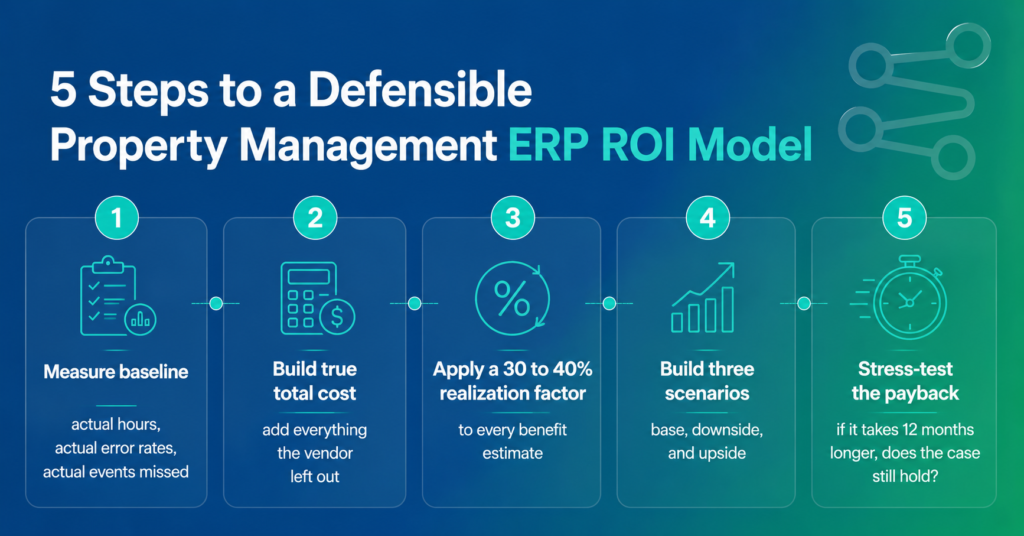
| 1. Measure baseline | Record actual hours on close, AP, audit prep, and lease events missed | Without this, assumptions will not survive a board question |
| 2. Build true total cost | Add staff time, integrations, migration, and post-go-live support | Panorama Consulting Group finds organizations consistently undercount total ERP cost by 30 to 50% |
| 3. Apply realization factor | Reduce every benefit estimate by 30 to 40% | Accounts for adoption curve, change resistance, and delays |
| 4. Build three scenarios | Base case, downside (30% cost overrun), upside (full adoption by month 18) | Most organizations land between base and downside |
| 5. Stress-test payback | If payback takes 12 months longer, is the case still sound? | A fragile model means costs are understated or benefits are overstated |
Questions Worth Asking Before Committing
- Which clients with a similar portfolio size and structure can we speak with directly?
- What percentage of clients license a full module suite but do not actively use all modules?
- What do clients typically struggle with 12 months after go-live?
- What ongoing costs are not included in the implementation quote?
What Does Good ROI Look Like at 12, 24, and 36 Months?
| Metric | 12 Months | 24 Months | 36 Months |
| Financial ROI | Likely still negative | Turning positive | 40 to 80% cumulative (mid-market) |
| Month-end close | 2 to 4 days faster per entity | At or below business case target | Materially faster, team no longer stretched |
| AP processing | 30 to 40% more volume per FTE | Stable, duplicates rare | Fully automated, minimal manual work |
| Reporting speed | Improving, not yet reliable | 1 to 2 days post-close | Real-time for most reports |
| User adoption | 60 to 70% of transactions in ERP | 80 to 90%, spreadsheets declining | 90%+, ERP is trusted source of record |
| CAM reconciliation | First cycle in new system | Running cleanly, recovery documented | Optimized, disputes reduced |
| Audit readiness | Improving, some gaps remain | First clean audit in new system | Materially faster prep |
| Portfolio growth | Still manual in places | New entities onboarding faster | Growth absorbed without adding headcount |
Frequently Asked Questions
When does property management ERP software start paying off?
Most implementations run net-negative for the first 12 months. Mid-market operators see break-even around 24 months. Enterprise organizations typically take 36 to 60 months.
What is the most reliable ROI driver in property management ERP?
Lease event management. Missing 3 to 8% of scheduled rent escalations annually is common without automation. On a $10 million rent roll, that is up to $800,000 in uncollected revenue per year.
How much does property management ERP actually cost in total?
A realistic first-year total cost for a mid-market operator falls between $150,000 and $400,000 once software, implementation, internal staff time, integrations, and training are included. Software licensing alone is typically only 20 to 30% of that figure.
Why do ERP implementations fail to deliver projected ROI?
The most common causes are underutilized modules, staff reverting to spreadsheets after go-live, and integrations that never stabilize. These are people and process problems, not technology problems.
How should non-financial benefits like investor confidence be included in an ROI model?
They should appear as reasons to accept a longer payback period, not as revenue in the ROI numerator. Audit defensibility and scalability headroom justify a 36-month payback. They should not be assigned dollar values in the model.
Start With the Right Questions
Property management ERP software delivers real ROI. The operators who achieve it go in with accurate cost projections, build their business case on their own operational baseline, and treat the first 18 months as infrastructure rather than payback period.
The more meaningful question is not whether ERP delivers ROI. It is how long after go-live it takes before the organization trusts the system enough to stop running spreadsheets in parallel.
If the portfolio is at the stage where this analysis applies, the most useful starting point is a direct conversation about what the numbers actually look like for that specific portfolio structure.
Talk to Propertese about a business case grounded in the portfolio’s actual operations.