Key Takeaways
- AI is already useful in real estate ERP for lease abstraction, invoice matching, and anomaly detection, but end-to-end autonomous accounting is still years away from production readiness. ESG reporting has moved from a voluntary disclosure exercise into a system requirement, and ERP platforms that cannot support carbon accounting and sustainability data are falling behind. The real estate ERP market is splitting into two layers: industry-specific platforms for property workflows and enterprise ERP for multi-entity finance, and most mid-market companies need both talking to each other. Workflow automation delivers more immediate value than AI for most portfolios, because it removes the manual handoffs where most errors actually enter the system. The platforms updating monthly are already materially ahead of those on two to three year upgrade cycles, and that gap widens with every release.
In 2019, a major commercial real estate firm in London began testing an AI tool. It could read lease documents and extract key financial terms automatically. After six months, the tool had processed 40,000 legacy leases across 18 markets. It cut manual review time by 85% and surfaced $2.4 million in missed rent escalations.
What did not get as much attention was the rest of the story. The tool required human review of every output. Accuracy on complex lease clauses was around 80%. The escalations it found had been sitting in documents the firm already owned but had never digitized.
AI did not replace the work. It made specific parts of it faster and found things the manual process was too slow to catch. That distinction matters when evaluating what the future trends in real estate ERP software actually mean for a mid-market portfolio.
This post covers what is actually changing in 2026 and beyond, what is still positioned as the future without a delivery date, and what mid-market property management companies should prepare for.
How Is the Real Estate ERP Market Changing in 2026?
The real estate ERP market is splitting into two distinct layers rather than converging around one dominant platform.
The first layer covers industry-specific platforms such as Yardi, MRI, Entrata, AppFolio, and RealPage. These handle property workflows, tenant operations, and lease-centric processes in depth.
The second layer covers enterprise ERP from NetSuite, SAP, Oracle, and Microsoft Dynamics. These provide multi-entity finance, controls, and integration depth.
Most mid-market property management companies need both layers communicating cleanly. The question is no longer which platform is best overall. It is which platform owns the financial control layer, and which owns the property workflow layer.
Gartner’s cloud ERP research confirms cloud adoption is still accelerating, and that generative AI is becoming a material driver of buying decisions. That matters because real estate buyers increasingly expect systems to receive continuous updates, not replacement every seven to ten years.
This is also the context for the commercial real estate technology trends driving ESG requirements, IoT integration, and cybersecurity into ERP architecture. These are no longer optional add-ons but baseline expectations.
What Is Working in AI Right Now?
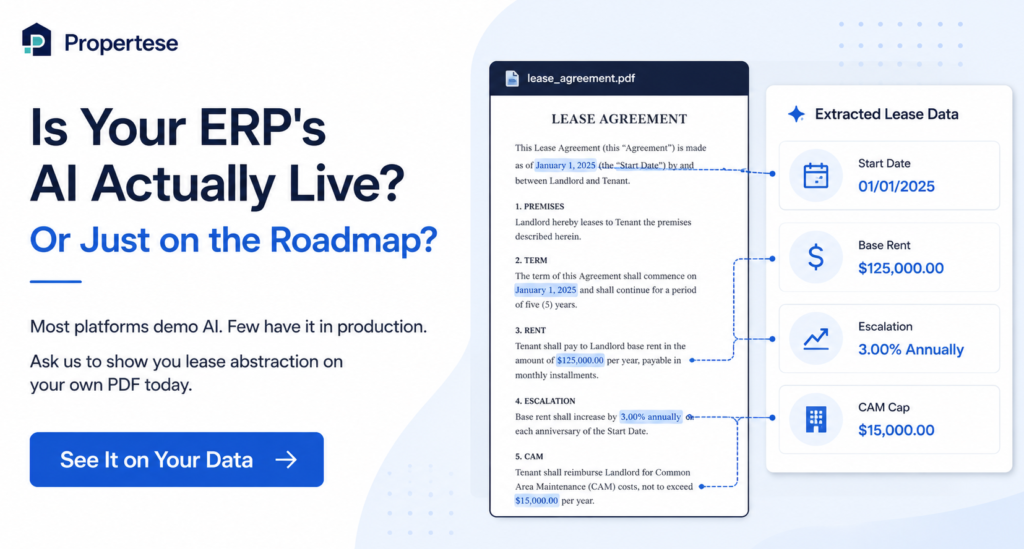
The future trends in real estate ERP software include a lot of AI language. The most useful thing a mid-market CFO can do is separate what is already in production from what is still in a sales deck.
Already working in production for mid-market portfolios:
- AI-assisted lease abstraction with human review on complex clauses
- Automated bank reconciliation with exception flagging
- Invoice matching and routing through AP workflows
- Reconciliation anomaly detection that flags variance before month-end
- Natural language dashboards for standard financial queries
- API-based integrations between ERP and investor portals
Still beta or enterprise-only in 2026:
- Fully autonomous financial close without human review
- Reliable natural language queries producing accurate financial analysis
- AI-generated investor narratives without material editing
- Predictive lease renewal recommendations based on tenant behavior at scale
The practical test is simple: does the AI reduce cycle time and error rate in a measurable way, or is it only a dashboard feature? Ask any platform to demonstrate the specific AI capability on your own data, not sample data. The ones that cannot do this are showing you the roadmap, not the product.
What Is Predictive Analytics in Real Estate ERP and How Does It Work?
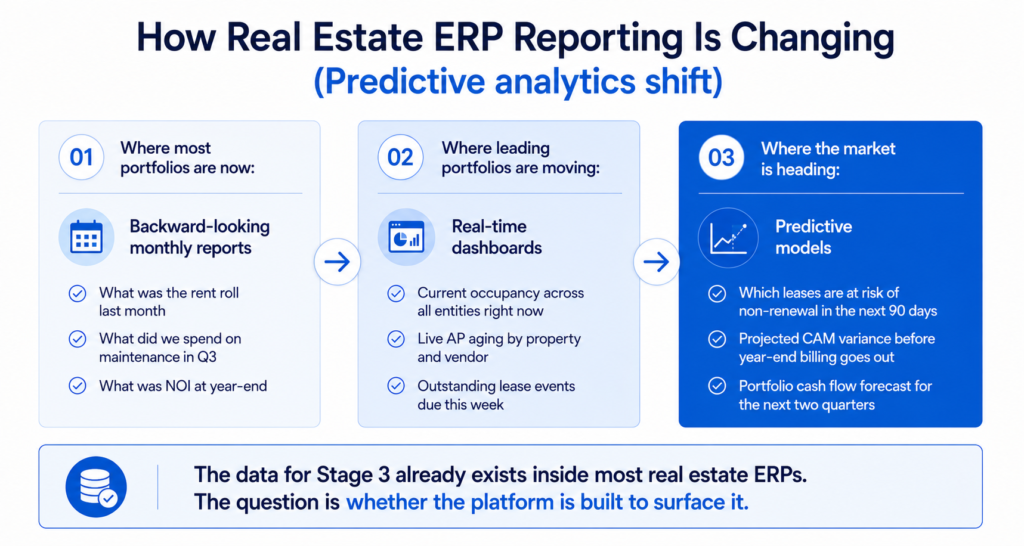
Predictive analytics in real estate ERP means using historical financial and operational data to forecast future outcomes before they happen, rather than analyzing what already occurred.
Most real estate finance teams currently work from reports that describe the past. The shift toward predictive tools means the system surfaces what is likely to happen next, with enough lead time to act on it.
Here is what this looks like in practice:
1. Lease expiration risk modeling
The system tracks upcoming lease expirations, scores each one for renewal probability based on payment history and tenant financial indicators, and flags the ones most likely to result in vacancy. This feeds directly into the cash flow forecast rather than being discovered during a quarterly review.
2. CAM variance forecasting
Rather than discovering at year-end that CAM costs have drifted significantly from estimates, the system tracks operating expenses against CAM pools monthly and projects the year-end reconciliation before tenants receive their final billing.
3. Portfolio-level cash flow visibility
Combining lease payment schedules, operating expense trends, debt service, and capital expenditure plans into a single forward-looking view gives CFOs the ability to model scenarios rather than respond to outcomes.
McKinsey’s research on the future of finance found that CFOs consistently rate the shift from backward-looking reporting to forward-looking forecasting as the highest-value change in the finance function. For real estate specifically, the data required to do this is already inside the ERP. The question is whether the platform is built to use it predictively.
Understanding how discount rate selection affects portfolio-level DCF models is one area where predictive ERP data connects directly to investment decisions. The discount rate selection guide covers how this analysis changes when it draws from live financial data rather than spreadsheet inputs.
How Is Workflow Automation Changing Property Management ERP?
Real estate ERP workflow automation is removing the manual handoffs between property operations and financial records. These handoffs are where most avoidable errors in real estate finance come from.
The erp for property management trends driving this come down to one observation: every time data moves from one system to another through a person, there is a chance it gets lost, delayed, or entered incorrectly. The goal of automation is to eliminate that move.
1. Continuous Close
Traditional month-end close happens because financial data was not available in real time. Teams had to collect, reconcile, and assemble information scattered across systems. As ERP platforms add continuous close capabilities, the reconciliation work happens throughout the month rather than all at once at the end of it.
For mid-market property management companies, this compresses the close cycle from seven to fourteen days down to one to three days, because most of the reconciliation is already done before the period ends.
2. Document and Approval Workflows
Lease documents, vendor contracts, compliance certificates, and board resolutions all require review, approval, and filing. When these workflows run through the ERP rather than through email and shared drives, every approval is timestamped, every document version is tracked, and nothing goes missing between parties.
For commercial portfolios dealing with multiple entities and investor reporting obligations, having document management and approval workflows connected to the financial records means that compliance and audit readiness are built into the daily workflow rather than assembled at year-end.
3. Investor Distribution Automation
For portfolios with outside investors, quarterly distribution calculations involve pulling income data, applying waterfall structures, calculating preferred returns, and generating distribution statements. When this process draws on live data from the ERP rather than manually assembled spreadsheets, the time required drops and the error rate drops with it.
For portfolios managing multiple entities and subsidiaries, this is where the financial infrastructure layer becomes the defining factor. Distribution calculations that need to cross entity lines require a general ledger that handles intercompany eliminations natively, not a spreadsheet reconciliation step.
What Are the Biggest Real Estate ERP Integration Trends?
The real estate ERP integration trends shaping 2026 and beyond are about connecting platforms that have historically run separately. The direction is toward open APIs and composable architecture rather than closed monolithic systems.
1. Banking and Treasury Integration
Direct connections between ERP and banking systems mean incoming payments, outgoing disbursements, and account balances update in the financial records without daily manual reconciliation. For portfolios with multiple bank accounts across multiple entities, this is the highest-frequency data connection in the stack.
2. Lease Signing and Document Platforms
Integration between ERP and lease signing platforms means executed lease terms flow directly into the lease record and the ASC 842 calculations without re-entry. Integration with platforms like DocuSign means the signed document and the extracted financial terms arrive in the system at the same time rather than requiring a separate data entry step after execution.
3. Listing and Market Data Integration
For portfolios actively leasing commercial or residential space, integrations with listing platforms bring market data into the ERP context. This connects vacancy analysis to the financial model rather than keeping them in separate tools. The cap rate calculation guide shows how this market data feeds into investment-level analysis when it comes from a connected system rather than a manual input.
4. Low-Code and API-First Architecture
The real estate ERP software innovations driving the most flexibility are not AI features. They are the low-code frameworks and open API ecosystems that let mid-market teams build custom workflows without requiring a developer for every change. Platforms with composable architecture allow different tools to connect cleanly. Those without it force workarounds that eventually become their own maintenance problem.
For commercial property management portfolios specifically, the ability to connect to specialized tools for lease administration, CAM billing, and tenant communication without rebuilding the financial layer each time is increasingly a platform selection criterion.
How Is ESG Changing What Real Estate ERP Software Needs to Do?
Environmental Social and Governance Data (ESG) has moved from a voluntary disclosure exercise into a system requirement. Deloitte, PwC, and KPMG now treat sustainability as central to real estate operating strategy, which means ERP platforms increasingly need to support carbon accounting, energy tracking, and audit evidence in structured workflows rather than bolted-on reporting tools.
The capability set becoming standard includes:
- Energy and utility tracking. Automated utility data feeds into the ERP so energy costs are tracked at the property and entity level without manual data collection.
- Carbon accounting. Scope 1 and Scope 2 emissions calculations are becoming an expected ERP output, with Scope 3 requirements increasing as regulatory and investor expectations mature.
- ESG audit trails. The same financial record traceability that matters for accounting audits is now being applied to sustainability data, because lenders and institutional investors want evidence, not assertions.
- Compliance monitoring. Regulatory requirements around building energy standards vary by jurisdiction and change frequently. Platforms that update compliance rules automatically reduce the risk of operating out of step with local requirements.
For affordable housing property management portfolios in particular, ESG data quality is already a requirement from lenders and from HUD-related compliance frameworks. The demand for structured sustainability reporting is coming from investors and regulators simultaneously, which means it cannot be treated as a separate reporting project.
What Other Trends Should Real Estate Companies Watch?
1. IoT and Building Data
Smart meters, HVAC sensors, occupancy tracking, and equipment-health monitoring can feed maintenance prioritization and energy analysis inside the ERP. The realistic near-term use case is better facilities management: fewer reactive work orders, lower energy waste, and more accurate operating-cost allocation by property. The longer-term vision is continuous asset-performance monitoring that feeds both maintenance and capital planning.
2. Cybersecurity as ERP Architecture
Cybersecurity has moved from an IT policy concern to an ERP architecture requirement. Real estate ERP systems hold sensitive tenant data, investor financial records, banking connections, and payroll information. As AI is embedded into ERP workflows, governance expands from access control to AI model control, output validation, and data lineage.
The direction of travel is clear: zero-trust architecture, multi-factor authentication, role-based permissions, and SOC 2 discipline are becoming baseline requirements rather than premium features. Any platform evaluation that does not include a cybersecurity review of the ERP architecture is incomplete.
3. Construction-to-Operations Convergence
For REITs and developer-operators, the line between construction accounting and property operations is getting thinner. Owners want a single view of capital planning, project delivery, lease-up, and ongoing operations because fragmented systems distort lifecycle economics. ERP platforms that can carry a project cleanly from construction-in-progress to operating asset without a manual migration step are becoming more relevant to growing portfolios.
What Should Mid-Market Real Estate Companies Prepare For Now?
The real estate enterprise software future does not require the same preparation from every portfolio. For mid-market property management companies managing five to fifty entities, here is what is worth acting on now versus what can wait.
Act on now:
Data quality first
Every AI and analytics application depends on clean, consistent data. A portfolio with duplicate tenant records, inconsistent property naming, and manually managed lease abstractions will get limited value from any intelligent feature the platform adds. The foundation determines the ceiling.
Automation before AI
Getting the manual handoffs out of AP, lease renewals, and month-end close delivers more immediate value than any AI capability. AI on top of a clean automated workflow works well. AI on top of disconnected manual processes mostly surfaces problems the team already knew existed.
Platform update frequency
The gap between ERP platforms that update monthly and those on two to three year upgrade cycles is already measurable. Platforms with continuous deployment are delivering AI, analytics, and integration capabilities significantly faster. This question belongs in every evaluation.
ESG readiness
If institutional investors or lenders are already asking for sustainability data, the time to build structured ESG tracking into the ERP is now rather than at the next audit.
Frequently Asked Questions
What are the biggest future trends in real estate ERP software?
AI-assisted lease abstraction, continuous close workflows, predictive cash flow forecasting, ESG reporting integration, and direct banking and investor portal connections are already in production for mid-market portfolios. Autonomous AI-driven accounting is still two to three years from reliable production use.
Is AI actually useful in real estate ERP systems today?
Yes, for specific tasks. Invoice matching, reconciliation anomaly detection, and lease data extraction are working in production for real estate portfolios, where AI handles high-volume consistent tasks and human review covers complex lease clauses and anything involving financial judgment.
What is predictive analytics in real estate ERP?
It means using historical financial and operational data to forecast future outcomes including lease expiration risk, CAM variance at year-end, and portfolio cash flow before those outcomes occur, rather than reporting on what already happened.
How does ESG affect real estate ERP software selection?
ESG requirements are moving from voluntary reporting into system requirements. Platforms that support structured energy tracking, carbon accounting, and ESG audit trails are becoming necessary for portfolios reporting to institutional investors or operating under energy compliance frameworks.
How does workflow automation reduce errors in real estate finance?
By removing the manual steps where data moves between systems. Every manual transfer is a point where data can be delayed or entered incorrectly. When lease events, maintenance costs, and rent payments post to the financial records automatically, the errors never enter the system in the first place.
The Gap Between Platforms Is Already Visible
The most important of the future trends in real estate ERP software for a mid-market finance team is not any single feature. Knowing which future trends in real estate ERP software actually matter for the portfolio’s specific stage is what determines whether the next platform decision ages well. It is the pace at which the platform delivers new capabilities.
Platforms updating monthly compound their advantage over time. The ones on multi-year upgrade cycles are falling further behind with every release they miss. That gap is already visible in what mid-market teams can and cannot do with their current setups.
If the current platform delivers updates on a multi-year cycle, the distance to what is already available on continuous-deployment platforms is larger than most finance teams realize. That gap is worth understanding before it becomes a constraint.
Talk to Propertese about what the current generation of real estate ERP capabilities looks like for a portfolio at your stage.