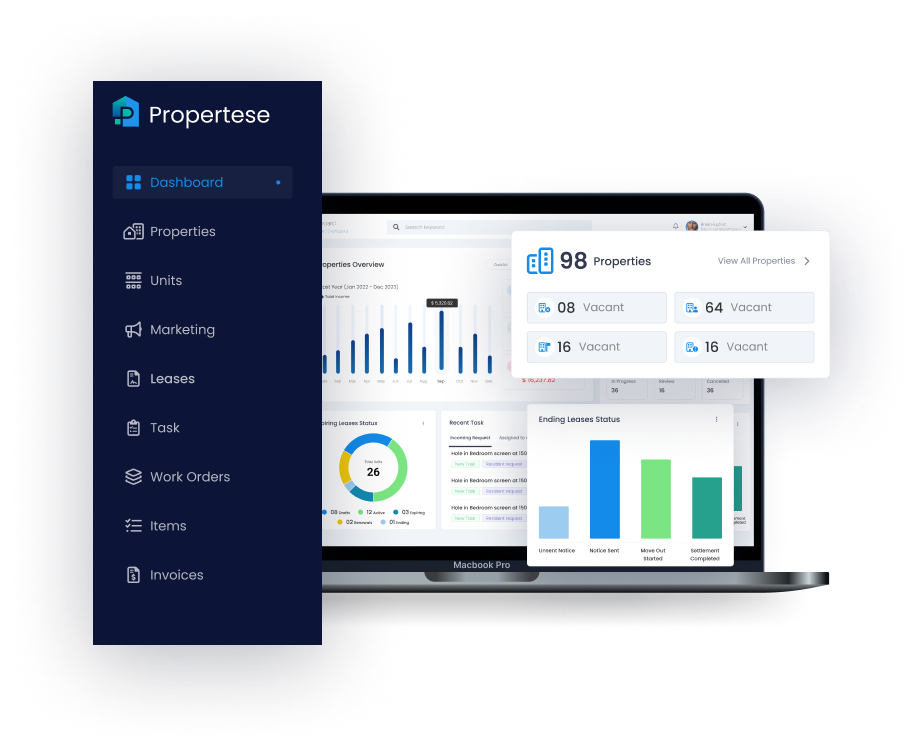

Net Operating Income is the backbone metric that tells you how profitably a property runs before debt and taxes. In plain terms, NOI in real estate is a property’s annual income from operations minus operating expenses—excluding mortgage payments, income taxes, depreciation, amortization, and capital expenditures. Because it isolates true operations, NOI is the cleanest way to compare income-producing properties and value them using the income approach. For investors, asset managers, and property managers, mastering NOI means clearer underwriting, sharper operational decisions, and greater confidence in valuations. Propertese helps mid- to large-scale portfolios track, benchmark, and forecast NOI in real time through ERP-grade integrations, automated reporting, and unified workflows that keep financial performance accurate and actionable.
Key takeaways:
- NOI = Total Revenue − Operating Expenses; excludes debt service, taxes, depreciation, amortization, and capex.
- It standardizes performance comparisons and underpins income-based valuation via cap rate (Value = NOI ÷ Cap Rate).
- Typical income includes rent and rent-like items; expenses include taxes, insurance, utilities, R&M, management, and admin/marketing.
- Variants include trailing (T-12), stabilized, and projected (pro forma) NOI used in underwriting and lender sizing (DSCR).
- Improving NOI through rent optimization, expense controls, and tenant retention can materially increase asset value.
Definition of Net Operating Income in Real Estate
Net Operating Income (NOI) is a property’s annual income from all operations after subtracting operating expenses, but before deducting financing costs, income taxes, depreciation, amortization, or major capital improvements. This real estate profitability metric applies across multifamily and commercial real estate, as well as other income-producing properties.
By excluding owner-specific factors like financing and taxes, NOI enables apples-to-apples performance comparisons across similar assets and markets.
How to Calculate NOI
The standard formula used by lenders, appraisers, and investors is:
NOI = Total Revenue − Operating Expenses
Quick example: If a building produces $110,000 in revenue and incurs $40,000 in operating expenses, its NOI is $70,000.
Typical income and expense categories:
Income sources
| Category | Examples |
|---|---|
| Base rent | Apartment, office, retail rent |
| Other rent-like income | Parking, storage, RUBS/utility reimbursements |
| Fees | Application, pet, late, lease-up/admin fees |
| Ancillary | Laundry, vending, billboard/signage |
Operating expenses
| Category | Examples |
|---|---|
| Taxes and insurance | Property taxes, hazard/liability insurance |
| Utilities | Water/sewer, gas, electric, trash (owner-paid) |
| Repairs & maintenance | Routine R&M, supplies, janitorial, landscaping |
| Property management | Management fees, payroll, benefits, training |
| Admin/marketing | Leasing, advertising, software, office, HOA/condo fees |
What Expenses and Incomes Are Included and Excluded in NOI
Operating income that counts toward NOI typically includes rent, parking, laundry, storage, utility reimbursements, vending, and various tenant fees. Operating expenses commonly include property taxes, insurance, utilities, routine repairs and maintenance, admin/marketing, and property management fees.
Non-operating or owner-specific items are excluded from NOI: mortgage principal and interest, depreciation and amortization, income taxes, one-time capital expenditures (capex), and major improvements.
Included vs. excluded at a glance
| Included in NOI | Excluded from NOI |
|---|---|
| Rent and rent-like revenue | Mortgage payments (principal and interest) |
| Parking, storage, laundry, vending | Depreciation and amortization |
| Utility reimbursements (RUBS) | Income taxes |
| Tenant fees (application, pet, late) | Capital expenditures and major improvements |
| Routine operating expenses | Owner-specific costs and non-cash charges |
The Role of NOI in Property Valuation
Cap rate (capitalization rate) links an asset’s operating performance to its market value. The core income-approach formula is:
Property Value = NOI ÷ Cap Rate
If an asset has $200,000 in NOI and trades at an 8% cap rate, the implied value is $2,500,000. The “NOI multiplier” captures how each $1 in stable NOI growth can expand value; at an 8% cap, each additional $1 of NOI equates to about $12.50 of value. This is why operational improvements and durable income are prized in acquisition underwriting and negotiations.
Keywords to know:
- NOI and cap rate: the pairing used in the income approach to valuation.
- Debt coverage ratio (DSCR): lenders compare NOI to annual debt service to assess loan safety.
Types of NOI: Trailing, Stabilized, and Projected
Trailing NOI is the actual operating performance over the prior 12 months and is often called “T-12” or historical NOI.
Stabilized NOI is the expected recurring performance once occupancy, rents, concessions, and expenses normalize.
Projected (pro forma) NOI is a forward-looking forecast that reflects business-plan improvements and market assumptions. Pro forma (forecast NOI) should be stress-tested and grounded in transparent underwriting assumptions.
Impact of NOI on Real Estate Investment and Asset Management
NOI sits at the center of underwriting, acquisition pricing, lender sizing (DSCR), and return metrics like cash-on-cash and IRR. Lenders and investors routinely bridge from NOI to unlevered yield, then to levered cash flows.
Actionable levers to grow NOI include:
- Rent optimization: market-aligned pricing, revenue management, and fee structures.
- Expense controls: vendor negotiations, preventative maintenance, and utility efficiency.
- Tenant retention: renewals that reduce turnover cost and vacancy downtime.
- Smart capital improvements: targeted projects that drive durable rent or expense savings.
Benchmarking NOI per unit or per square foot helps compare assets against local comps and isolate underperformance by line item.
Market Trends Affecting NOI and Property Valuation
Operating costs—especially insurance—have risen meaningfully; commercial real estate insurance premiums have grown steadily, pressuring margins. At the same time, sector-specific vacancy trends (e.g., office softness vs. resilient multifamily in many markets) require conservative underwriting. Cap rates increased through 2024, and they tend to lag movements in Treasury yields. Together, these dynamics compress valuations unless NOI grows; keep assumptions data-driven and refresh forecasts frequently.
Best Practices for Managing and Forecasting NOI
- Build realistic reserves: budget for turnover, R&M spikes, property taxes, and insurance adjustments.
- Benchmark locally: compare NOI per unit or per square foot to peer assets and submarket medians.
- Stress-test assumptions: model rent, vacancy, concessions, delinquency, and key expense lines under base, downside, and upside cases.
- Review trends: analyze 2–3 years of monthly T-12s to surface seasonality and volatility.
- Leverage integrated software: Propertese unifies rent rolls, work orders, invoices, and GLs to deliver real-time NOI tracking, automated reporting, and tighter controls across portfolios.
A simple NOI forecasting workflow:
- Gather historicals: last 24–36 months of income/expense by GL category.
- Normalize: remove non-recurring items; annualize partial periods.
- Set assumptions: rent growth, vacancy, bad debt, expense inflation, tax/insurance reassessments.
- Build scenarios: base, conservative, and growth.
- Validate: benchmark against comps and vendor quotes.
- Monitor: compare actuals vs. forecast monthly; course-correct quickly.
Frequently Asked Questions
What is a good NOI for a rental property?
There’s no universal benchmark; it varies by market, asset class, and strategy. Compare against local comps and prioritize growing NOI relative to your basis.
Does NOI include mortgage payments or depreciation?
No. NOI excludes financing costs, depreciation, amortization, income taxes, and capex; it only includes operating income and expenses.
How does NOI relate to capitalization rate and property value?
Value under the income approach is calculated as NOI divided by the cap rate; higher NOI, all else equal, directly increases value.
What are common mistakes in calculating NOI?
Including mortgage payments, omitting key operating expenses (taxes, maintenance), and overestimating revenue without market support.
How can property managers improve NOI effectively?
Tighten operating costs, negotiate vendor contracts, optimize rents and renewals, and introduce durable revenue streams like parking, storage, or amenities.
Table of Contents
Stay Updated
Subscribe to get the latest news, industry trends, blog posts, and updates...