Key Takeaways
- There are three categories of real estate ERP software, and choosing from the wrong category is the most common reason implementations fail to deliver.
- Most platforms look similar in a demo because the operational features shown are nearly identical across every option, and the financial differences that actually matter are in the layer underneath.
- Mid-market property management companies with multiple entities and investor reporting obligations need both operational depth and financial consolidation in one platform, something most platforms in categories one and two cannot provide.
- The right evaluation questions are about multi-entity consolidation, lease accounting automation, and financial record traceability, not about dashboards and mobile apps.
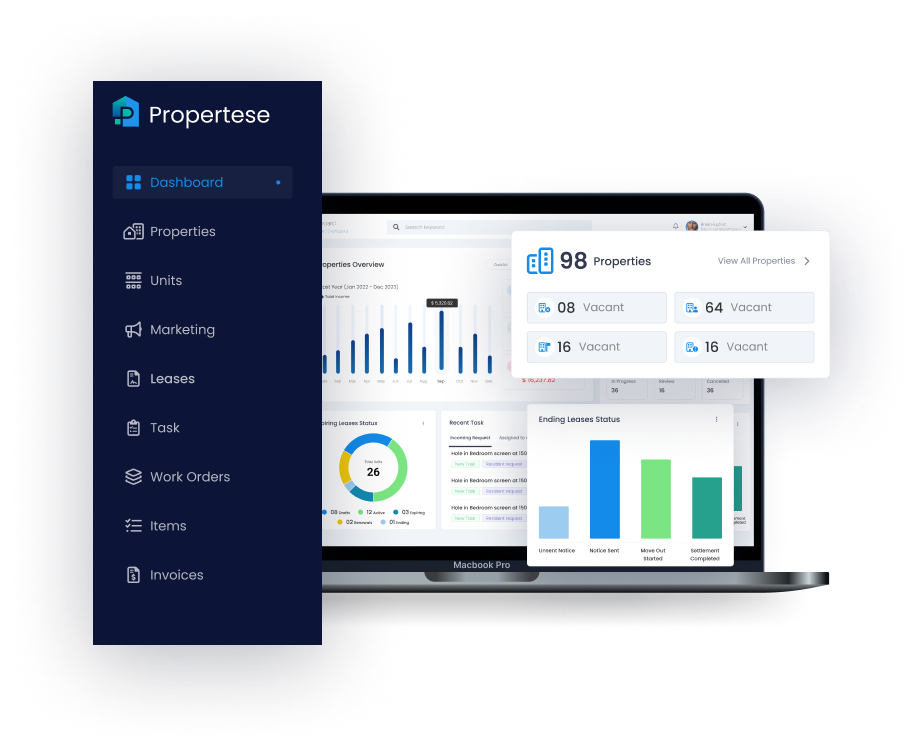
- Propertese is built on NetSuite’s financial infrastructure, which means the general ledger, accounts receivable, accounts payable, and lease accounting all operate at enterprise-grade from day one.
There are three types of real estate ERP buyers. The ones who choose a platform for the portfolio they have today. The ones who choose for the portfolio they will have in three years. And the ones who end up switching platforms again two years later because they did not know the difference.
This guide is for the second type.
Knowing how to choose ERP for real estate requires understanding what each platform category is actually built for before a single demo is booked. This real estate ERP selection guide covers exactly that. Most evaluations skip this step and go straight to feature comparisons. The features visible in a demo are similar across almost every platform on the market. The architecture underneath is where the real differences are.
According to Gartner, the primary reason ERP implementations fail to deliver expected value is misalignment between what was evaluated during selection and what the platform actually needs to do. In real estate, that misalignment shows up fastest in multi-entity accounting, lease accounting compliance, and investor reporting. This guide on how to choose ERP for real estate is written specifically for mid-market property management companies dealing with exactly those problems.
What Is Real Estate Enterprise Resource Planning?
Real estate enterprise resource planning is a platform that connects the financial records, lease accounting, property operations, and reporting functions of a real estate portfolio into one system, so everything updates from the same data rather than being manually transferred between tools.
The key difference from standard property management software is the financial layer. A real estate ERP system includes a general ledger, multi-entity accounting, compliance-grade record tracing, and investor-ready reporting. Property management software handles daily operations but almost always requires a separate accounting tool to produce accurate financial statements.
For mid-market portfolios managing multiple entities and reporting to outside investors, this distinction determines everything about which platform will actually work.
What Are the Three Categories of Real Estate ERP Software?
Most platforms fall into one of three categories. Knowing which category a platform belongs to immediately removes most of the wrong options before a single demo is ever booked.
Category 1: General-Purpose ERP
Platforms like SAP and Microsoft Dynamics 365 Finance fall here. They have strong general ledgers, solid multi-entity consolidation, and enterprise-grade financial controls. Large institutional operators and global REITs use these successfully.
The trade-off is that none of them were built for real estate. CAM reconciliation, rent roll management, lease tracking, and ASC 842 compliance all require custom modules, third-party tools, or significant configuration work. Implementation timelines for this category typically run 18 to 36 months and costs scale accordingly.
Who it fits: Enterprise REITs and large institutional operators with dedicated IT teams and budgets above $500,000 per year for licensing and maintenance. According to ERP Research, enterprise real estate ERP implementations in this category run $1 million to $5 million or more (source).
Who it does not fit: Mid-market property management companies that need a working system in 12 to 18 months without a large IT organization behind it.
Category 2: Property Management Software with Accounting Added
Yardi Voyager, MRI Software, AppFolio, and RealPage fall here. These platforms started as operational tools for managing tenants, maintenance, and leases, then added accounting functionality over time.
Their operational depth is genuine. For portfolios where day-to-day property operations are the primary complexity, these platforms perform well. Lease management, CAM reconciliation, and maintenance workflows are mature in this category.
The gap appears on the financial side. Multi-entity consolidation, fund-level investor reporting, and the depth of financial record tracing required for compliance-grade reporting show constraints as entity count grows. Many organizations in this category end up running a separate financial ERP alongside the property management platform, which reintroduces the reconciliation problem they were trying to solve.
Who it fits: Single-entity or two-entity portfolios focused primarily on residential property management, where operational depth matters more than financial consolidation. Typical annual licensing runs $15,000 to $130,000 depending on portfolio size and modules.
Who it does not fit: Mid-market commercial portfolios with five or more entities and investor reporting obligations, where the financial layer is as important as the operations layer.
Category 3: Purpose-Built Real Estate ERP
This category covers platforms built specifically for the intersection of real estate operations and enterprise financial management. The defining characteristic is a real estate-specific general ledger at the foundation, with the operations layer built on top of it.
This means lease events, rent payments, maintenance costs, and CAM charges all post to the general ledger automatically as part of the same workflow. There is no reconciliation step between the property management side and the accounting side because they are the same system.
For mid-market property management companies managing five to fifty entities with investor reporting requirements, this represents the best ERP for real estate business operations at that scale. The financial infrastructure handles the accounting complexity that general-purpose ERP takes years of customization to reach, without the operational gaps that category two creates.
How Do You Know When Your Portfolio Needs a Real Estate ERP System?
The signal is rarely a single visible failure. It is a pattern of small frictions that grow with every new entity and every new investor added to the portfolio.
These are the signs a mid-market portfolio has grown past its current setup:
- Month-end close takes longer than seven days, and at least half that time is manual reconciliation
- The same reconciliation discrepancies appear every month because two systems never quite agree
- Adding a new entity requires setting up a new system or a new spreadsheet structure
- Investor reports are assembled manually from multiple exports rather than coming directly from the system
- The lease accounting team tracks ASC 842 entries in a spreadsheet alongside the property management platform
- Only one person fully understands how the current reporting setup works
- An investor asked for a report the current system cannot produce without significant manual work
If three or more of these are true right now, the friction will not resolve on its own. It grows with every property and entity added.
What Features Matter Most When Choosing ERP for Real Estate?
The features that appear most prominently in a demo are the ones that look most impressive: tenant portals, maintenance dashboards, mobile apps, and reporting interfaces. These features are present in almost every platform. The features that determine whether the platform actually scales are the ones underneath them.
1. General Ledger Built for Real Estate
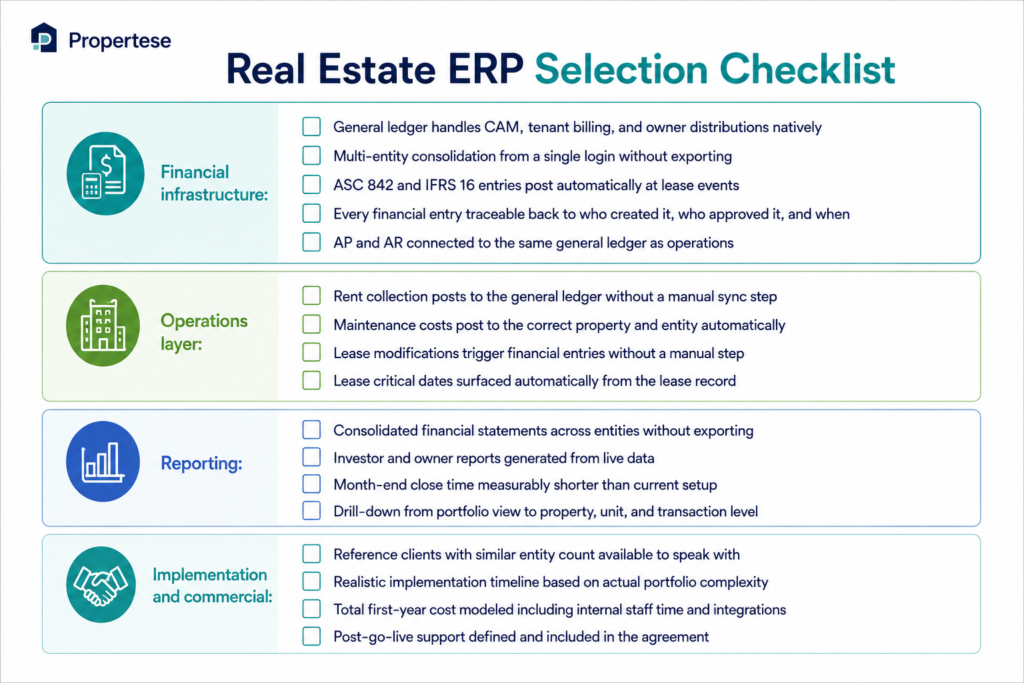
The general ledger is the foundation. Every transaction in the portfolio eventually posts somewhere, and that somewhere needs to handle real estate-specific entries without manual journal entries. CAM reconciliation, tenant billing, owner distributions, and ASC 842 lease entries should all post as part of the same workflow that created them.
Ask any platform to demonstrate a CAM reconciliation from expense pool to final tenant billing without exporting at any point. If an export appears anywhere in that demonstration, the general ledger is not as native as the sales materials suggest.
2. Multi-Entity Accounting
For portfolios with more than one legal entity, the platform must maintain separate books per entity while producing a consolidated view across all of them from a single login. Ask the platform to show a consolidated income statement across three entities in real time. If that requires an export or takes more than thirty seconds, consolidation is not happening natively.
Before selecting any platform, understanding how portfolio management works at scale across multiple entities is worth spending time on. The visibility requirements at the portfolio level often look quite different from what individual property reports show.
3. Lease Accounting Compliance
ASC 842 and IFRS 16 require lease obligations to appear on the balance sheet. Every lease modification, renewal, or early termination requires recalculation of the right-of-use asset and lease liability. The platform should handle these entries automatically when a lease event occurs, not require a separate manual step each time.
4. Financial Record Traceability
Every financial entry should trace back to who created it, who approved it, and when. This matters during external audits and investor reviews. The question to ask during evaluation is simple: show me how you would trace a specific invoice back to its source transaction, approval, and posting record. A platform that cannot answer this directly from the system is a risk for any portfolio with regular external oversight.
How Do the Main Real Estate ERP Platforms Compare?
This section places the main platforms mid-market property management companies evaluate into their honest categories. The goal is to help narrow the field, not to rank every platform exhaustively.
Cost ranges below are sourced from ERP Research’s 2026 real estate ERP buyer’s guide.
| Platform | Category | Best For | Multi-Entity | ASC 842 Native | Typical Annual Cost |
| Propertese | Purpose-Built RE ERP | Mid-market property management with multi-entity and investor reporting | Native | Native, posts automatically | Contact for pricing |
| Yardi Voyager | PM Software + Accounting | Commercial and residential operators, lower entity count | Moderate | Via separate module | $40K to $120K |
| MRI Software | PM Software + Accounting | Commercial real estate, deep lease management | Moderate | Via add-on | $40K to $130K |
| AppFolio | PM Software + Accounting | Residential portfolios, simpler structures | Limited | Not confirmed natively | $15K to $50K |
| Sage Intacct | General Purpose | Finance-first companies, strong consolidation | Strong | Via partner integrations | $30K to $100K |
| SAP / D365 | General Purpose | Enterprise REITs, global institutional operators | Strong | Native | $200K to $1M+ |
A few honest notes on this table:
Yardi and MRI are the operational platforms in category two. If the primary need is lease management, CAM reconciliation, and maintenance workflows for a simpler portfolio structure, both deserve evaluation. Their financial consolidation capabilities exist but were not where those platforms were originally designed.
Sage Intacct has the strongest financial consolidation of the general-purpose options at mid-market scale. The trade-off is that it requires a separate property management platform for operational workflows, which creates a data connection between two systems that needs ongoing maintenance.
Propertese is built on NetSuite’s financial infrastructure, which means the general ledger, accounts receivable, accounts payable, and revenue recognition all operate at enterprise-grade. How this financial backbone works in the context of a property management portfolio is the defining feature for this category. Lease events post directly to the general ledger as part of the same workflow. There is no separate sync or export between the operations side and the financial side.
The Greendale case study shows what this looks like in practice for a real portfolio, including what changed in consolidation and investor reporting after implementation.
How Do You Evaluate a Property Management ERP System?
Evaluation of any erp software for property management is not about the platform with the most features. It is about finding the platform whose structure matches the specific complexity of the portfolio. Knowing how to choose ERP for real estate starts here, before the first demo is booked.
Stage 1: Define Requirements Before Any Demos
Write down the three most painful problems in the current setup in specific terms. Not “we need better reporting” but “we need to produce a consolidated income statement across seven entities within two days of period close.” Specific problems produce specific evaluation questions.
A useful starting point is reviewing how platforms compare on the dimensions that matter most to this specific business model. This comparison of property management platforms covers how leading options differ on multi-entity support, lease accounting, and reporting depth.
Stage 2: Run Structured Demos Against Real Scenarios
Give each platform three scenarios from the actual portfolio, not the platform’s standard demo flow. The scenarios that surface the most useful information:
- A lease modification that triggers an ASC 842 recalculation
- A CAM reconciliation with variable charges across multiple tenants
- A consolidated report across three or more entities in real time
Stage 3: Speak to Reference Clients with Similar Portfolios
Ask for two clients who are twelve or more months past go-live with a similar entity count and a similar mix of commercial and residential. Ask specifically about month-end close time before and after, what surprised them during implementation, and what the platform still cannot do.
What Questions Should You Ask Before Choosing Real Estate ERP?
These questions surface platform limitations before the contract is signed.
Financial depth:
- Show me a CAM reconciliation from expense pool to final tenant billing without exporting at any point
- How does the platform handle an ASC 842 entry when a lease is modified? Is that automatic or does someone enter it manually?
- Can you produce a consolidated income statement across five entities right now, in this call?
Multi-entity support:
- How many entities does this platform support before performance or licensing changes?
- What does adding a new entity to the portfolio actually involve on the platform side?
- How are intercompany transactions recorded and eliminated?
Implementation and support:
- Who specifically will be assigned to this implementation and what is their real estate experience?
- What is the realistic timeline for a portfolio with our entity count and complexity?
- What does post-go-live support cover and what does it cost?
Reference clients:
- Can you provide two clients twelve or more months past go-live with a similar number of entities?
- What do clients typically struggle with in months six to eighteen after go-live?
Understanding how vacancy and absorption rates affect portfolio-level financial decisions is one area where ERP-quality data makes a measurable difference. The guide on absorption rate and vacancy underwriting shows exactly the kind of analysis that requires clean, connected financial data to produce reliably.
Frequently Asked Questions
How do I choose the right ERP for a real estate business?
Start with the category and identify whether the portfolio needs operational depth, financial consolidation, or both. That narrows the field before any demos. Then define the three most painful problems in specific terms and test every platform against those.
What is the difference between property management software and a real estate ERP system?
Property management software handles daily operations: rent collection, maintenance, tenant communication. A real estate ERP adds a general ledger, multi-entity accounting, lease accounting compliance, and investor-grade reporting on top of that.
What is the best ERP for a mid-market real estate business?
For a property management company with five to fifty entities and investor reporting obligations, a purpose-built real estate ERP such as Propertese covering both operations and financial consolidation from one platform is almost always the right fit.
How long does real estate ERP implementation take?
For a mid-market portfolio with five to twenty entities, expect ten to sixteen months including data migration, configuration, testing, and go-live.
What is the most important feature to evaluate?
Multi-Entity and Subsidiary Management from a single login. It is the clearest line between platforms that scale with a growing portfolio and those that hit a ceiling as entity count grows.
Does every real estate portfolio need ERP?
No. A single-entity portfolio with simple accounting and no investor reporting obligations can run well on property management software plus a standard accounting tool. ERP makes sense when entity count grows, investor reporting is required on a schedule, or month-end close keeps running long.
Start With the Right Questions, Not the Longest Feature List
Knowing how to choose ERP for real estate means understanding which platform category fits the portfolio before the first demo, not after. Getting this right is what separates the buyers in group two from those who end up switching again. The businesses that choose well define their evaluation scenarios from their actual pain points. They test platforms against those specific scenarios. They speak to reference clients a year past go-live, not six weeks.
For mid-market property management companies with multiple entities and investor reporting obligations, the platform category matters more than any individual feature. A purpose-built real estate ERP covering both operations and financial consolidation from one platform is worth evaluating before committing to a general-purpose option that requires years of customization or a property management tool that needs a separate accounting system to close the financial gap.
Talk to Propertese about what the right ERP looks like for a portfolio at your specific stage.