Owning a commercial rental property can be a profitable venture, but it also carries significant risk. From natural disasters and tenant accidents to data breaches and inflation-driven repair costs, owners face a wide range of potential exposures. Commercial rental property insurance protects against financial loss tied to these events, providing long-term stability for both landlords and tenants. This guide outlines essential coverages, cost trends, and practical ways to manage risk effectively.
Key takeaways:
- Commercial rental property insurance protects owners against property damage, liability, and income loss.
- Rising premiums and market volatility make proactive risk management essential.
- Core coverages include lessor’s risk only (LRO), business interruption insurance, and cyber liability insurance.
- Property condition and organized documentation strongly influence coverage terms.
- Propertese helps landlords centralize maintenance and insurance documentation for stronger renewal outcomes.
Overview of commercial rental property insurance
Commercial rental property insurance safeguards landlords from losses caused by damage, legal claims, or operational downtime at their leased assets. It forms the foundation for financial stability in a shifting risk environment.
Premiums have risen by roughly 20% in recent years as insurers adjust to higher claim frequencies, inflation, supply chain constraints, and reduced reinsurance capacity. New risks like severe weather and cyberattacks on smart-building systems add further complexity.
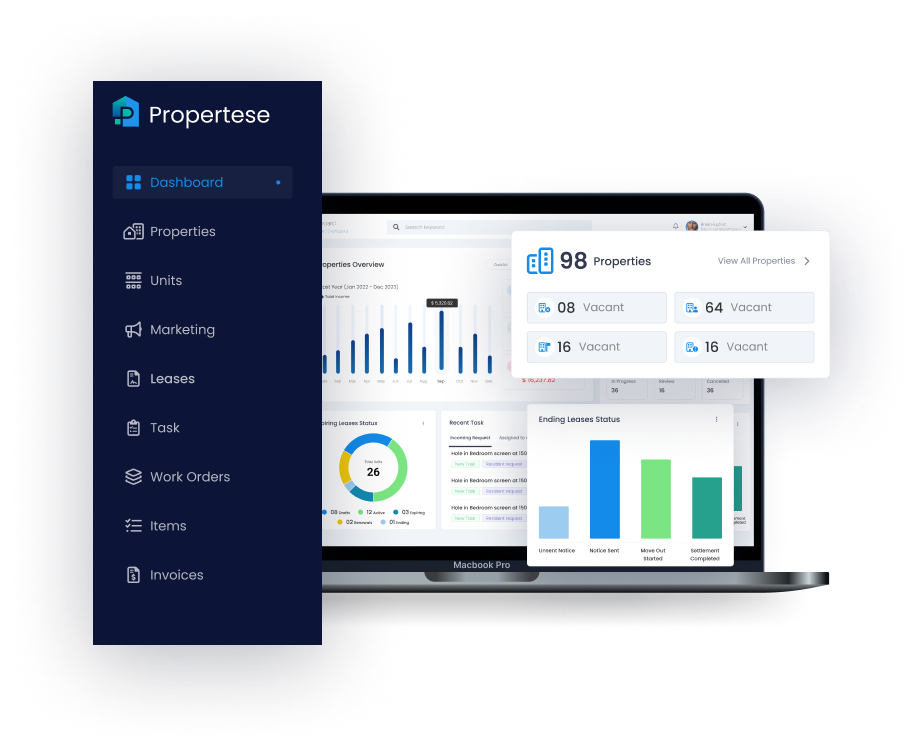
Owners now rely on data-backed insights to ensure policies reflect the realities of their assets. Platforms like Propertese commercial property management tools bring this intelligence together, helping landlords compare exposures, documentation, and policy needs in one place.
Key insurance coverages for commercial landlords
The right combination of coverages protects commercial rental property owners from costly shortfalls.
| Coverage type | What it protects | Typical exclusions |
|---|---|---|
| Building insurance | Physical structure, fixtures | Tenant property |
| Lessor’s risk only (LRO) | Lawsuits from tenant damages | Tenants’ business |
| Business interruption | Lost income due to covered events | Utility shutoffs |
| General liability | Injuries or accidents on property | Professional errors |
| Cyber liability | Data breaches, ransomware, disruptions | Physical damage |
Building insurance anchors most commercial policies, covering events such as fire, flood, vandalism, and storm damage. LRO coverage reduces exposure to tenant-related claims, while business interruption coverage replaces lost rental income after an insured event.
Cyber liability insurance has become equally vital as automated systems create more entry points for digital threats. With the average ransomware claim now exceeding hundreds of thousands of dollars, even small portfolios benefit from appropriate cyber protection.
Impact of property condition and risk mitigation on insurance terms
A well-maintained commercial property consistently earns better insurance terms. Insurers recognize documented investments in risk mitigation, such as upgraded electrical systems, improved fire protection, or flood barriers, as indicators of proactive management.
Visible, verifiable records typically lead to lower premiums and more favorable renewal terms. In contrast, incomplete maintenance logs or aging building systems can prompt higher rates. Two similar properties may receive very different quotes simply based on documentation quality.
Consolidating inspection reports, maintenance logs, and upgrade records in one platform, such as Propertese, gives owners a transparent record of diligence that supports smoother negotiations with brokers and insurers.
Managing replacement cost and underinsurance risks
Replacement cost refers to the expense of rebuilding a property as new, while underinsurance occurs when coverage limits fail to match actual reconstruction costs.
To avoid coverage gaps, owners should:
- Reassess property valuations annually.
- Update insurance-to-value (ITV) calculations to reflect inflation.
- Compare business interruption models with current rebuild times.
- Review policy limits with brokers to reflect today’s labor and material costs.
With construction costs still climbing, disciplined review ensures policies remain aligned with current market conditions.
Emerging insurance trends and technology impacts
Technology now reshapes how insurance carriers underwrite and price risk. Artificial intelligence and real-time analytics allow insurers to assess buildings with far greater precision.
The Internet of Things (IoT)—connected devices such as leak detectors, HVAC sensors, and occupancy trackers—helps prevent issues early but introduces new cyber vulnerabilities. While smarter sensors enhance resilience, landlords must confirm policies evolve alongside these technologies.
Premium volatility and the rise of parametric insurance illustrate the market’s ongoing shift. Propertese supports this evolution by giving landlords digital dashboards that capture and report performance data continuously, helping insurers recognize transparency and proactive management.
Alternative insurance structures and premium management strategies
Innovative insurance structures give property owners more control over cost pressures while maintaining sufficient protection.
Parametric insurance, for example, triggers automatic payment when a defined event—such as a specified flood level—occurs, avoiding claim delays and liquidity gaps. Its popularity continues to grow among commercial property owners seeking faster recovery cycles.
Other practical strategies include:
- Portfolio programs: Bundling multiple properties to secure volume pricing.
- Captive insurance: Using an owner-controlled entity to retain certain risks and stabilize premiums.
- Layered programs or higher deductibles: Balancing coverage depth with cost efficiency.
Engaging experienced brokers to model these structures can significantly improve long-term cost predictability.
Best practices for proactive risk management and insurance renewal
Treating insurance renewal as a continual process strengthens negotiations and ensures up-to-date protection. A focused renewal plan can improve outcomes for any commercial portfolio:
- Update property values and insurance-to-value annually.
- Record mitigation actions and completed safety upgrades.
- Begin broker consultations at least 90 days before renewal.
- Evaluate cyber and operational coverage against current exposures.
- Explore alternative policy structures to manage cost escalation.
Propertese enables property, finance, and asset teams to track and share renewal documentation in real time, ensuring all updates are visible and verifiable when premium discussions begin.
Frequently asked questions about commercial rental property insurance
What insurance coverages are essential for commercial landlords?
Commercial landlords typically need building insurance and lessor’s risk only (LRO) coverage, along with business interruption, general liability, and cyber liability insurance for full-spectrum protection.
Can landlords require tenants to carry insurance?
Yes. Most lease agreements require tenants to maintain business and liability coverage as standard practice.
How do property upgrades and maintenance affect insurance premiums?
Verified maintenance and safety upgrades—like modern fire systems—can reduce premiums by decreasing perceived risk.
What is the difference between replacement cost and actual cash value?
Replacement cost covers full rebuild expenses, while actual cash value deducts for depreciation.
How does tenant selection impact insurance costs and coverage?
Tenants engaged in higher-risk operations can raise premiums and limit available coverage options.
Conclusion
Comprehensive insurance planning protects commercial assets against unforeseen loss. With premiums rising and risk profiles evolving, disciplined documentation and informed evaluations are critical.
Propertese equips owners with centralized tools to manage maintenance records, policy renewals, and property data—all in one place—helping demonstrate operational readiness and earn better coverage terms. To explore integration options for your portfolio, visit Propertese commercial property management.
For more guidance, learn how to reduce rental property maintenance costs without sacrificing quality or explore rental arrears management strategies.
Table of Contents
Stay Updated
Subscribe to get the latest news, industry trends, blog posts, and updates...