Net Operating Income is the single number that drives valuation, debt qualification, and investment decisions in real estate. To understand how NOI real estate works as a valuation tool, read our guide on what is NOI in real estate and how it is used in valuation. At a 6% cap rate, a $10,000 annual error in NOI real estate doesn’t just misrepresent cash flow. It distorts property value by over $166,000. That’s not a rounding issue. That’s a deal-breaking discrepancy that surfaces at the worst possible moment. Like during due diligence, at refinance, or when a buyer’s accountant starts asking questions.
The formula itself is not the problem. NOI = Effective Gross Income minus Operating Expenses. The problem is everything that sits inside those two buckets. And how easily things move between them based on habit, assumption, and software that wasn’t built with real estate accounting in mind.
Key Takeaways
- NOI errors compound into valuation errors. At a 6% cap rate, every $10,000 of misreported income or expense moves property value by over $166,000. Small classification mistakes are not small problems.
- Self-managers still need to include a market-rate management fee. NOI measures the property’s standalone income capacity, not the owner’s personal cost structure. Lenders and buyers normalize for this regardless.
- The CapEx vs. operating expense line is where the most systematic bias gets introduced. Without a clear policy enforced at the point of entry, operators end up with NOI that either overstates or understates performance, depending on who coded the invoice.
- Ancillary income is real income. Parking, storage, pet fees, and RUBS that live in a separate spreadsheet and never reach the income statement produce a materially understated NOI.
- The root cause of most NOI errors is a systems gap, not an accounting knowledge gap. When lease data and financial data live in separate places and reconcile manually, errors accumulate faster than they get caught.
Why “Getting NOI Wrong” Is More Common Than You Think
Search any real estate forum, and you will find the same recurring confusion: where do management fees go when you self-manage? Is a roof replacement an operating expense or a capital item? Does straight-line rent get included? What about the free rent months you gave a new tenant to get them signed?
These aren’t beginner questions. Operators who have been in the business for a decade still run into edge cases that their existing workflows (often a mix of spreadsheets, property management software, and a generic accounting tool) were never designed to handle consistently.
The deeper problem is structural. Most property management software handles the leasing and operations layer reasonably well. Most accounting software handles debits and credits. But the intersection, where lease events generate accounting entries that feed into NOI in ways that comply with GAAP and survive external scrutiny, is where gaps appear. And those gaps compound across a portfolio.
The Edge Cases That Actually Move the Needle
Self-Management and the Missing Management Fee
One of the most consequential and consistently overlooked items in NOI real estate calculations is property management fees, and not just for operators who use third-party managers.
Consider a case documented repeatedly in professional underwriting discussions: a seasoned investor acquires a multifamily asset and excludes management fees from the pro forma because he intends to self-manage. At a 5% management fee on a property with $2.4 million in gross income, that’s $120,000 annually that never appears in the expense line. At a 6% cap rate, that omission inflates perceived property value by $2 million.
The logic seems rational at first. If you manage it yourself, why include a cost you’re not paying? The error is treating NOI as a personal cash flow tool rather than what it actually is: a measure of the property’s standalone income-producing capacity, independent of ownership structure. Professional appraisers and institutional buyers always normalize for management fees, regardless of who currently manages the asset. When your NOI excludes it, you are not just understating expenses. You are presenting a number that won’t survive any serious buyer’s due diligence.
In property accounting software, this issue gets worse when management fee calculations aren’t embedded at the property level. Instead, get treated as a periodic journal entry that’s easy to skip or inconsistently applied.
CapEx vs. Operating Expense: The Misclassification That Corrupts Your NOI
The capital expenditure boundary is where many otherwise careful operators introduce systematic bias into their NOI, often in the direction that serves them in the moment.
A roof replacement, HVAC overhaul, parking lot reseal, or elevator modernization is a capital expenditure. It improves or extends the useful life of the asset. Moreover, it belongs on the balance sheet and gets depreciated over time. It does not belong in the operating expense line for the period in which it occurs.
Putting it through operating expenses in a single period creates an artificially depressed NOI. That can look prudent in isolation, the kind of thing people call “conservative,” but during a sale or refinance, it means trailing financials don’t reflect the property’s true earning capacity, and you end up with awkward explanations about why adjusted NOI differs so substantially from reported NOI.
The reverse error is equally damaging. Some operators treat routine maintenance (painting, plumbing repairs, appliance replacements) as capital investments to keep the operating expense line artificially low and NOI artificially high. This inflated figure won’t survive scrutiny, but it can influence seller price expectations and buyer offers in ways that lead to expensive post-close disputes.
The honest application of this distinction requires clear policy: who decides whether a cost is CapEx or OpEx, at what threshold, and through what approval process? Without that in place as a workflow inside your property accounting software, the decision gets made case by case, inconsistently across properties, and often in whatever direction makes this quarter’s report look better.
To understand how operating costs affect overall property performance, the guide on what is a good operating expense ratio and why it matters gives useful context for benchmarks by property type.
Ancillary Income: The Revenue That Goes Uncounted
Go into almost any stabilized multifamily or mixed-use property and you will find income streams that have real economic value but never make it into the NOI calculation because the system that captures them isn’t connected to the system that calculates income.
Parking fees. Storage unit rentals. Laundry revenue. Pet fees. Late fees. RUBS (Ratio Utility Billing System) income. Move-in administration fees.
These aren’t trivial amounts. For a 200-unit multifamily property in a market where parking commands $100 per month per space and 60% of tenants use it, that’s $144,000 annually from a single ancillary category. If that income is tracked in a separate spreadsheet maintained by the property manager but never flows into the financial statements your property accounting software produces, the NOI is understated by that amount. At a 6% cap rate, that’s a $2.4 million undervaluation.
The issue is almost never that operators don’t know about this income. It’s that ancillary income is often captured in operational systems (leasing platforms, payment portals, onsite tracking sheets) that have no automated feed into the accounting layer. Reconciliation happens manually, late, or not at all.
Vacancy: Physical vs. Economic, and Why the Difference Matters
Vacancy is reported in two ways, and most operators conflate them.
Physical vacancy is the percentage of units that are unoccupied. Economic vacancy accounts for both unoccupied units and occupied units where rent isn’t being collected: credit loss from non-paying tenants, units under concession, or units held offline for renovation.
The distinction matters enormously for NOI. A property with 5% physical vacancy but 3% credit loss has an effective economic vacancy of 8%. Using the physical figure inflates Effective Gross Income and therefore inflates NOI.
In rising concession markets (which describes most major metro multifamily markets through 2025 and 2026), operators who offer one to two months of free rent as a move-in incentive need to account for that cost somewhere. If it runs through the income line as a reduction, it appropriately lowers Effective Gross Income. If it runs through the expense line as a marketing cost, it lowers NOI from the other side. Either treatment can be defensible. What isn’t defensible is booking the full face rent as income while also booking the free rent months as if they never happened, which is what occurs when leasing-system data and accounting-system data aren’t in sync.
Straight-Line Rent and Lease Concessions: The GAAP Treatment Most Operators Skip
This one matters primarily for commercial operators (office, retail, industrial, mixed-use) but its impact on reported NOI can be substantial.
When a commercial lease includes escalations (rent steps over the lease term) or concessions (free rent periods, reduced initial rent), GAAP requires that the total economic rent be recognized on a straight-line basis over the full lease term. This means the rent you recognize for accounting purposes in any given period differs from the cash actually received.
In a 5-year office lease with 6 months of free rent and a base rent of $50,000 per month thereafter, the straight-line calculation averages the total rent over the full 60 months. You recognize approximately $45,000 per month from day one, even though you’re receiving $0 in months 1 through 6. This creates a straight-line rent receivable (sometimes called deferred rent) on the balance sheet.
The error most operators make is reporting only cash-basis rent in their NOI, showing $0 in free rent months and the full $50,000 in paying months. That produces an NOI that swings wildly by lease event, gives a misleading picture of stabilized property income, and is not GAAP-compliant.
Why does this matter? Because lenders, appraisers, and sophisticated buyers use GAAP-based financials to normalize NOI. If your property accounting software only tracks cash received, this entire adjustment has to be made manually at report time, if it gets made at all.
This is particularly relevant in triple net lease structures, where the lease terms and cost pass-throughs already require precise accounting. Our breakdown of what a single tenant triple net lease is and how the gain works covers how these arrangements affect income recognition.
Tenant Improvement Allowances: Below the Line, Except When They’re Not
Tenant improvement allowances (TIAs) are amounts a landlord pays to fund a tenant’s buildout. They’re CapEx, not operating expenses, and therefore below the NOI real estate line, most of the time.
The complexity arises in two scenarios. First, when TIAs are structured as a lease incentive rather than a direct capital expenditure, accounting treatment changes. Under ASC 842, the characterization of who owns the improvement (lessor vs. lessee) determines how it flows through the financial statements, and a misclassification of ownership means the wrong party is depreciating the asset and potentially treating a balance sheet item as a P&L item.
Second, when a TIA flows through operating expenses because someone coded it wrong, or because the property management system doesn’t have a clear CapEx classification workflow, it depresses NOI in a way that’s hard to unwind after the fact and creates discrepancies between what the operator reports and what an auditor or buyer will find.
Across a large commercial portfolio with multiple concurrent lease executions, staggered buildouts, and overlapping lease terms, these misclassifications add up fast. A single-property error stays a single-property error. A portfolio-level misconfiguration becomes an audit finding.
Management Fees Paid to Related Parties: The Normalization Issue
For operators who use third-party management, or who run an in-house management company that charges a fee to the property-owning entity, the question of what fee gets included in NOI becomes a normalization challenge.
If the management fee charged to the property is below market (because the management entity is owned by the same sponsor), NOI looks better than it should. An institutional buyer or lender will normalize that fee to market rate, typically 3 to 8% of EGI depending on property type and geography, and recalculate NOI accordingly. If you have been pricing the asset or modeling returns on the below-market fee, the gap between your NOI and their normalized NOI will produce a valuation disagreement that’s difficult to resolve late in a transaction.
The inverse is also true: some operators run personal or overhead expenses through the management company and charge them back to properties. Those costs inflate management fees, depress NOI, and may represent non-arm’s-length transactions that require disclosure.
None of this is unusual. But it requires your property accounting software to track the management fee as a clearly labeled, auditable line item with documentation of how it was determined, not a lump sum that resists decomposition.
The Spreadsheet Problem
Most of the edge cases above share a common origin: the data that should inform them lives in multiple disconnected places, and the reconciliation between them happens manually on a cycle that’s too slow to catch errors before they affect decisions.
Research consistently shows that 88% of spreadsheets contain input errors from manual data entry. For a property-level model, each manual transfer (from property management software into a spreadsheet, from a spreadsheet into accounting software, from accounting software into a report template) is a point of failure. Multiply that by 20 properties and 12 months of accruals and you have a system that produces figures that feel precise but contain errors that stack up over time.
The operators who get NOI right consistently are not necessarily more knowledgeable about real estate accounting theory. They have better systems, specifically property accounting software, where lease events, operating transactions, and financial statements share a single data layer.
What Good Property Accounting Software Needs to Handle
Getting NOI right across a real estate portfolio requires software that does more than track rent payments and export to QuickBooks. It requires:
A unified data model where lease terms, rent schedules, concessions, and operating expenses live in the same environment as the accounting entries they generate. When a free rent period is recorded in the leasing module, the accounting impact (straight-line rent recognition) should flow automatically, not wait for a month-end manual entry.
CapEx workflow with classification controls that enforce the distinction between capital and operating expenditures at the point of entry, not after the fact during audit cleanup.
Ancillary income tracking that feeds the income statement, not a separate spreadsheet. Every revenue stream (parking, storage, pet fees, RUBS) should be coded to the correct property income account and visible in the NOI roll-up without manual consolidation.
GAAP-compliant lease accounting for commercial portfolios, including straight-line rent calculations and proper handling of TIAs under ASC 842.
Property-level and portfolio-level NOI reports with drill-down capability so when a lender asks why Q3 NOI differs from Q2 by 12%, you can trace it to a specific lease event or expense classification within minutes, not days.
A Practical Checklist: Audit Your Own NOI Calculation
Before your next refinance, acquisition, or investor report, run through the following:
Income side: Does your Effective Gross Income include all ancillary revenue streams, or only base rent? Are concessions and free rent periods reducing gross income correctly, rather than being ignored? If you’re a commercial operator, are you recognizing rent on a straight-line basis across escalation periods and concession windows? Is your vacancy rate economic vacancy (including credit loss) rather than physical vacancy only?
Expense side: Is your CapEx/OpEx boundary applied consistently across all properties, or property-by-property, based on whoever coded the invoice? Does your NOI include a management fee at market rate, regardless of whether you self-manage? Are TIAs being treated as capital items, not operating expenses? Are any personal or unrelated overhead expenses running through property-level accounts?
Systems: Does a single system own both the lease data and the accounting data, or is reconciliation done manually? Can you drill from a portfolio-level NOI number down to the individual transaction that drove a variance? Are your financial statements GAAP-compliant, or cash-basis reports that will require restatement during due diligence?
If you’re answering “I’m not sure” to more than two or three of these questions, the issue isn’t your understanding of NOI. It’s the gap between how your systems capture data and what defensible real estate financials actually require.
Conclusion
Most NOI errors don’t come from ignorance. They come from systems that weren’t built for the specific accounting demands of real estate: lease events that generate automatic entries, ancillary income that needs to reach the income statement without a manual step, CapEx and OpEx that need to be separated at the point of entry, and management fees that need to be normalized before any lender or buyer touches your numbers.
By the time those errors surface, you’re usually in the middle of a transaction where restating financials is expensive and losing credibility is worse.
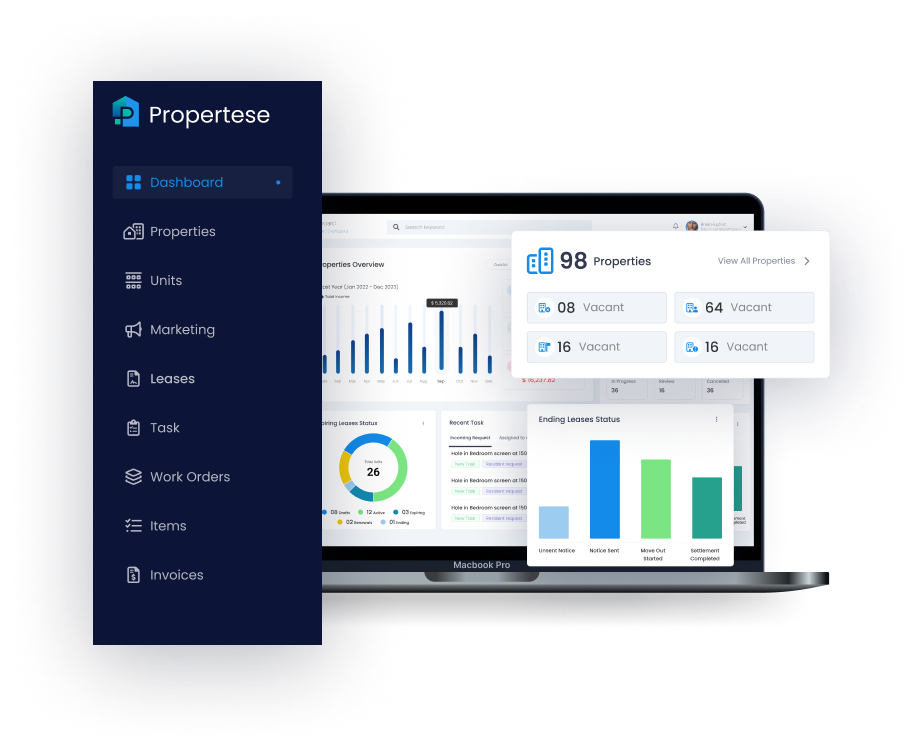
Propertese is property management software built specifically for real estate operators who need their operational data and their financial data to live in the same place. The platform handles lease administration, expense tracking, ancillary income capture, and financial reporting in a single environment. For teams already on NetSuite for corporate financials, the native integration keeps property-level and entity-level books in sync without manual reconciliation or a third-party connector.
If your current setup produces NOI figures you’d feel confident defending in front of a lender or buyer, you’re in good shape. If it doesn’t, that’s worth fixing before the next deal.
You can schedule a meeting with us to discuss how Propertese handles property-level accounting and NOI reporting.
Table of Contents
Stay Updated
Subscribe to get the latest news, industry trends, blog posts, and updates...