Accurate property-level profit and loss (P&L) statements depend on proper maintenance cost allocation, the process of mapping work order expenses to the correct general ledger (GL) accounts. When executed correctly, this alignment gives property managers, accountants, and owners a true view of operating performance and asset health. It bridges maintenance data from field operations with financial reporting to ensure every repair, replacement, or inspection is reflected precisely in the property’s books. Done right, it transforms operational detail into financial clarity, supports faster closes, reliable benchmarking, and data-driven portfolio decisions.
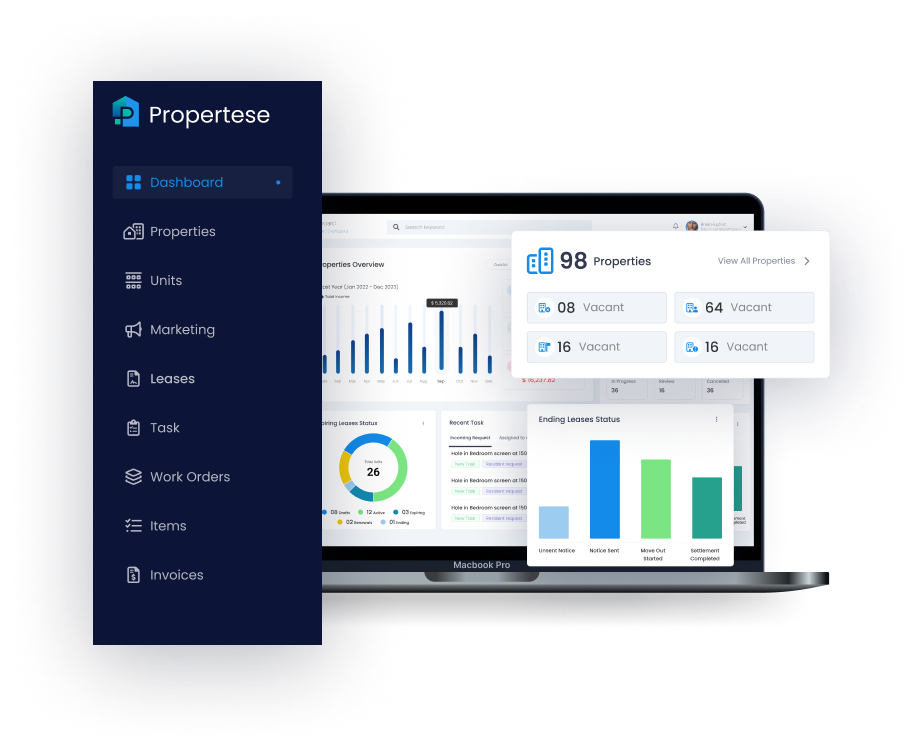
Propertese simplifies this process by uniting maintenance workflows, accounting data, and ERP integrations. Cost allocation then happens in a single centralized platform.
Key takeaways:
- Clear rules for mapping maintenance cost to GL accounts drive accurate property-level P&Ls
- A strong chart of accounts and clean work order data reduces reclassifications and close friction
- Automation with two-way validation cuts errors and speeds the month-end close
- Governance and version tracking keep mapping accurately as portfolios evolve
Understanding maintenance cost allocation and its importance
Maintenance cost allocation is the structured process of assigning each maintenance expense from work orders, labor hours, or vendor invoices to a GL account tied to the correct property, asset, or cost center.
Without clear mapping, expenses may blend together, distorting maintenance benchmarking and net operating income (NOI) insights. Consistent allocation ensures costs are transparent, comparable, and auditable across assets and time periods. It provides the precision needed for owner statements and financial reviews.
For a deeper look at drivers and fixes, explore why property maintenance costs are too high and 7 ways to fix them.
How allocation supports accurate property-level P&Ls:
| Impact area | Result of proper mapping |
|---|---|
| Transparency | Maintenance costs tied to specific properties and assets |
| Benchmarking | Apples to apples comparison across sites and regions |
| Compliance | Audit trails and standardized expense categorization |
| Speed | Faster financial closing with fewer manual adjustments |
Preparing your chart of accounts and work order data
A well-structured chart of accounts (COA) provides the foundation for accurate maintenance cost mapping. The COA organizes all financial accounts into consistent categories, often with property-level subaccounts, to capture activity at the right level of detail.
Start by exporting your COA and a recent GL extract. Align this data with operational details from your maintenance or property management system, ensuring every expense category, labor, materials, vendor, and part type can link to a GL account.
Integrations with platforms like Propertese connect maintenance requests directly to accounting codes in NetSuite or Xero, ensuring that operational and financial records remain synchronized.
For multi-property portfolios, use property-specific subaccounts, such as 5101.001 for “Repairs Property A,” to keep allocations distinct and audit-ready.
Defining mapping taxonomy and naming conventions
A consistent mapping taxonomy provides the rules for how costs flow from operations to the ledger. It defines which costs belong to each category, repairs, preventive maintenance, or capital improvements, and ensures all stakeholders apply the same logic.
Use clear, rule-based naming conventions that scale across properties. For instance, naming GL accounts like “Plumbing Repairs Property B” allows automated mapping rules to match work orders consistently. Document your conventions in a shared reference file managed jointly by operations and finance.
Propertese supports structured account naming and metadata tagging, so these conventions embed into automated workflows for accuracy.
Building the mapping rules table for work orders to GL accounts
Each work order should connect directly to the correct GL account through a predefined mapping table. This table outlines how key fields, such as asset tag, category, or vendor, translate to financial accounts.
A typical rules table might look like this:
| Work order attribute | Example value | GL account | Allocation logic | Confidence tag |
|---|---|---|---|---|
| Asset type | HVAC Unit | 5202 | Category direct map | High |
| Vendor | ABC Mechanics | 5101 | Vendor rule | Medium |
| Keyword | Tire Replacement | 5115 | Regex pattern match “tire” | High |
Keep rationale statements for each rule so exceptions can be reviewed or audited efficiently. Where multiple work orders fall into shared cost pools, mark them for pooled allocation later.
With Propertese, rule logic can be tested, stored, and adjusted centrally to maintain a single source of truth across teams.
Implementing the mapping: integration and automation techniques
Once mapping rules are defined, integrate maintenance data with your financial systems to reduce manual entry and strengthen data accuracy. Automation accelerates the month-end close and reinforces audit reliability.
You can begin with simple tools like Excel or Power BI, then advance to ETL (Extract, Transform, Load) processes, SQL scripts, or embedded ERP integrations. Ensure two-way validation: operational data should flow accurately to the GL, and financial entries should trace back to their work order origins.
Propertese automates this two-way synchronization with NetSuite and Xero, ensuring your GL always reflects real-time maintenance activity without manual cross-checking.
Maintain complete mapping logs, who, when, and why each rule was applied, to preserve integrity and compliance. Automated validations help identify unmapped work orders or missing accounts before they affect P&L results.
Allocating costs from pooled GL accounts using ratio and percentage methods
Some maintenance costs, like shared equipment or multi-property service contracts, accumulate in pooled GL accounts. To assign them equitably, use ratio-based or percentage-based allocation methods.
Common techniques:
| Method | When to use it | Allocation basis |
|---|---|---|
| Ratio based | When usage data exists | Metrics such as labor hours, square footage, or asset count |
| Percentage based | When precise data is not available | Fixed proportional splits (for example, 60/40 across properties) |
Choose a basis that reflects real use so each property gets a fair share of maintenance cost. Ratio allocation best reflects actual operational use. Where detailed data is unavailable, percentage splits maintain fairness and repeatability. The objective is consistent, transparent logic, not arbitrary precision.
For savings ideas that do not sacrifice quality, see how to reduce rental property maintenance costs without sacrificing quality.
Propertese’s analytics modules can help calculate and automate these ratios within your integrated financial reports.
Validating and testing your maintenance cost allocation model
Validation ensures your mapping logic delivers correct and dependable results before implementation. Run sample transactions, simulate monthly close processes, and test for missing or duplicate mappings.
Collaborate with both accounting and maintenance teams to resolve exceptions and document rationale. Retain audit trails that record reclassifications and rule updates.
Propertese enables version tracking of mapping logic, helping maintain continuity and compliance as portfolio data evolves.
Operationalizing and governing the maintenance cost allocation process
Sustained accuracy relies on governance. Assign clear ownership of the COA and mapping framework, typically within finance or operations, responsible for periodic reviews and adjustments.
Establish a quarterly refresh schedule for mapping rules and automate alerts for anomalies such as unmapped accounts or cost spikes.
For a practical playbook to keep teams aligned, use this property management maintenance checklist for 2026.
Governance transforms allocation from a setup task into an ongoing discipline that improves financial control. Within Propertese, configurable approval workflows and notifications reinforce this accountability in real time.
Evolving mapping granularity for enhanced property-level financial insights
Over time, refining your mapping improves insight. Subdivide broad categories, for example, splitting “Parts” into “Tires,” “Engine Components,” and “Hydraulics,” to sharpen visibility into maintenance cost drivers and optimize future budgeting.
Tracking how your mapping evolves also supports year-over-year analysis, performance benchmarking, and investor transparency.
With Propertese, historical mapping versions and change logs are stored automatically, making it easier to correlate financial outcomes with operational shifts.
Frequently asked questions
How do you separate planned maintenance costs from emergency repair costs in budgeting?
Categorize each work order in Propertese as planned, scheduled, or emergency to forecast more accurately and distinguish proactive from reactive spend.
When should maintenance costs be capitalized instead of expensed?
Capitalize costs that extend an asset’s useful life or improve performance, and classify routine servicing as an operating expense.
How can indirect maintenance costs be allocated across multiple properties or projects?
Allocate indirect costs using logical bases such as labor hours or material consumption. Propertese automates these ratios across properties.
What methods reveal which assets drive most maintenance expenses?
Apply Pareto analysis in Propertese reporting to identify the small percentage of assets generating the most maintenance cost.
How should maintenance costs be classified for accurate financial reporting?
Record routine repairs as expenses and improvements that enhance value as capital expenditures of the appropriate GL type.
Conclusion
Effective mapping turns every line item into clear insight at the property level. Focus on the right data, rules, and controls so each maintenance cost lands in the correct GL account and supports faster close and better decisions. If you want a simpler path, see how Propertese can centralize your workflows and automate mapping from work order to ledger while preserving full audit trails.
Table of Contents
Stay Updated
Subscribe to get the latest news, industry trends, blog posts, and updates...