If you manage properties on behalf of multiple owners, you know that accounting is not what people outside the industry assume it to be. Trust accounting in property management is the structured practice of holding, tracked, and disbursed funds that legally belong to your clients (rent receipts, security deposits, maintenance reserves)/ They have to be maintained in a manner that keeps those funds perpetually distinct from your operating capital. That sounds straightforward. But when you are managing ten, fifty, or two hundred owner relationships simultaneously, each with their own properties, tenants, expense obligations, and payout schedules, the architecture required to do this correctly becomes one of the most demanding financial compliance challenges in the real estate industry.
This article breaks down exactly why that complexity exists, where firms are most exposed, and how purpose-built property accounting software like Propertese, particularly solutions that operate natively inside an ERP like NetSuite, changes the compliance calculus.
Key Takeaways
- Trust accounting in property management is a legal obligation, not an accounting preference. As per enforcement priorities, violations can be fined with $1,000 and $25,000 per incident before license exposure is factored in.
- Fraud does not cause the most common compliance failures. They come from systems that cannot enforce fund separation, manual workflows that introduce errors, and reconciliation processes that do not happen on schedule.
- General accounting tools like QuickBooks have no native trust accounting module. Firms that force trust compliance into these platforms are running a fragile setup that will not hold up under audit conditions.
- Multi-owner portfolios require ledger-level owner isolation, pooled trust account architecture with sub-ledger separation, automated reconciliation, and owner statement generation. These are not optional features. They are compliance requirements.
- Property accounting software that operates natively inside NetSuite eliminates the reconciliation gap between operational data and financial data, which is where most multi-system setups fail.
The Fiduciary Layer Most Software Vendors Ignore
Property managers operate under a fiduciary duty. That word, fiduciary, is not marketing language. It is a legal standard that requires you to act in the best interests of your clients when you handle their assets. In most jurisdictions, this duty is codified through state real estate commissions, broker licensing requirements, and trust account statutes.
The National Association of Realtors’ Code of Ethics (Article 8) requires property managers to maintain trust accounts for client funds. State regulators including the California Department of Real Estate (DRE), the Texas Real Estate Commission (TREC), and the North Carolina Real Estate Commission (NCREC) go further. They mandate specific account structures, deposit timelines, reconciliation frequencies, and record retention periods. Several of these agencies have explicitly identified trust fund violations as their top enforcement priority.
REGULATORY EXPOSURE: Fines for a single trust accounting violation range from $1,000 to $25,000 depending on jurisdiction, and that is before factoring in license suspension or civil liability.
What makes this particularly difficult for multi-owner portfolios is that each owner relationship represents a separate set of fiduciary obligations. A dollar collected from Tenant A in Unit 301 belongs to Owner X. A deposit held for Tenant B in Unit 204 belongs to Owner Y. The moment that distinction breaks down, even temporarily, even accidentally, you have commingled funds. And commingling is not a bookkeeping error regulators treat leniently.
If you want a foundational primer on what trust accounting actually requires at the structural level, this overview of trust accounting in property management and real estate covers the core mechanics before the compliance architecture layer gets involved.
What Commingling Actually Looks Like in Practice
Practitioners on property management forums describe this problem in remarkably consistent terms. The failure mode is rarely intentional fraud. It is typically a systems problem: general-purpose accounting tools that cannot enforce the required separation, manual workflows that introduce transcription errors, and month-end reconciliation processes that nobody has time to complete properly.
Common commingling scenarios that trigger audits:
- Management fees left in the trust account beyond the legally permitted window because the disbursement workflow was not automated
- Operating expenses paid from the trust account because a vendor bill was routed to the wrong ledger
- A security deposit for one owner’s tenant applied toward another owner’s maintenance costs due to a manual posting error
- One client’s funds used to cover a temporary shortfall in another client’s account, a practice that is illegal regardless of intent
- Commission fees retained in the trust account longer than state law permits, creating constructive commingling even without any actual misuse
Each of these scenarios is a compliance event. Regulators who examine your books during an audit do not need to find malicious intent. They look at transaction timing, account structure, sub-ledger accuracy, and reconciliation documentation. If any of those elements are deficient, you are exposed.
Why General Accounting Software Fails at This
This is where the conversation gets uncomfortably honest for a lot of firms: QuickBooks, Xero, and spreadsheets cannot do this correctly at scale.
A 2022 study by RETI found that 64% of property management businesses still use spreadsheets as their primary accounting tool. Another substantial segment uses QuickBooks. These tools have their place in general business accounting. But trust accounting for multi-owner property portfolios requires capabilities that generic accounting platforms were not built to enforce.
The Structural Problem with QuickBooks
QuickBooks has no native trust accounting module. To manage trust compliance in QuickBooks Online, you need a highly complex custom setup that involves separate company files or sub-accounts that simulate the required ledger separation. This setup is fragile, difficult to maintain, and does not prevent the system from allowing transactions that violate trust accounting rules.
Industry practitioners who work in the accounting infrastructure of property management firms describe this bluntly: forcing trust bookkeeping into QuickBooks requires a setup that is difficult to maintain and still does not reliably meet trust compliance standards or pass regulatory audits. QuickBooks cannot enforce the separation that property management requires. A security deposit from one unit should never be accessible to cover a bill for a different owner’s property. The system simply does not have that constraint built in.
The workaround many firms adopt, running QuickBooks for business operations alongside a dedicated property management system for trust accounting, introduces its own problems: double data entry, reconciliation friction between two sets of books, and version control issues when transactions touch both systems.
SYSTEMS RISK: Two sets of books means two sets of errors. When the property management system and the accounting platform do not sync in real time, reconciliation gaps accumulate between month-end closes.
The Spreadsheet Problem at Scale
For smaller portfolios, spreadsheets work until they do not. The moment you add a third owner, a second property type, or a second jurisdiction with different deposit rules, the spreadsheet model starts to break down. There is no audit trail for changes, no enforcement of fund separation, and no automated reconciliation. And there is no alert mechanism to catch a misallocation before it becomes a compliance violation.
A portfolio that grows while trust accounting runs on spreadsheets is not on a growth path. It is on a liability accumulation path.
The Compliance Architecture Required for Multi-Owner Portfolios
When you manage money on behalf of multiple property owners simultaneously, your compliance architecture needs to do several things that cannot be achieved through manual processes or generic accounting tools alone.
1. Ledger-Level Owner Isolation
Every financial transaction needs to be traceable to a specific owner, property, and unit. This is not optional. Regulators require it. During an audit, you must be able to demonstrate, at the transaction level, that Owner A’s funds were never used for Owner B’s obligations.
This requires sub-ledger architecture that treats each owner relationship as a distinct financial universe. Income flows in at the owner-property level. Expenses are allocated against the correct owner ledger. Management fees are extracted on schedule and moved to your operating account. Distributions go to the right owner at the right time with full documentation.
2. Pooled Trust Account with Sub-Ledger Separation
Most jurisdictions allow, and many prefer, a single pooled trust account that holds funds for multiple owners simultaneously, provided each owner’s balance is separately trackable through a sub-ledger. This is the standard architecture for property management firms that operate at scale: one bank account, multiple isolated ledger lanes.
The compliance requirement is that the sub-ledger must be accurate, current, and reconcilable against the bank account at all times. If the pooled bank balance does not match the sum of all owner sub-ledger balances, you have a trust shortage, and that is one of the most serious findings an auditor can make.
AUDIT EXPOSURE: A forensic audit triggered by a trust account shortage does not just examine the current period. Investigators typically examine 4 to 6 years of transaction history, depending on state record retention requirements.
3. Multi-Jurisdiction Compliance Awareness
If your portfolio spans multiple states, your trust accounting obligations are not uniform. Oregon requires monthly reconciliations explicitly. North Carolina and Oregon require deposits within three banking days of receipt. California has specific audit trail requirements under DRE regulations. Nevada requires an annual reconciliation submitted to the Division on a prescribed form.
Multi-state compliance cannot be managed through manual policy enforcement at any serious scale. The compliance logic needs to be built into your property accounting software, including deposit timing alerts, reconciliation reminders, and jurisdiction-specific configuration, rather than carried in someone’s head.
4. Automated Reconciliation Workflows
Monthly reconciliation is not just a best practice. In several states, it is a legal requirement. The reconciliation process requires you to match your trust account bank statement against your aggregate sub-ledger balances for all owners. Any variance needs to be identified, investigated, and corrected, with that correction documented in the reconciliation record.
When this process is manual, it typically happens under time pressure, which increases the probability of errors that go undetected until an audit. When it is automated, with the system comparing bank feed data against ledger balances and flagging discrepancies in real time, issues are caught before they compound.
5. Owner Statement Generation at Scale
Each property owner in your portfolio is entitled to regular financial reports: income received, expenses allocated, management fees deducted, and net distributions made. At scale, producing accurate owner statements manually is time-consuming and error-prone. More importantly, owner statements that contain errors erode the owner’s trust in your firm and create disputes that can escalate into regulatory complaints.
Property accounting software that generates owner statements automatically from the underlying transaction data, without requiring manual compilation, is not a convenience feature. It is a compliance and client retention requirement.
Where Firms Are Most Exposed
Drawing on practitioner accounts and regulatory enforcement patterns, there are several recurring failure points that consistently appear in trust accounting compliance failures.
Disbursement Timing Failures
Management fees and operating expenses need to be moved out of the trust account on schedule. When the disbursement process is manual, fees can sit in the trust account longer than permitted, not because of fraud, but because the workflow was not completed on time. Regulators classify this as commingling regardless of intent. Automated disbursement schedules eliminate this exposure entirely.
Deposit Timing Failures
Most states require trust funds to be deposited within 3 to 5 banking days of receipt. The practical standard is to deposit daily. Waiting even within the permitted window creates what some regulators describe as constructive commingling, where funds in transit are technically neither in the trust account nor in the client’s designated account. Firms with high transaction volumes need automated payment collection and deposit workflows to meet this standard consistently.
Security Deposit Tracking Failures
Security deposits are among the most regulated funds in property management. Some states require them to be held in entirely separate accounts from operating trust funds. All states require them to be returned within specified timeframes after lease termination, with documented deductions if any amounts are withheld. Tracking these obligations manually across a large portfolio, with varied lease end dates and varied state rules, is where errors concentrate.
CAM Reconciliation Misalignments
For commercial property portfolios, Common Area Maintenance (CAM) reconciliations introduce additional complexity. Estimated expenses need to be tracked against actuals, allocations need to reflect actual lease terms, and reconciliations need to be issued on schedule. Inconsistent expense treatment across time periods creates overcharge exposure and can trigger tenant disputes that escalate into audits of the broader accounting structure.
Revenue Recognition Errors
Prepaid rent is one of the most commonly mishandled transactions in property accounting. When a prepaid rent payment is applied to the current month rather than the correct future period, both the owner’s ledger and the firm’s revenue recognition are misrepresented. This kind of error compounds when it occurs across multiple owner accounts simultaneously and can produce materially inaccurate owner statements.
Why Property Accounting Software Needs to Live Inside Your ERP
There is a structural argument that most property management firms encounter as they grow: the operational system that manages leases, tenants, and maintenance is not the same system that manages the company’s finances. When those systems are disconnected, the accounting is always one import cycle behind reality.
This is not just an efficiency problem. It is an accuracy problem. Trust accounting compliance requires that your ledgers reflect current reality at all times, not last night’s data export, not a batch sync that failed without notice, not a manual reconciliation completed three days after month-end.
To understand why this matters at a structural level, it helps to first understand what property accounting is and how rental property accounting software supports it, particularly the difference between accounting for your own business and accounting for funds that belong to your clients.
The Case for ERP-Native Property Accounting
NetSuite is the ERP platform that property management firms and real estate groups at scale increasingly rely on for their enterprise financials. It offers a general ledger, accounts payable, accounts receivable, multi-subsidiary consolidation, and financial reporting infrastructure that can handle the complexity of a large portfolio.
What NetSuite does not do natively is manage the property operations layer: lease administration, unit tracking, tenant communications, maintenance workflows, rent collection at the property and unit level, and the trust accounting architecture required to manage multi-owner fund separation.
This is where integration architecture matters. A property management platform built to run on top of NetSuite natively, not through a third-party connector that pushes data on a schedule, gives you operational management and enterprise-grade financial compliance in the same system.
How Propertese Addresses the Trust Accounting Architecture Problem
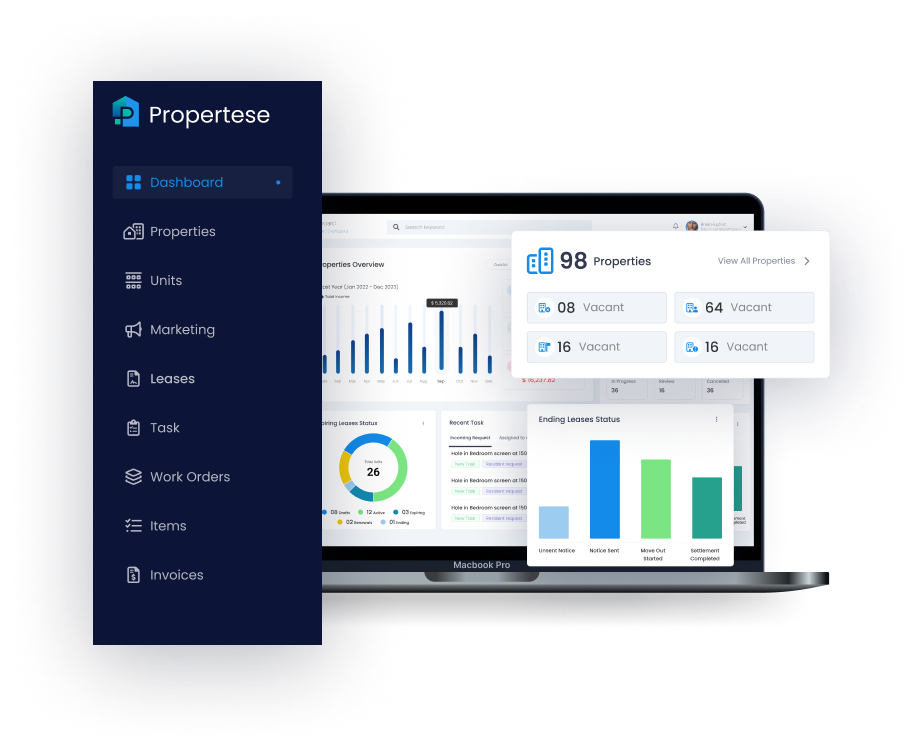
Propertese is purpose-built property management software that runs natively on NetSuite. It is not a standalone application with a NetSuite connection attached after the fact. The platform was designed from the ground up with NetSuite as its financial backbone, which means every operational transaction in Propertese surfaces in NetSuite’s general ledger in real time.
For property management firms with multi-owner portfolios, this architecture resolves the core trust accounting challenges in several concrete ways.
Subsidiary-Level Financial Segregation
Propertese maps each company or ownership entity in your portfolio to a corresponding NetSuite subsidiary. Financial data is segregated at the entity level within the ERP, not simulated through account naming conventions or manual tagging, but enforced through NetSuite’s native multi-subsidiary architecture. Revenue, expenses, and net operating income for each owner relationship are tracked separately and consolidated only when you choose to view them that way.
Property and Unit-Level GL Mapping
Every property and unit in Propertese carries its own GL account map into NetSuite. Rent invoices, vendor bills, maintenance expenses, and payment receipts are posted to the correct subsidiary, property, and unit automatically. This is the ledger-level owner isolation that regulatory compliance requires, built into the data model rather than enforced through manual discipline.
Automated Revenue Recognition and Deferred Revenue Management
Prepaid rent and deferred revenue are handled automatically. When a tenant pays ahead, the system recognizes revenue in the correct future period rather than pulling it into the current month. This eliminates one of the most common sources of owner statement errors and prevents misrepresentation of owner account balances.
Real-Time Financial Synchronization
Because Propertese operates natively with NetSuite, there is no batch sync, no manual export, and no reconciliation gap between the operational system and the financial system. When a payment is received in Propertese, it is reflected in the NetSuite general ledger automatically. When a vendor bill is created, it flows into NetSuite’s accounts payable immediately. The trust account sub-ledger and the ERP ledger are always in agreement.
Automated Rent Collection and Payment Tracking
Late fee automation, payment reminders, bounced check tracking, and accounts receivable aging are all managed within Propertese and synchronized with NetSuite. This reduces the manual intervention required in the collections process and ensures that the trust account balance reflects actual collected funds rather than expected payments.
Owner Statement Automation
Owner statements in Propertese are generated from the underlying transaction data in NetSuite. There is no manual compilation, no spreadsheet assembly, and no risk of the statement diverging from the actual ledger. Each owner receives an accurate summary of income received, expenses allocated, management fees deducted, and distributions made, all traceable to the source transaction.
Multi-Portfolio Visibility Without Ledger Contamination
For firms with portfolios that span multiple ownership structures, individual owners, investment funds, syndicates, and institutional clients, Propertese supports consolidated financial reporting across all entities without requiring the fund separation between those entities to be compromised. You can see the full portfolio picture at the top level while maintaining complete financial isolation between owner relationships at the sub-ledger level.
The NetSuite integration also means that firms already on NetSuite do not need to operate a separate financial system for property management. The operational and financial layers work in the same environment, with the same data, under the same chart of accounts.
IMPLEMENTATION ADVANTAGE: For firms already on NetSuite, Propertese is additive rather than disruptive. There is no parallel accounting system to maintain. Property operations and enterprise finance operate on the same ledger.
Conclusion
Trust accounting for multi-owner portfolios is ultimately an architecture problem. The firms that stay audit-ready, retain owner confidence, and scale without rebuilding their financial infrastructure from scratch are not the ones with the most diligent staff. They are the ones whose systems enforce the rules automatically.
The separation of owner funds at the sub-ledger level, the real-time reconciliation between operational data and the general ledger, the automated disbursement schedules that prevent constructive commingling, the owner statements generated directly from source transactions rather than assembled manually: none of these outcomes is achievable through willpower and spreadsheets at any serious portfolio size. They require a platform that was built with this problem in mind.
Propertese was built precisely for this. As a property management platform that operates natively on NetSuite, it gives you the operational control your team needs and the financial compliance architecture your regulators require, without asking you to manage two systems, two sets of books, or two reconciliation processes. If your portfolio has grown to the point where your current property accounting software is the weakest link in your compliance chain, it is worth a conversation.
Talk to the Propertese team about how the platform handles trust accounting, multi-owner fund separation, and NetSuite-native financial reporting for portfolios at your scale.
Table of Contents
Stay Updated
Subscribe to get the latest news, industry trends, blog posts, and updates...