Real estate waterfall distribution models define how investment cash flows are divided between limited partners (LPs) and general partners (GPs). These tiered payout systems ensure capital recovery and preferred returns before performance-based profits are distributed.
A distribution waterfall outlines the contractual order of allocation, typically moving through return of capital, preferred return, catch-up, and promote tiers. This structured approach promotes transparency, aligns interests, and rewards strong performance.
In practice, waterfall distributions allocate cash flow and carried interest between LPs and GPs through a predictable sequence to support investor protection and incentive-based growth.
A typical waterfall sequence:
Return of capital → Preferred return → Catch up → Promote
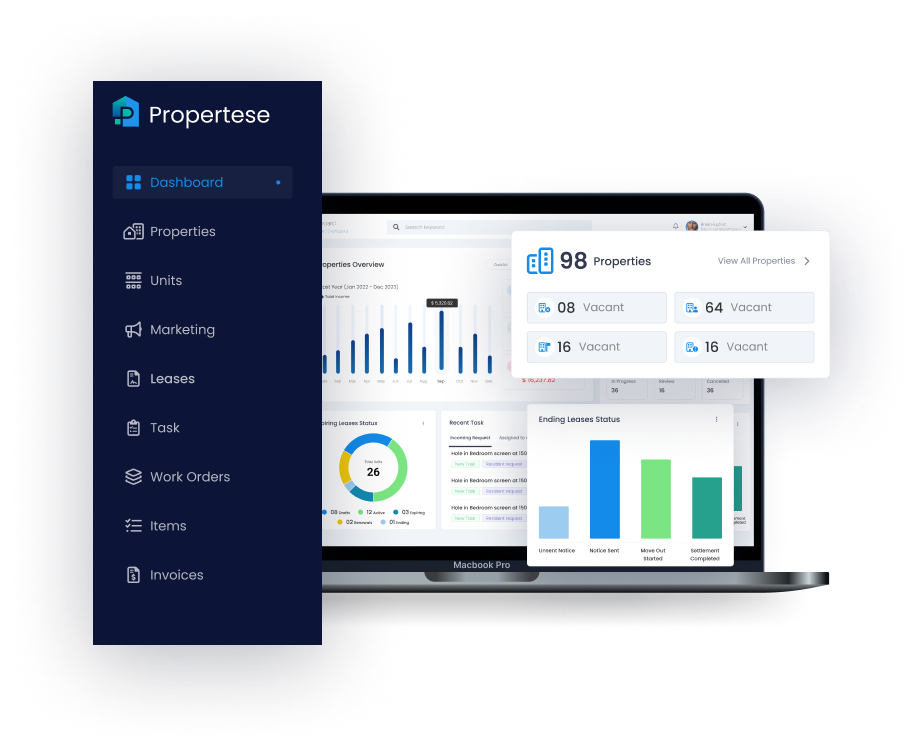
With integrated financial and investment tracking tools such as those available in Propertese, users can model and monitor these real estate waterfall distribution models to ensure accuracy and compliance across projects.
Key takeaways:
- Real estate waterfall distribution models set a clear order for paying capital, preferred returns, and promos.
- LPs receive priority returns, and GPs earn more as performance improves.
- Hurdle rates and catch-up terms shape the timing and size of GP promotion.
- Tools like Propertese help teams test terms and confirm fair payouts.
LP/GP split structures explained
The LP/GP split determines how profits are divided at each tier in real estate waterfall distribution models. LPs usually provide most of the capital and receive priority distributions, while GPs who manage the investment earn larger participation as returns increase.
| Tier | LP share | GP share | Typical trigger |
|---|---|---|---|
| Return of capital | 100% | 0% | LP recovers all capital |
| Preferred return | 100% | 0% | LP achieves 7 to 10 percent IRR |
| GP catch up | 0 to 50 percent | 50 to 100 percent | GP catches up to target promote |
| Promote (residual) | 70 to 80 percent | 20 to 30 percent | Above a higher IRR hurdle |
A promote, or carried interest, is the GP’s share of profits above a performance threshold. For instance, a 20 percent promotion gives the GP one-fifth of profits after investors reach the agreed return, regardless of the GP’s smaller equity stake.
Split ratios such as 90/10 or 95/5 on early tiers typically evolve to 80/20 or 70/30 promotions at higher IRRs, which increases GP incentives as performance improves.
Hurdle rates and preferred returns
In real estate waterfall distribution models, hurdle rates or preferred returns set the minimum annualized return that LPs must earn, usually between 7 and 10 percent, before GPs receive promotional distributions. The industry average sits near 8 percent.
Preferred returns may be cumulative, which carry forward unpaid amounts, or non-cumulative, which forfeit unearned portions. Institutional deals generally favor cumulative models for greater investor protection.
| IRR tier | LP share | GP share | Example split |
|---|---|---|---|
| 0 to 8 percent | 100% | 0% | Only LP receives returns |
| 8 to 12 percent | 90% | 10% | Minor GP participation |
| 12 to 15 percent | 80% | 20% | Moderate GP promote |
| 15 percent plus | 70% | 30% | Greater GP share |
Roughly 85 percent of funds benchmark these hurdles using IRR, which reinforces performance alignment over simple profit multiples.
Catch-up mechanics and their impact
Once LPs achieve their preferred return in real estate waterfall distribution models, the GP usually enters a catch-up phase and receives subsequent profits until reaching their pro rata share. In a 100 percent catch-up, GPs receive all profits until their promotion level is met; in partial catch-ups, such as 50/50, payouts are shared proportionally.
Catch-up design, including percentage and methodology, strongly affects payout timing. Modern vintages average around a 55 percent catch-up, which fosters faster compensation when performance exceeds expectations while maintaining investor alignment.
Platforms like Propertese enable transparent simulation of catch-up scenarios, which help managers validate distribution timing before real transactions.
Key waterfall model types: American, European, and hybrid
Different waterfall types vary in how and when carried interest is paid in real estate waterfall distribution models:
- American (deal by deal): GP receives a promotion once each deal exits successfully. This speeds up payments but may trigger clawbacks if later deals underperform.
- European (whole fund): GP earns promotion only after LPs recover capital and preferred returns across the full fund, which provides greater protection for investors.
- Hybrid models: Combine both structures to balance faster GP incentives with portfolio-level safeguards.
| Waterfall type | Payment timing | Risk profile | LP protection | GP incentive speed |
|---|---|---|---|---|
| American | Per deal exit | Higher clawback risk | Moderate | Fast |
| European | After total fund return | Lower | High | Slow |
| Hybrid | Conditional or tiered | Medium | Balanced | Balanced |
Investor protections in waterfall agreements
Investor safeguards maintain equitable distributions and minimize disputes. Essential provisions include:
- Cumulative preferred returns – Carry forward unpaid returns until met.
- Clawback provisions – Require GPs to return excess promotion if later performance declines.
- Lookback provisions – Allow LPs to reclaim overpaid promote proceeds at fund close.
- Escrow arrangements – Hold carried interest until performance outcomes are validated.
Clearly defining recycled capital, fee offsets, and performance metrics helps maintain fairness and reduce over-distribution risk. Propertese supports this precision through its integrated financial reporting and audit-ready workflows.
Practical considerations for drafting and modeling waterfalls
Accurate real estate waterfall distribution models depend on clarity and controlled variables. Key practices include:
- Specify whether preferred returns compound and which metric, IRR or equity multiple, applies.
- Define interactions between fees, recycled capital, and expenses in hurdle calculations.
- Model both deal-level and fund-level outcomes to analyze liquidity and clawback risk.
- Keep documentation explicit, especially around catch-up, fee offsets, and clawback mechanics.
Basic modeling workflow:
- Return capital to LPs.
- Apply preferred return.
- Execute GP catch-up.
- Allocate remaining profits per promoted splits.
Comprehensive tools like Propertese simplify this process and enable real-time scenario analysis within the same platform used for property, fund, and tenant management.
Recent trends in hurdle rates and catch-up terms
Post 2020, investor expectations have risen, which reshapes incentive structures. Average hurdles hover around 8.7 percent for opportunistic funds and 6.5 percent for debt or core strategies. GP equity stakes, now often 5 to 20 percent, show strengthened alignment.
Catch-up speeds have also increased, with an average of 55 percent GP participation. Meanwhile, investors increasingly favor escrowed, promoted payments and refined definitions to safeguard distribution fairness.
Key considerations ahead:
- Higher hurdle thresholds across strategies.
- Detailed catch-up and clawback provisions.
- Increased use of fund-level or hybrid waterfall designs for better transparency.
Frequently asked questions
What is a distribution waterfall in real estate investing?
A distribution waterfall defines the structured order in which profits flow to LPs and GPs based on specific performance milestones.
How do LP/GP split structures typically work across tiers?
LPs first receive capital and preferred returns, then profits transition to shared tiers as GPs earn catch-up and promote allocations.
What does cumulative preferred return mean for investors?
It ensures unpaid preferred returns carry forward until satisfied, which guarantees LPs receive full entitlements before GPs earn promoted income.
How does catch-up affect the timing of general partner earnings?
Catch-up phases accelerate GP participation once LPs achieve their preferred return, which aligns timing with performance.
Why are clawback and escrow provisions important in waterfall models?
They ensure fair, verified distributions by requiring overpaid promotion amounts to be returned if final performance falls short. Propertese helps track and document these provisions for compliance and transparency.
Conclusion
Real estate waterfall distribution models work best when the terms are clear, tested, and easy to audit. If you want a simple way to build, test, and track your waterfall terms from preferred return through promote, Propertese can help you model scenarios, confirm payout order, and share results with stakeholders without friction.
Table of Contents
Stay Updated
Subscribe to get the latest news, industry trends, blog posts, and updates...