Understanding the duration and stability of property income and financing is fundamental to effective portfolio management. Two key metrics, Weighted Average Lease Term (WALT) and Weighted Average Life (WAL), help measure how long rental income or principal repayments are expected to continue before renewal or repayment. This article explains these measures, how to calculate them, and how they inform real-world decisions for property managers, lenders, and investors. With accurate WALT and WAL insights, teams can anticipate cash flow shifts, align leasing and finance strategies, and reduce exposure to manageable portfolio risks.
Key takeaways
- WALT shows how long current rental income lasts before expenses start to affect cash flow.
- The weighted average life shows the average time to recover the loan principal.
- Compare WALT and WAL to spot duration alignment risk across assets and debt.
- Use both metrics to guide renewals, refinance plans, and capital allocation.
Understanding Weighted Average Lease Term (WALT)
WALT measures the average remaining lease duration across a property portfolio, weighted by each lease’s economic importance, typically its annual rent or leased area. It answers a straightforward question: how long will current rental income continue before expirations begin to affect cash flow?
A higher WALT generally signals greater income stability and gives investors and asset managers confidence that a property’s earnings are secure for several years. Lenders view this as a proxy for refinancing safety, while portfolio managers use it as an early indicator of upcoming leasing activity. In short, WALT distills complex rent rolls into one duration figure that captures both occupancy risk and timing.
Calculating Weighted Average Lease Term
The basic formula for WALT is:
WALT = Σ(Remaining Lease Term × Lease Weight) ÷ Σ(Lease Weights)
Lease weights reflect each tenant’s relative contribution to income or area. A manager can apply rent-based weights to prioritize financial exposure or area-based weights to capture physical occupancy risk.
Example:
| Tenant | Annual Rent ($M) | Remaining Lease Term (Years) | Rent Weight | Weighted Term |
|---|---|---|---|---|
| A | 5 | 10 | 5 | 50 |
| B | 1 | 2 | 1 | 2 |
| C | 1 | 1 | 1 | 1 |
Total weight = 7
WALT = (50 + 2 + 1) ÷ 7 = 7.6 years
Regional naming conventions vary: WAULT (Weighted Average Unexpired Lease Term) and WALE (Weighted Average Lease Expiry) often serve similar purposes, differing mainly by reference point and terminology.
Practical uses of WALT in portfolio management
A strong WALT underpins financial stability and marketability. Property managers, investors, and banks use it in different but complementary ways:
- Underwriting and valuation: Analysts compare WALT across assets to assess cash-flow durability and justify yields.
- Rent roll analysis: Identifies clusters of expiring leases to target renewals or marketing campaigns.
- Vacancy forecasting: Highlights concentrated expirations that could disrupt income streams.
- Strategic allocation: Differentiates long income (“core”) assets from short lease (“value add”) investments.
When debt maturities extend beyond a property’s WALT, lenders often identify misalignment risk, and rental income may decline before loan payoff.
Understanding Weighted Average Life (WAL)
Weighted Average Life (WAL) assesses how long it takes, on average, to recover principal from an amortizing loan. Each repayment is weighted by its size and timing, so WAL illustrates how principal risk unfolds through the life of a loan.
WAL is primarily used by credit risk analysts and lenders to evaluate portfolio liquidity and interest rate exposure. In essence, while WALT measures when leases expire, WAL shows when funds are repaid.
Calculating Weighted Average Life
The formula for WAL mirrors WALT’s logic but substitutes lease terms with principal cash flows:
WAL = Σ(Principal Repayment × Time until Repayment) ÷ Total Principal
The result is expressed in years. WAL is typically longer than the Macaulay duration because it directly accounts for principal repayment timing.
Example:
| Year | Principal Repaid ($M) | Time (Years) | Weighted Product |
|---|---|---|---|
| 1 | 2 | 1 | 2 |
| 2 | 3 | 2 | 6 |
| 3 | 5 | 3 | 15 |
Total principal = 10
WAL = 23 ÷ 10 = 2.3 years
WAL is sensitive to amortization schedules and prepayment patterns. Accelerations shorten WAL, increase liquidity recovery, and also alter expected yield.
For a deeper look at weighted average life calculation in debt and fixed income, explore our guide.
Practical uses of WAL in loan and risk management
Financial institutions incorporate WAL into many risk processes because it captures both the time and exposure dimensions of debt repayment. Its main applications include:
- Liquidity and duration matching: Comparing WAL of assets and liabilities prevents funding mismatches.
- Stress tests: Scenario models apply WAL to simulate the effects of prepayments or refinance shifts.
- Provisions and credit forecasts: Drive expected credit loss models under CECL frameworks.
By monitoring WAL alongside maturity distribution, lenders better understand exposure to refinancing cliffs or concentrated principal repayments.
Key limitations and considerations for WALT and WAL
Both metrics simplify complex portfolios into a single average, which can conceal concentration risks. For example, two portfolios could share the same WALT even if one has a cluster of expiries next year and another is evenly staggered across a decade. Similarly, WAL does not account for borrower credit quality or prepayment behavior beyond timing.
To strengthen interpretation, portfolio managers should pair these averages with:
- Tenancy or borrower concentration ratios
- Expiry or repayment ladders
- Credit or covenant quality indicators
Averages are diagnostic tools, not risk eliminators.
Best practices for using WALT and WAL together
When combined, WALT and WAL form a powerful framework for duration risk oversight. For property-backed loans, managers should compare the WALT of underlying leases with the WAL of associated debt structures. Misalignment, when debt outlasts leases, signals refinancing or covenant risk.
Integrating both metrics into performance dashboards supports real-time stress tests and informed decisions. Additional best practices include:
- Supplement averages with detailed lease or cash flow schedules
- Visualize exposure via expiry and amortization charts
- Incorporate WALT/WAL trends into capital allocation reviews
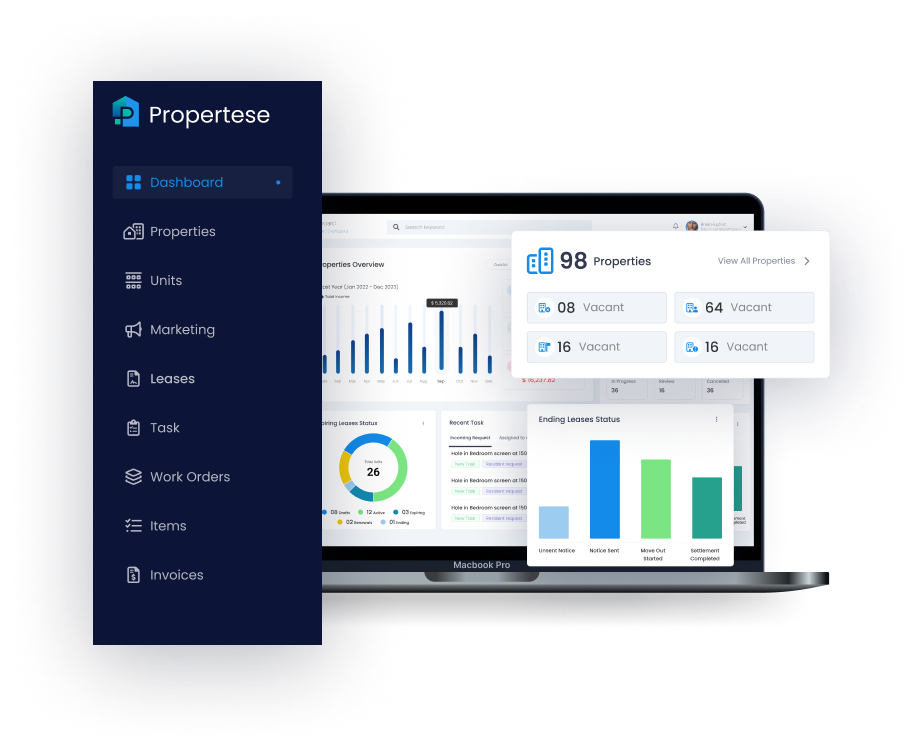
In Propertese, users can view both metrics side by side on dynamic dashboards and apply filters to identify short-duration risk pockets long before they affect cash flow.
Incorporating WALT and WAL into property management workflows
Modern property management platforms make it easy to track WALT and WAL. Within Propertese, real-time lease and financial data automatically update both metrics, so dashboards reflect current performance.
Teams can set automated alerts for leases that are near expiry or loans whose WAL exceeds acceptable limits. This enables coordination between leasing, finance, and asset management. Custom workflows flag short WALT exposures early. This strengthens compliance, forecasts, and risk oversight.
Learn more about automation of portfolio risk analytics in our Accounting & Financial Management resources.
Frequently asked questions
What is the difference between Weighted Average Lease Term and Weighted Average Life?
Weighted Average Lease Term measures average lease duration, while Weighted Average Life measures the average time to recover principal from a loan.
How do WALT and WAL help assess portfolio duration risk?
WALT captures exposure to lease expiries, and WAL identifies timing risk in loan repayments, together they show how income and obligations align.
Why are weighted averages preferred over simple averages for these metrics?
Weighting ensures larger leases or loans influence results proportionally, giving a more accurate picture of exposure.
What does a long or short WALT or WAL indicate about portfolio risk?
A long duration signals steady, predictable income or repayments; a short one highlights potential near-term turnover or refinancing volatility.
How do lease breaks or loan prepayments impact WALT and WAL calculations?
Early terminations shorten WALT, and prepayments shorten WAL; both bring future risks forward and compress duration stability.
Conclusion
WALT and weighted average life give a clear view of how income and debt line up over time. When you track both on the same screen, you reduce surprises and plan renewals and refinances with confidence. Propertese brings these metrics into one place with real-time data and alerts so your team acts early and stays aligned. If you want a simple way to put this into practice, get in touch to see Propertese in action.
Table of Contents
Stay Updated
Subscribe to get the latest news, industry trends, blog posts, and updates...