ASC 842 Compliance for Real Estate: What CFOs Need to Know

Key Takeaways

  • ASC 842 requires real estate companies to recognize operating leases on the balance sheet as right-of-use assets and lease liabilities. This changes how lenders and investors interpret financial statements.
  • Commercial real estate leases are harder to classify under ASC 842 than standard office or equipment leases. Escalation clauses, free-rent periods, and CAM structures all affect the lease liability calculation.
  • Every lease modification, renewal, or early termination requires recalculating the right-of-use asset and lease liability. Tracking these changes in spreadsheets increases compliance risk as the portfolio grows.
  • Most real estate portfolios include a mix of operating and finance leases. Incorrect classification affects both the income statement and the balance sheet.
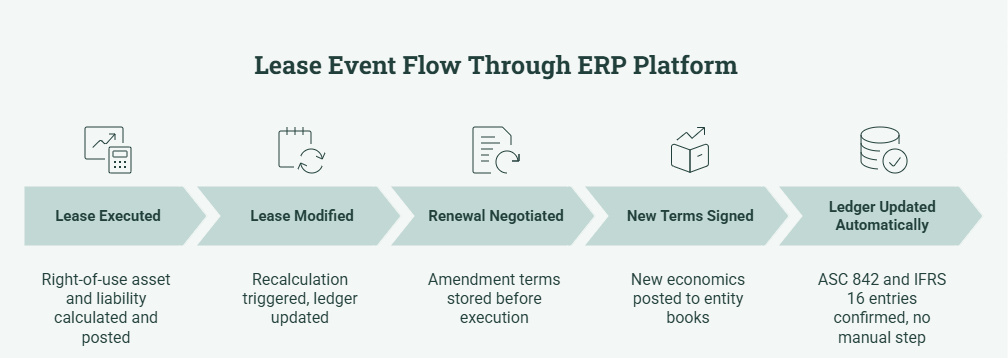
  • Propertese is built on NetSuite’s financial infrastructure. ASC 842 journal entries post directly to the general ledger whenever a lease event occurs, without a separate manual step.

In 2019, a large commercial real estate company discovered during an audit that seventeen of its ground leases had been classified incorrectly under ASC 842. The entries had been posted manually in a spreadsheet alongside the property management system. Nobody had caught the error because the numbers looked reasonable. The restatement took four months and cost more in accounting fees than the company had budgeted for the entire compliance project.

This is not an unusual outcome. ASC 842 has been effective for public companies since 2019 and for private companies since 2022, but real estate portfolios present specific challenges that standard lease accounting templates do not handle well. Ground leases, percentage rent clauses, stepped escalations, and CAM structures all affect the liability calculation in ways that require careful interpretation rather than standard data entry.

Real estate CFOs managing ASC 842 real estate leases across large commercial portfolios are responsible for getting this right. This post covers what ASC 842 real estate leases require, where the complexity lives, and what a compliant process looks like in practice.

What Is ASC 842 and Why Does It Matter for Real Estate?

ASC 842 is the lease accounting standard issued by the Financial Accounting Standards Board (FASB) that requires companies to recognize most leases on the balance sheet. Under the previous standard, operating leases were kept off the balance sheet entirely. Under ASC 842, they appear as both a right-of-use asset and a corresponding lease liability.

For real estate companies, this matters in two ways. First, as tenants, any office space, equipment, or land held under an operating lease must now appear on the balance sheet. Second, as landlords or operators managing leases on behalf of owners, the accounting treatment of each lease affects how financial statements are read by lenders, investors, and auditors.

The standard became effective for public companies in fiscal years beginning after December 15, 2018, and for private companies in fiscal years beginning after December 15, 2021. Most real estate portfolios are now well past the adoption deadline, but ongoing compliance, particularly around lease modifications and renewals, remains a common source of accounting errors.

How Does ASC 842 Apply to Commercial Real Estate Leases?

ASC 842 applies differently depending on whether a real estate company is acting as a lessee or a lessor, and the treatment varies significantly between the two roles.

As a Lessee

Any lease of land, buildings, or equipment with a term longer than twelve months must be assessed under ASC 842. Operating leases, which represent the majority of commercial real estate arrangements, generate a right-of-use asset and a lease liability on the balance sheet. Finance leases generate a right-of-use asset that is amortized separately from the lease liability interest.

As a Lessor

Lessor accounting under ASC 842 is largely unchanged from the previous standard. Operating leases are recognized on a straight-line basis over the lease term. Sales-type and direct financing leases follow a different treatment that most commercial real estate operators do not encounter frequently.

Understanding how lease terms translate into specific financial entries is the foundation of ASC 842 compliance. The difference between how net effective rent and face rent are calculated, for example, affects what gets recognized in the liability calculation. The breakdown of net effective rent versus face rent covers exactly how this plays out in commercial lease structures and where the numbers can diverge from what the lease document appears to say.

What Are the ASC 842 Requirements for Real Estate Companies?

The ASC 842 requirements that affect real estate companies most directly fall into four categories. Understanding how each one applies to ASC 842 real estate leases is the starting point for building a compliant process.

1. Lease Identification

Every contract that conveys the right to control an identified asset for a period of time in exchange for consideration must be assessed under ASC 842. In real estate, this means ground leases, building leases, parking arrangements, and certain equipment leases. The identification step is where most errors start because teams apply the old standard’s judgment rather than ASC 842’s specific criteria.

2. Lease Classification

Once a lease is identified, it must be classified as either an operating lease or a finance lease. The classification test involves five criteria relating to ownership transfer, purchase options, lease term, present value of payments, and asset specialization. Most commercial real estate operating leases are classified as operating leases, but ground leases and long-term land arrangements can meet the finance lease criteria.

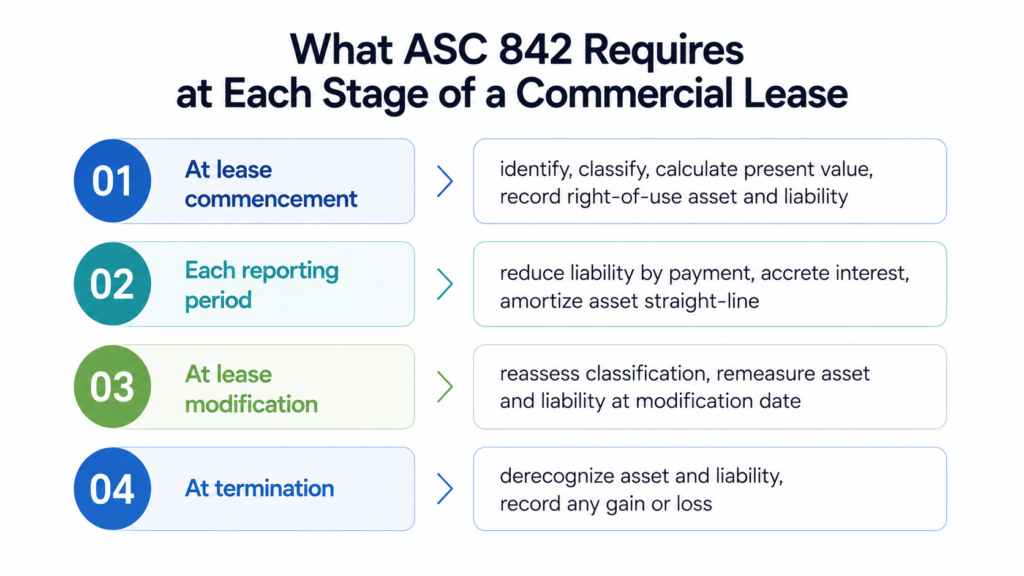
3. Initial Measurement

At lease commencement, the lessee must calculate the present value of all future lease payments using the implicit rate in the lease or the incremental borrowing rate. This produces the initial lease liability. The right-of-use asset is then calculated as the lease liability plus initial direct costs plus prepaid lease payments, minus lease incentives received.

For guidance on the incremental borrowing rate calculation and how discount rate selection affects these numbers, the post on discount rate selection in real estate DCF models covers the underlying principles that apply to ASC 842 present value calculations as well.

4. Subsequent Measurement

After initial recognition, the lease liability is reduced by lease payments and increased by interest accretion each period. The right-of-use asset is amortized on a straight-line basis for operating leases. Any lease modification, including a change in lease term, payment amount, or scope, requires reassessment and remeasurement of both the asset and the liability.

This is where commercial real estate creates real complexity. A portfolio with rent escalation clauses, free-rent periods, tenant improvement allowances, and CAM structures requires ongoing recalculation, not a one-time setup.

ASC 842 requirements at each commercial lease stage

What Makes Real Estate Lease Classification So Difficult?

Standard ASC 842 guidance assumes relatively simple lease structures, but ASC 842 real estate leases in commercial portfolios are rarely simple.

1. Escalation Clauses

Stepped rent increases and CPI-linked escalations affect the total lease payments used in the present value calculation. Under ASC 842, fixed escalations are included in the liability calculation while variable CPI-linked increases are excluded until they take effect. Getting this distinction right requires reading the lease carefully, not applying a standard formula.

2. Free-Rent Periods

Free-rent periods at lease commencement are common in commercial real estate as a tenant incentive. Under ASC 842, the right-of-use asset and lease liability are still calculated based on total payments over the full lease term. The straight-line rent expense smooths the free-rent period across the entire term, which means the income statement looks different from the cash flow statement during the free-rent period.

3. Tenant Improvement Allowances

TI allowances paid by the landlord to the tenant affect the lease liability calculation on the lessee side. Under ASC 842, landlord TI allowances are treated as lease incentives that reduce the right-of-use asset at commencement. Tracking these correctly requires connecting lease terms to the accounting entries, not treating them as separate transactions.

For real estate portfolios where TI allowances and escalation schedules are part of every lease, having lease and rental management built into the accounting platform means these items live in the same record as the ASC 842 entries rather than in separate tracking files that need manual reconciliation at period end.

4. CAM Structures

Common area maintenance (CAM) charges are variable lease payments under ASC 842. Their actual amount depends on operating expense actuals. They are excluded from the lease liability calculation. However, CAM estimates used for lease billing should be tracked separately from ASC 842 entries. This prevents double-counting in the financial statements.

For commercial portfolios, CAM accounting requires separate treatment for variable and fixed payments. Keep variable CAM charges separate from fixed lease payments in the general ledger.

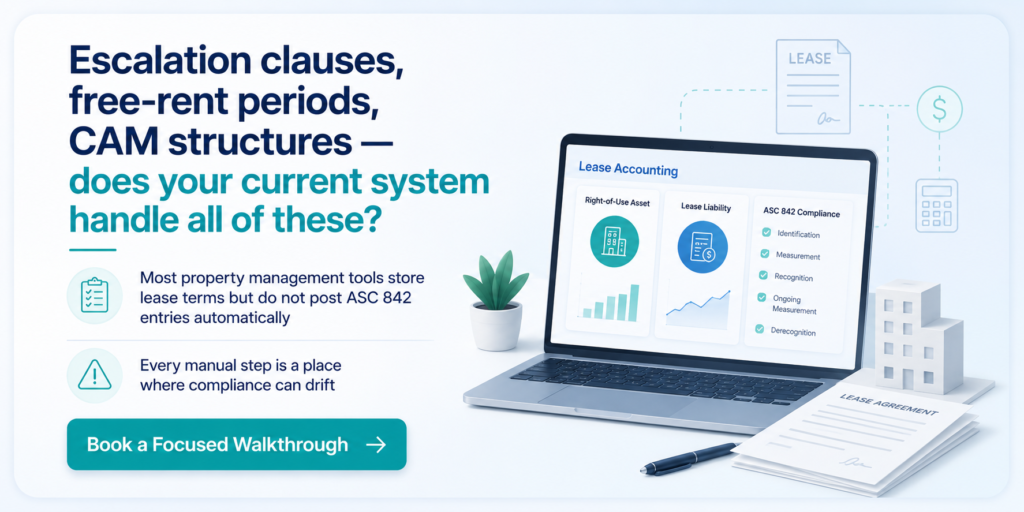
Post ASC 842 entries automatically

What Does ASC 842 Compliance Look Like for a Commercial Portfolio?

A compliant ASC 842 process for a mid-size commercial real estate portfolio involves several interconnected steps that must work consistently across every lease event.

1. At Lease Commencement

When a new lease begins, the finance team must identify and classify the lease. They must calculate the present value of future payments using the appropriate discount rate. They also record the initial right-of-use asset and lease liability. Finally, they document the assumptions and calculation inputs.

For a portfolio with hundreds of active leases, this process needs to be systematic rather than manual. Affordable housing operators and community associations, who face both ASC 842 and additional regulatory requirements, benefit particularly from having compliance-grade lease accounting built into the platform rather than managed in separate spreadsheets.

2. At Each Reporting Period

Every month, the lease liability must be reduced by the payment amount and increased by interest accretion at the discount rate used at commencement. The right-of-use asset is amortized on a straight-line basis. The journal entries for each lease must post to the general ledger accurately and consistently.

3. At Each Lease Event

Any modification to the lease terms, including a change in rent, a lease extension, an early termination, or a change in scope, requires the finance team to reassess the lease classification and remeasure the right-of-use asset and lease liability as of the modification date.

This is where manual processes break down. A portfolio with active lease management, where renewals and amendments are regular occurrences, generates modification events continuously. Tracking each one accurately in a spreadsheet creates accumulating risk that eventually surfaces during an audit.

How Do Real Estate Companies Implement ASC 842 at Scale?

For real estate companies managing dozens or hundreds of ASC 842 real estate leases, the implementation question is less about understanding the standard and more about building a process that handles ongoing compliance without requiring constant manual intervention.

What a Scalable Process Requires

  • A single lease record that connects the legal terms to the accounting entries
  • Automatic recalculation and journal entry posting when lease events occur
  • A discount rate library that maintains the rate used at commencement for each lease
  • An audit trail that traces every entry back to the lease event that triggered it
  • Consolidated reporting that shows ASC 842 balances by property, entity, and portfolio

Where Most Real Estate Companies Struggle

The most common failure in ASC 842 implementation at scale is not the initial adoption but the ongoing maintenance. Teams adopt the standard, calculate the initial entries, and then manage subsequent events in the same spreadsheets they used before. Different team members record lease modifications in different ways. They also apply different discount rates between lease events. As a result, the right-of-use asset balance can drift from the spreadsheet because someone used a different calculation method.

Propertese is built on NetSuite’s financial infrastructure, which means ASC 842 entries post directly to the general ledger when a lease event occurs. Seeing how the financial backbone handles lease accounting makes the difference between a one-time setup and an ongoing compliance process clearer than any description can.

Frequently Asked Questions

What is ASC 842 in simple terms? 

ASC 842 is an accounting rule that requires companies to put most leases on their balance sheet. Before this rule, operating leases were kept off the balance sheet. Now they appear as an asset and a matching liability.

Does ASC 842 apply to real estate companies? 

Yes, on both sides. As tenants, real estate companies must recognize any lease longer than twelve months on the balance sheet. As landlords, the way they account for leases they grant to tenants changes depending on the lease type.

What is a right-of-use asset in real estate? 

A right-of-use asset is the balance sheet entry that represents a company’s right to use a leased property for the duration of the lease. It is calculated as the present value of future lease payments, adjusted for initial direct costs and lease incentives.

How does ASC 842 handle CAM charges? 

ASC 842 treats CAM charges as variable lease payments because the actual amount varies. The standard excludes them from the lease liability calculation. However, include fixed CAM estimates when the lease states them as fixed amounts.

How does ASC 842 treat a lease modification?

A lease modification requires reassessment of the lease classification and remeasurement of both the right-of-use asset and the lease liability as of the modification date. The new calculation uses the facts and circumstances at the modification date, including the discount rate in effect at that time.

How does ASC 842 differ from IFRS 16?

Both standards require operating leases on the balance sheet, but IFRS 16 treats all leases as finance leases on the income statement while ASC 842 maintains a distinction between operating and finance leases. For US-based real estate companies, ASC 842 applies. For international operations, IFRS 16 may apply instead.

ASC 842 Is an Ongoing Commitment, Not a One-Time Project

The initial adoption of ASC 842 is the start, not the finish. Every lease event, modification, renewal, and termination requires the same careful calculation that the first entry required. For real estate portfolios where lease events happen regularly, that means ASC 842 compliance needs to be built into the daily workflow rather than handled as a periodic project.

If the current process relies on spreadsheets to track those events and calculate the entries manually, the compliance risk grows with every lease that changes.

Talk to Propertese about what ASC 842 compliance looks like when lease accounting is part of the platform rather than a separate process running alongside it.

Why Real Estate Finance Teams Are Drowning in Spreadsheets

Key Takeaways

  • Real estate finance spreadsheets are a symptom of disconnected tools that do not share data automatically, not the root problem in themselves.
  • Spreadsheet errors in real estate compound silently, and a wrong formula in January can quietly become a billing dispute by March.
  • Each new entity or investor makes the problem worse, not better.
  • The fix is fewer tools that share the same data, not more tools added to a stack that is already fragmented.
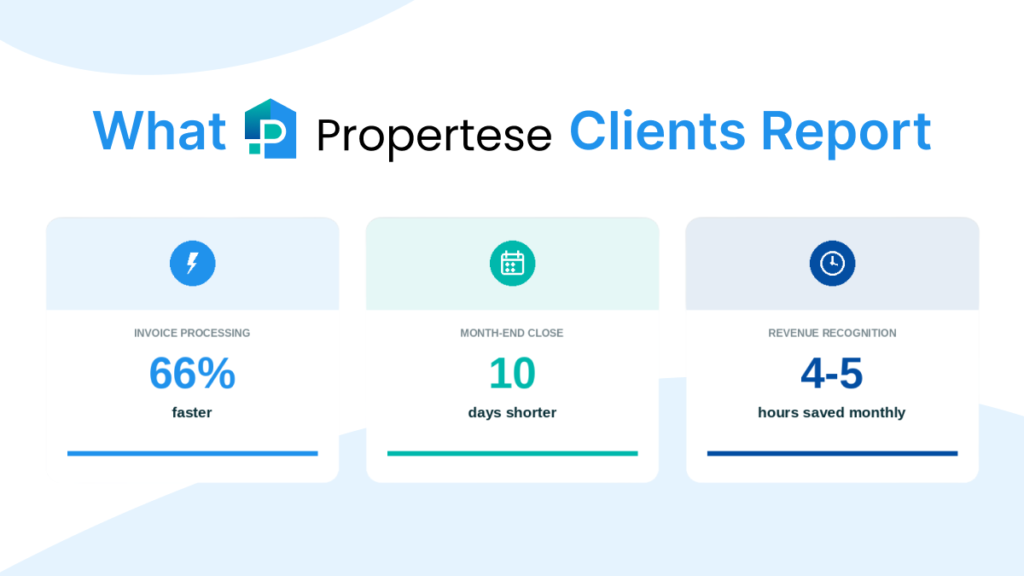
  • Propertese clients report month-end close running 10 days shorter and invoice processing 66% faster after switching to a single connected platform.

In 1996, a single spreadsheet error at a UK investment bank caused a $24 million loss. The mistake was a misplaced formula that went undetected because nobody was checking whether the numbers coming out matched reality. They looked right but they were not.

Most real estate finance teams are not managing investment bank portfolios. But they are running the same risk, at a smaller scale, every single month.

A formula that pulls from the wrong column. A rent roll that has not been updated since the last lease amendment. An escalation schedule that was correct when it was built two years ago, and nobody has touched it since. These are not catastrophic failures. They are quiet ones that accumulate over months before showing up as a reconciliation discrepancy nobody can trace back.

McKinsey’s CFO Pulse Survey found that a plurality of CFOs report just one-quarter or less of their finance processes are currently digitized or automated, despite nearly all of them having invested in digitization. In real estate, where lease terms are complex, entity structures multiply, and reporting obligations grow with every investor, the gap between what is automated and what should be is wider than in almost any other industry.

Real estate finance spreadsheets are not a technology problem. They are the result of a finance stack that was built one tool at a time, and nobody ever stopped to ask whether those tools were talking to each other.

Why Do Real Estate Companies Still Rely on Spreadsheets?

Spreadsheets do not take over a finance operation suddenly. They take over gradually, one tab at a time, because each individual addition made sense when it was made.

Most real estate businesses start simple, with one entity, a handful of properties, and a rent roll in Excel, and that setup works well at that scale. Then the portfolio grows, a new entity gets added, an investor asks for a separate report. The leasing team tracks renewals in their own file. The accounting team keeps a separate general ledger. The rent roll spreadsheet becomes the connective tissue between all of them because no single platform holds everything at once.

Real estate finance team challenges rarely begin with a visible failure. They begin with a second tab. Then a version saved for a specific investor. Then a formula that references a file only one person on the team knows how to update. By the time the problem is visible, the spreadsheet is load-bearing. Removing any piece of it means rebuilding something else, which nobody has time to do while managing a live portfolio.

What Does Running Finance on Spreadsheets Cost?

The cost of real estate finance spreadsheets is rarely tracked because it does not appear as a line item. It shows up as time, and nobody invoices for the hours a senior accountant spent reconciling two files that should have matched automatically.

Here is what that cost looks like broken down:

1. Month-End Close Runs Longer Than It Should

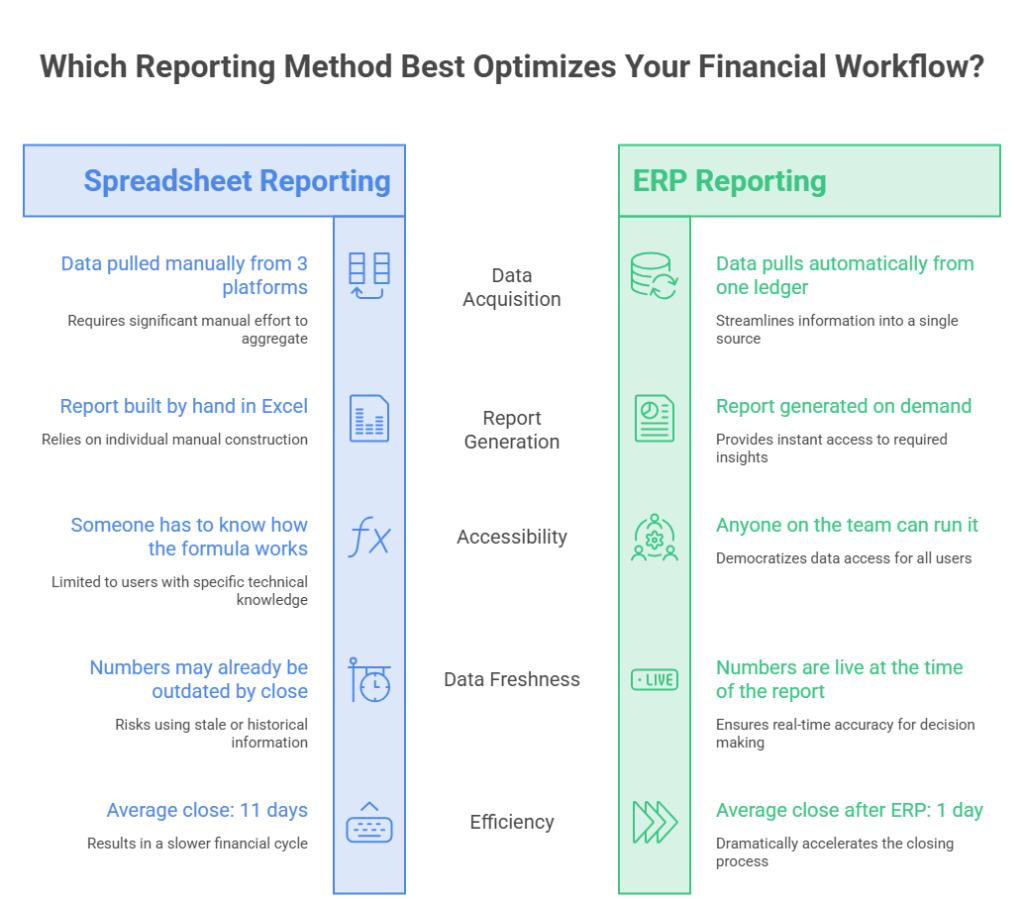
When the general ledger, the rent roll, and the expense tracker each live in different places, someone has to pull them together manually every single month. Propertese clients who moved to a connected platform report month-end close running 10 days shorter. For a senior accountant earning a competitive salary, ten days is a meaningful number before even accounting for the knock-on effect on investor reporting deadlines.

2. Invoice Approvals Create a Backlog No One Can See

When approvals happen over email, the accounting system has no idea they are happening. Invoices queue up in inboxes. Nobody can tell at a glance what is approved and what is waiting. Moving invoice approvals into a connected workflow removes the backlog and creates a full audit trail automatically. Teams that have taken their invoice approval process off email and into a structured workflow report processing invoices 66% faster, based on Propertese client data.

3. Rent Reconciliation Becomes a Monthly Manual Job

For a portfolio with hundreds of tenants, matching payments to ledger entries by hand is a weekly task. It adds nothing to the financial analysis the team should be doing. When rent collection connects directly to the general ledger, every payment posts automatically and the matching step disappears.

4. Investor Reports Become a Project Instead of a Pull

Commercial property management teams reporting to investors face a quarterly ritual of pulling data from multiple sources, standardizing formats, and assembling a report that should come out of the system in minutes. Understanding how much work goes into a single NOI calculation helps explain why this takes so long. The guide on NOI in property management breaks down how many data points feed into that one number. When those data points live in separate spreadsheets, producing a reliable investor report is a construction project, not a report run.

calculate your manual reconciliation cost

Where Do Spreadsheet Errors Do the Most Damage in Real Estate?

Real estate data management errors in spreadsheets rarely appear immediately. The expensive ones build over months before anyone connects the symptom to the source.

1. CAM Reconciliation

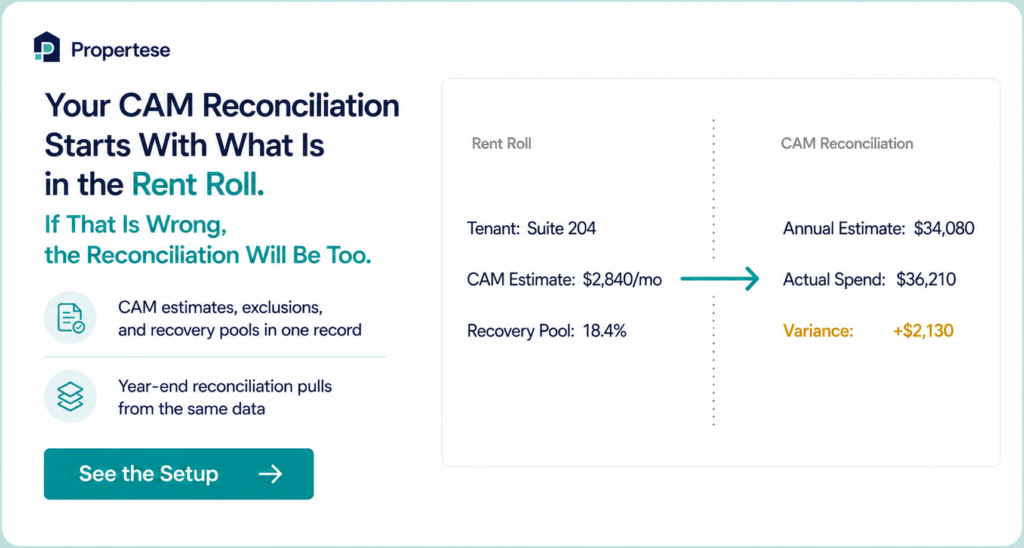
CAM reconciliation depends on expense pool calculations that are often maintained in spreadsheets separate from the lease tracking system. When a lease amendment changes a tenant’s pro-rata share, the spreadsheet needs to be updated manually. If it is not, the annual reconciliation produces incorrect billings. Tenants dispute them and the resolution drags on for months.

2. Rent Escalation Tracking

Lease escalation schedules in spreadsheets miss trigger dates more often than most teams realize. The escalation is recorded in the lease document. The spreadsheet was not updated. The rent collects at the old rate for six months before someone catches it. On a significant rent roll, even a modest miss rate is material uncollected income.

3. Multi-Entity Consolidation

For portfolios running through multiple legal entities, each entity often has its own spreadsheets. Producing a consolidated view means pulling each entity’s data, standardizing formats, and combining results manually. Investment management firms handling fund-level reporting across multiple entities face this every quarter, spending days on a process a connected platform handles automatically.

4. Audit Preparation

When financial records exist across spreadsheets, emails, and separate systems, preparing for an audit means reconstructing the trail from scratch. An auditor asking to trace one specific expense back to its source can turn a two-day audit into a two-week documentation project.

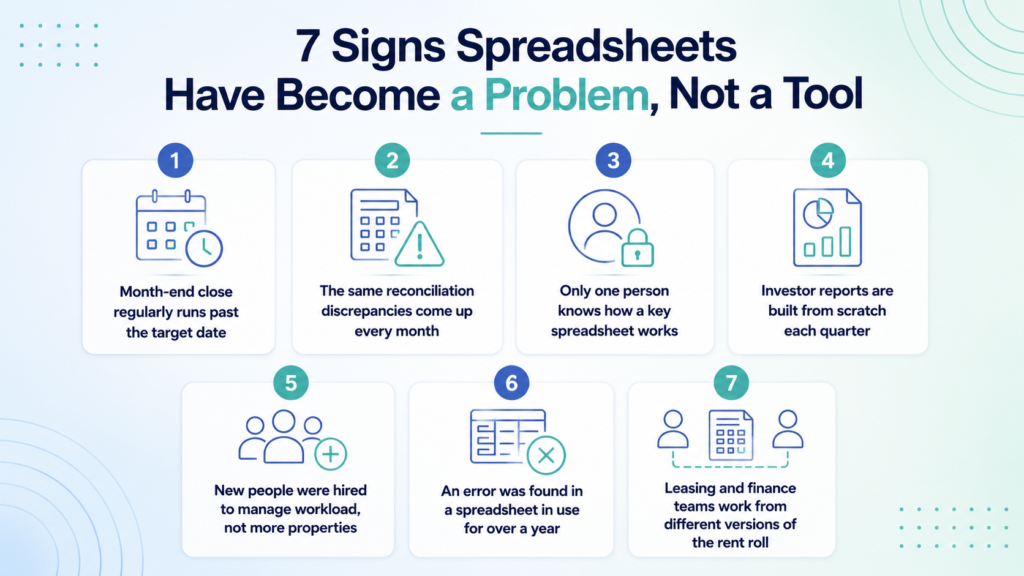
signs to replace spreadsheets with an erp for real estate

How Do Real Estate Teams Move Past Manual Reporting?

Moving past real estate finance spreadsheets does not require replacing everything at once. Most teams that succeed start with the function creating the most friction and build from there.

1. Connect the general ledger to operations first

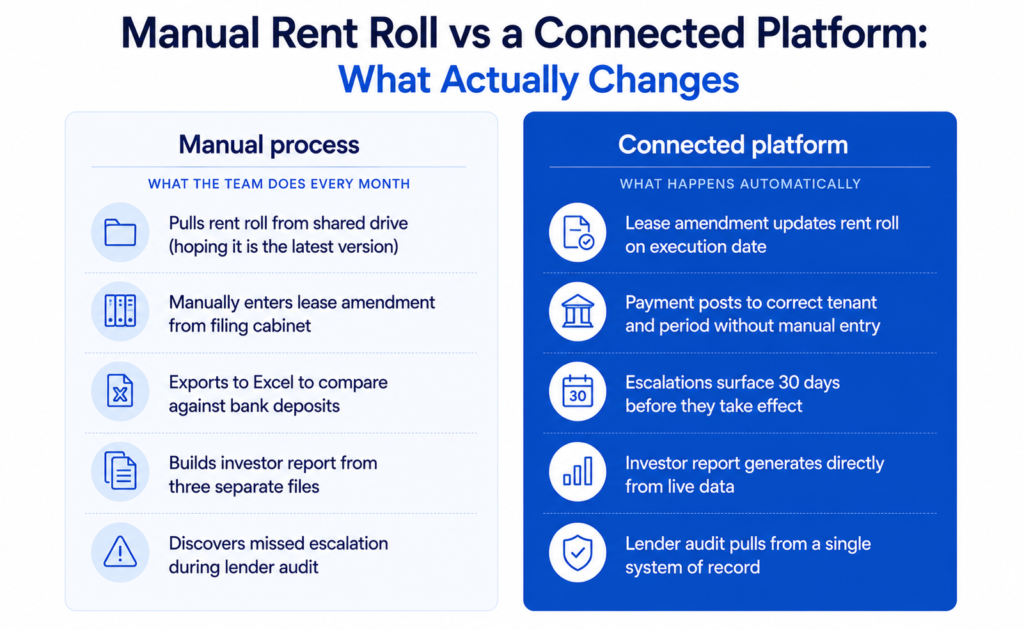
The single change with the broadest impact is connecting property operations to the financial records so data moves automatically rather than manually. When a rent payment or a lease amendment updates the financials as part of the same workflow that recorded it, the reconciliation step disappears. Propertese is built on NetSuite’s financial infrastructure, which means the general ledger, AR, AP, and revenue recognition all run from the same data source as the property operations layer.

For a detailed look at how automated rent collection connects to financial reporting, the post on automating rental income tracking covers what this connection eliminates from the monthly close process and how to set it up.

2. Automate lease event tracking

Rent escalations, renewal deadlines, and option exercise dates should trigger from the lease data automatically, not from someone watching a spreadsheet. When lease events post to the financial records without manual input, the missed escalation problem goes away.

Real estate reporting automation at the lease level is one of the highest-return changes for commercial portfolios because the financial impact of missed events is direct and immediate.

3. Replace the email approval chain

Invoice approvals that happen over email are invisible to the accounting system. Moving them into a connected workflow removes the manual data entry step and creates a complete approval history the accounting team can actually use.

4. Use real estate automation software built for multiple entities

For portfolios with multiple legal entities, the consolidation problem does not go away until a platform manages the entity structure natively. General-purpose property accounting software handles parts of this. A platform designed for commercial property management at scale handles the full picture, including intercompany eliminations and consolidated reporting.

Frequently Asked Questions

Why do real estate finance teams still run on spreadsheets?

Spreadsheets were the right tool at an earlier stage and nobody had a clear moment to replace them. Each new spreadsheet seemed reasonable at the time. The problem built gradually until removing any piece of it felt riskier than keeping it.

How much time does manual reconciliation actually take?

Propertese clients on disconnected systems spent four to five hours of senior staff time per month on reconciliation alone. Over a year that is 50 to 60 hours per person on work that produces no analytical value.

What should a real estate finance team automate first?

Connect rent payments to the general ledger. It is the highest-frequency manual task in most portfolios and has the most direct effect on close time.

How do spreadsheet errors show up in real estate finance?

Usually as reconciliation discrepancies at month-end or incorrect CAM billings. The original error happened weeks earlier and went unnoticed because no system was cross-checking the data in real time.

Is this only a problem for large portfolios?

Portfolio size matters less than entity count and reporting complexity. A single-entity portfolio with no investor reporting can run on spreadsheets for years. A portfolio with five entities and quarterly investor reporting will feel the strain much sooner.

Conclusion

Every portfolio eventually reaches the point where the time spent managing the spreadsheet stack costs more than the time it would take to replace it. The teams that wait do so because the problem is invisible day to day. The month gets closed, the report goes out, and everything looks fine from the outside.

What does not appear on any report is how much capacity went into the close instead of into analysis, planning, or growth. That is the real cost of real estate finance spreadsheets, and it compounds every month.

If the current setup is taking more from the team than it is giving back, that is worth a direct conversation about what a connected platform would actually change.

Talk to Propertese about where the manual work is and what removing it looks like for a portfolio at your stage.

Data Migration Strategies for Real Estate ERP Systems

Key Takeaways

  • Starting the data audit six months before migration is one of the most reliable ways to stay on schedule. Every week it gets delayed adds risk to the go-live date.
  • Lease records are the most difficult part of any real estate ERP data migration. A 150-tenant commercial portfolio can mean 450 or more documents that need careful review and entry.
  • A full cutover migration is faster but riskier. A staged migration takes longer but gives teams time to find and fix problems before they affect live operations.
  • Data quality going in determines data quality coming out. No migration approach fixes poor source data.
  • Teams that start clean and organized consistently finish faster than those discovering problems mid-migration.

Three weeks before go-live, a controller at a mid-size commercial property company discovered that the lease modification history was not in any system. It was in a filing cabinet, forty-seven paper amendments across eighteen tenants, some going back nine years, and the migration script had no way to read them. The go-live date moved by six weeks.

This happens more often than most teams expect. Lease records, CAM pools, payment history, and entity-level account structures are almost always messier than they appear when a project kicks off.

Real estate ERP data migration requires a different approach from most industries. Lease terms vary by tenant. Revenue recognition depends on contract details. Multi-entity structures mean the same vendor might appear under five different names across five different property books.

Gartner research warns that many organizations plan and execute data migration too late in their ERP projects, leading to data quality issues that directly impact business outcomes. In real estate specifically, the problem goes deeper because of how much critical information lives outside digital systems. 

This post covers the data migration strategies for real estate ERP systems that actually work, what to prepare first, and where most teams run into trouble.

What Data Needs to Be Migrated in a Real Estate ERP Migration?

Not all data migrates equally. Some records are clean and well-organized while others are spread across spreadsheets, filing cabinets, and old systems that were never designed with clean data export in mind. Here is what typically needs to move in a real estate software data migration.

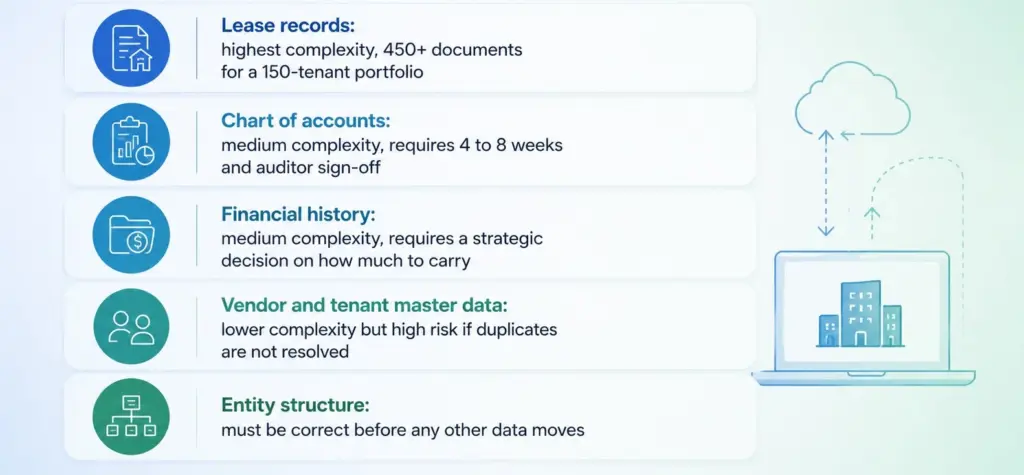
What Data Needs to Be Migrated in a Real Estate ERP Migration

Lease Records

This is the most labor-intensive category. Every active lease needs to be fully reviewed and entered before migration. That means:

  • Start and end dates for every lease
  • All renewal options and notice requirements
  • Base rent amounts and how they escalate over time
  • Tenant improvement allowances and any amortization schedules
  • Free-rent periods and security deposit terms
  • CAM exclusion lists and cap structures
  • Every amendment since the original lease was signed

A commercial portfolio with 150 tenants and an average of three amendments each means 450 documents that need to be read and entered accurately. For multi-entity portfolios, managing subsidiaries with separate lease books per entity adds another layer of complexity that has to be mapped before any data moves.

Chart of Accounts

Most real estate organizations have a chart of accounts that grew without a plan. Migration is the right moment to rebuild it properly. This requires the controller, CFO, and auditors to agree on how the business should be organized financially before anything moves. Expect four to eight weeks for this step alone.

Financial History

Every migration needs a decision on how much history to carry over. The standard approach is to migrate a trial balance at the cutover date and keep older transactions in the legacy system. Make this decision with the CFO and document it. Investors, lenders, and auditors will ask for historical data for years after cutover.

Vendor and Tenant Master Data

The same vendor often appears under three different names depending on who entered the invoice. Tenant records carry the same problem. Resolve all duplicates and set a naming convention before the migration runs. Every duplicate that makes it into the new system creates reconciliation errors that take weeks to fix.

How Do You Clean Data Before Migrating to a New Real Estate ERP?

Data cleaning means fixing problems in the source data before the migration begins. It is not something that happens during migration or after go-live. The earlier it starts, the fewer surprises appear at cutover.

Here is a simple approach, step by step:

1. Find every data source 

Before cleaning anything, map where the data actually lives. Most portfolios have more sources than expected: the current property management platform, a separate accounting system, lease tracking spreadsheets, paper files for older amendments, and email threads with approvals that were never formally entered anywhere.

2. Fix duplicate records 

Run a check for duplicate vendors, tenants, and properties. Set clear naming rules. Every duplicate that goes into the new system causes reconciliation failures that take time to untangle. Getting the contract management structure right before migration means lease terms post directly to financial records rather than requiring manual fixes afterward.

3. Abstract and validate lease records 

Lease abstraction is not a data entry task. It needs someone who understands lease accounting to read each document and interpret the financial terms correctly. For large portfolios, this should be a dedicated workstream with its own timeline, not a task folded into the general migration effort.

4. Decide what stays in the old system 

Not everything needs to move. Decide explicitly what stays in the legacy system and document that decision with the CFO and auditors. A choice made quietly during migration becomes a problem when someone asks for data six months later.

5. Validate against the new system’s requirements 

Before extraction begins, check that the source data matches the format and structure the new system expects. Schema mismatches discovered during migration cause the same kind of delays as poor data quality.

check your data readiness

What Is the Difference Between a Full Cutover and a Staged ERP Migration?

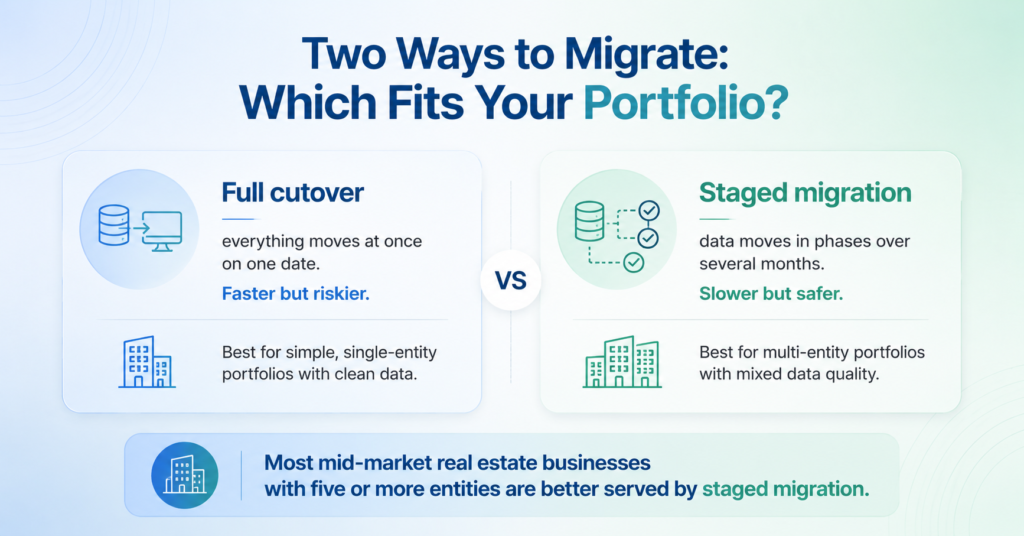
These are the two main data migration strategies for real estate ERP systems. A full cutover means everything moves at once on a single date. A staged migration means data and features move in phases over several months.

Neither is always better. The right choice depends on how complex the portfolio is and how much capacity the team has to manage the transition.

Full cutover vs staged Real Estate ERP Migration

Full cutover works well when:

  • The portfolio has one or two entities
  • Records are clean and well-organized going in
  • The team has dedicated implementation support throughout

Risk: If something breaks at go-live, there is no fallback. The team manages live operations and a migration problem at the same time.

Staged migration works well when:

Risk: Running two systems at the same time is expensive in both staff hours and software cost. Each phase needs clear completion criteria or it will extend indefinitely.

Most mid-market real estate businesses with five or more entities and mixed data quality are better served by a staged approach. The Eckelkamp case study shows how stabilizing the financial layer first, before moving lease administration, reduced the total number of issues found after go-live.

What Are the Steps in Real Estate ERP Migration Planning?

ERP migration planning for real estate follows a clear sequence. Most teams either rush through it or skip steps, and that is the most reliable predictor of a delayed go-live.

StepWhenWhat Happens
Data audit6 months beforeMap every source, find duplicates, check lease completeness
Chart of accounts redesign4 to 5 months beforeController, CFO, and auditors agree on the new structure
Entity setup4 months beforeBuild entity hierarchy in new system before extraction starts
Data extraction3 months beforePull from source, convert to fit new format, validate
Test migration6 to 8 weeks beforeRun full migration in a test environment and fix all gaps
Parallel run4 weeks beforeRun both systems together until two month-end closes match
Go-liveDay 0Live migration, legacy system stays read-only for 90 days

What Are the Most Common Real Estate ERP Migration Mistakes?

These problems appear consistently across real estate ERP projects. Knowing them in advance is the best way to avoid them.

Lease records with gaps: Paper amendments that were never scanned, verbal changes that were never written down, renewal notices in personal email inboxes instead of a shared system. Find these before anything else moves.

Chart of accounts rebuilt halfway through: When the account structure is rushed or designed without the auditors, it almost always needs to be redone once real data loads and the reports do not balance. Every rebuild costs weeks.

Duplicate records creating errors: A vendor listed three different ways means invoices cannot match automatically. These problems are invisible in the old system and immediately obvious in the new one.

Stopping the parallel run too early: Running old and new systems side by side is expensive in staff time. Teams cut it short and then find problems after go-live. Two clean month-end closes in the new system is the minimum before stopping.

Entity structure wrong at cutover: Fixing how entities are organized after go-live is one of the most expensive corrections in any ERP project. Getting the document management structure right for each entity before migration begins avoids losing critical files between phases.

Real Estate ERP Migration Checklist

Six months before go-live:

  • Assign a dedicated owner for the data audit
  • Map every data source including paper files
  • Begin lease abstraction for all active leases

Three to four months before:

  • Finalize chart of accounts with controller and auditors
  • Resolve all vendor and tenant duplicates
  • Confirm entity structure with legal and finance teams

After go-live:

  • Keep the legacy system read-only for at least 90 days
  • Do not end the parallel run until two consecutive month-end closes match
  • Track reconciliation errors weekly for the first three months

Frequently Asked Questions

How long does a real estate ERP data migration take?

For a mid-market portfolio with five to twenty entities, the migration workstream typically runs four to six months on its own. The full project including planning, configuration, testing, and go-live usually takes ten to sixteen months.

What is the biggest risk in real estate ERP data migration? 

Lease records with gaps are the most common problem. Paper amendments, undocumented changes, and renewal notices stored in personal email inboxes only surface when the new system tries to calculate rent or CAM charges.

Should we do a full cutover or a staged migration? 

A staged migration is lower risk for most mid-market real estate businesses. It lets teams stabilize one area before moving to the next. A full cutover works when data is clean and the portfolio is relatively simple.

How much does real estate ERP data migration cost? 

Most teams budget ten to fifteen percent of total implementation cost for migration. The actual effort consistently runs twenty-five to forty percent. The gap comes from underestimating lease abstraction time and the chart of accounts redesign.

What data should we prioritize first? 

Start with the chart of accounts and entity structure. Everything else maps to these two. Getting them wrong means remapping everything that follows.

Plan Earlier Than You Think Necessary

The real estate ERP migration teams that finish on schedule almost always started earlier than felt necessary. Choosing the right data migration strategies for real estate ERP systems and starting the data audit, the lease abstraction, and the chart of accounts redesign well before the project kicks off is the single most effective thing a team can do to protect the timeline.

If the portfolio is approaching a migration, the most useful first step is understanding what the data actually looks like today and what it needs before the move begins.

Talk to Propertese about what data migration strategies for real estate ERP systems look like for a portfolio at your stage.

The ROI of Property Management ERP Software

Key Takeaways

  • Mid-market operators realistically see break-even at 24 months, not 6 to 12.
  • Software licensing is only 20 to 30% of the real cost. Staff time, integrations, and data migration make up the rest.
  • Lease event management is the single highest-impact ROI driver. Missing escalations on a $10M rent roll costs up to $800,000 a year.
  • ROI most often fails because of unused modules, spreadsheet reversion, and integrations that never stabilize.
  • Build the model from your own operational baseline, not a vendor’s projected savings.

Every CFO evaluating property management ERP software is really asking three questions.

  • What will this cost in total, including everything the vendor’s proposal leaves out?
  • When will it start paying back?
  • How do we know if it actually worked?

Those questions deserve straight answers. This post covers the real cost structure, the quantifiable savings, and a realistic property management ERP software ROI timeline, plus a step-by-step model for building a business case that holds up in a boardroom.

Who this is for: This framework is built for mid-market and enterprise real estate portfolios. The ROI drivers, cost structure, and payback timeline at the ERP level are fundamentally different from those of basic property management tools.

The global property management software market was valued at $26.55 billion in 2025 and is projected to reach $52.21 billion by 2032, growing at a CAGR of 10.1%. Organizations that skip pre-implementation ROI analysis are significantly less likely to see expected returns. Those that build it carefully, using their own operational baseline rather than vendor projections, consistently achieve better outcomes.

How Do You Calculate Property Management ERP Software ROI?

Basic property management tools can pay back in months. ERP-level implementations take longer because the scope is fundamentally different: multi-entity accounting, lease compliance, and investor reporting carry more cost and deliver proportionally larger returns over time.

Here is the core formula, followed by what to plug into it from your own operations.

The ROI Formula

ROI = (Total Annual Savings − Annual Ongoing Cost) ÷ Total First-Year Investment × 100

Year 1 ROI will almost always be negative. The formula becomes meaningful at 24 months when upfront costs are absorbed and savings begin to compound.

What Goes Into Each Variable

Total annual savings:

  • Labor hours saved on month-end close × fully loaded hourly rate
  • CAM reconciliation recovery (typically 1 to 3% of annual CAM pool)
  • Lease escalations prevented × average escalation value
  • AP processing time saved × hourly rate
  • Audit preparation hours saved × hourly rate

Total first-year investment:

  • Vendor quote for software and implementation
  • Internal staff time at fully loaded rates (often 30 to 50% of controller and accounting team for 6 to 12 months)
  • Third-party integrations
  • Training and post-go-live support

Annual ongoing cost:

  • Software licensing
  • Support contracts
  • System administration
What the ROI formula looks like for your Portfolio

Why Is ERP ROI Hard to Measure in Real Estate?

The Attribution Problem

ERP ROI is difficult to isolate in real estate. Suppose a multifamily operator improves NOI margins by 8% over two years after implementation. What caused the improvement?

Possible contributors:

  • Favorable market rent growth
  • Improved occupancy
  • Staff changes
  • Operational restructuring
  • The ERP itself

The ERP rarely works in isolation. A portfolio owner who cuts close time from 18 days to 8 days cannot cleanly credit that to the software alone. The new controller, the chart of accounts redesign, and the workflow changes all played a role.

ROI Figures Vary Depending on What Is Being Counted

ROI claims in this space differ significantly depending on:

  • Which benefits are included (labor only vs. revenue recovery vs. scalability)
  • Whether internal staff time is factored into cost
  • How implementation quality affected outcomes

The most reliable approach is to ask for references from operators with a similar portfolio size and verify what they actually measured before and after go-live. That is the foundation of any credible ROI of property management software evaluation.

What Does a Real Estate ERP Actually Cost?

Most organizations undercount implementation cost by 40 to 60%. They price the software license and the vendor quote, and stop there.

Software Licensing

Annual licensing for mid-market portfolios typically runs $150,000 to $750,000. Enterprise portfolios and REITs can see $500,000 to several million annually. Software licensing is usually the smallest component of total first-year cost.

Implementation Services

Implementation consulting typically represents 30 to 45% of total first-year project cost, according to Panorama Consulting Group’s ERP benchmarking research across thousands of mid-market deployments. An ERP that is not properly implemented does not deliver ROI.

Vendor proposals frequently present implementation services as optional. They are not optional.

Internal Staff Time

The largest cost almost no vendor includes in their proposal:

  • Controller: 40 to 80% of working time during implementation
  • Property accounting teams: 30 to 70%
  • Operations: 20 to 50%

For a team of six people averaging $75,000 in fully loaded annual cost, that represents $135,000 to $225,000 in absorbed capacity over the implementation period. It appears nowhere in the vendor quote.

Data Migration

Property management data is notoriously messy:

  • Inconsistent naming conventions
  • Duplicate vendor records
  • Historical CAM pools tracked only in spreadsheets
  • Lease modifications spread across paper files

A clean migration for a 3,000-unit portfolio with five years of history typically requires four to eight weeks of dedicated effort.

Third-Party Integrations

Integrating a property management ERP with an existing general ledger, maintenance system, or investor reporting portal typically costs $15,000 to $50,000 per integration in professional services, plus ongoing maintenance.

What to Budget

A realistic first-year total cost for a mid-market operator with 1,000 to 3,000 units falls in the $150,000 to $400,000 range when all costs are included. Build your model from that number, not from the vendor’s proposal line items.

What Are the Quantifiable ROI Drivers?

These are the areas where property management ERP benefits translate into documented, measurable savings when conditions are right.

ROI DriverRealistic ImprovementAnnual Value ExampleSource
Month-end close10 days shorter on averageYour close hours × your hourly rate × (days saved ÷ total close days)Propertese client data
CAM reconciliation recovery1 to 3% of CAM billings$20K to $60K on $2M poolIndustry practitioner data
Lease escalation preventionPrevents 3 to 8% miss rateUp to $800K/year on $10M rent rollIndustry practitioner data
AP automationProcessing time and duplicates materially reduced$5K to $25K in duplicates preventedIndustry practitioner consensus
Audit preparation30 to 50% reduction in prep hours80 to 150 hours saved per audit cycleIndustry practitioner data
Reporting cycleMaterially faster for most organizationsHours to days saved per cycleIndustry practitioner consensus

1. Month-End Close Reduction

Research from Deloitte’s Finance Benchmark Survey finds that companies using ERP with integrated automation report 35% faster month-end close. In real estate specifically, the impact is often greater because consolidating multiple entities eliminates a significant manual reconciliation layer that does not exist in single-entity businesses.

A portfolio accounting team closing 15 to 20 entities manually frequently takes 12 to 15 business days. Well-implemented ERP teams consistently report 5 to 8 day close cycles. That freed capacity rarely translates to headcount reduction. It translates to capacity to scale without proportionally adding accounting staff.

2. CAM Reconciliation Accuracy

Under-billing in CAM reconciliations is common when expense pools are tracked in spreadsheets. ERP-driven CAM reconciliation typically recovers 1 to 3% of total CAM billings previously missed or disputed. On a $2 million annual CAM pool, that is $20,000 to $60,000 per year in additional revenue.

For how Propertese handles CAM natively across commercial property management portfolios, the feature is built directly into the platform rather than managed through manual exports.

3. Lease Administration and Missed Escalations

Portfolios without automated lease event management miss 3 to 8% of scheduled rent escalations annually. On a $10 million rent roll, a 3% miss rate represents $300,000 in uncollected revenue per year.

Understanding how lease events flow into net operating income is worth reviewing. The guide on understanding NOI in property management covers exactly how missed escalations affect portfolio performance over time.

4. Accounts Payable Automation

AP automation is one of the fastest property management automation ROI wins because manual invoice processing time is easy to measure before go-live and easy to confirm after. Organizations that audit AP records after ERP implementation consistently discover historical duplicate payment rates of 0.1 to 0.5% of total disbursements. On $5 million annual vendor spend, that is $5,000 to $25,000 in recoverable overpayments.

The approval workflows in Propertese route vendor bills through the same platform as lease events and rent payments, which eliminates the email-chain approval process that causes most delays.

5. Audit Preparation Time

Mid-market operators preparing for annual audits without a unified system typically dedicate 2 to 4 weeks of senior accounting staff time to documentation. With ERP-grade audit trails, that time reduces significantly because every entry is already traceable without manual reconstruction.

Affordable housing operators benefit most here, given regular compliance reviews. The affordable housing property management page covers the specific compliance requirements.

propertese business outcome

What ROI Benefits Cannot Be Put in Dollars?

These outcomes are real but resist clean dollar conversion. They belong in the business case as reasons to accept a longer payback period, not as revenue in the ROI numerator.

  • Audit defensibility: A portfolio processing transactions across multiple systems cannot produce a clean audit trail on demand. Reconstructing it under audit pressure is consistently expensive and disruptive.
  • Investor confidence: Institutional investors increasingly expect reporting in specific formats on fixed timelines. Operators who cannot deliver this systematically face slower fundraising cycles and higher cost of capital.
  • Scalability without proportional headcount growth: Adding 500 units to a portfolio without adding a property accountant is a real economic benefit. It is a future benefit, not a current-year savings figure.
  • Lender covenant compliance: ERP-produced debt service coverage ratio reports, occupancy certifications, and reserve account documentation reduce the risk of technical covenant violations from manual reporting errors.

For teams managing complex portfolios across multiple assets, the portfolio management use case covers how consolidated visibility across entities is handled without manual assembly.

What Is a Realistic ERP ROI Timeline?

First 12 Months: Net-Negative

This is the normal experience, not an outlier.

  • The team is learning the system
  • Configuration gaps are being discovered
  • Data quality issues are being resolved
  • Many teams are still running old and new systems in parallel

Productivity is below pre-implementation levels. Software cost is fully running. ROI is negative.

Mid-Market Operators (1,000 to 10,000 Units)

  • Typical payback: 24 to 42 months
  • Inflection point: When CAM, lease administration, and reporting modules are fully activated, usually 12 to 18 months post-go-live
  • What accelerates it: Clean data going in, high module adoption, no parallel spreadsheet processes by month 12

Understanding how financial metrics compound at the asset level matters here. The cap rate calculation guide shows how ERP-quality financial data improves the accuracy of those calculations directly.

Enterprise REITs and Institutional Operators (10,000+ Units)

  • Typical payback: 36 to 60 months
  • Why it takes longer: Multi-phase rollouts covering operations, then financial consolidation, then analytics
  • What accelerates it: Phased module adoption with clear business case review at each phase

Where Does ERP ROI Consistently Fall Short?

Modules Licensed but Never Used

Operators license full platform suites during contract negotiation, then go live on accounting and maintenance while everything else stays unused. The ROI model credited every module. The actual ROI only comes from the ones adopted.

Staff Reverting to Spreadsheets

The accounting manager who spent ten years building month-end close in Excel does not abandon it because a new system went live. She runs both in parallel to verify, and six months later the spreadsheet is still the source of truth.

Fixing this requires:

  • Clear policy on which system is the authoritative source
  • Management accountability for non-adoption
  • Consequences for running parallel processes

Most organizations underinvest in all three.

Integrations That Never Work Properly

When integrations between the ERP and the general ledger, maintenance platform, or investor reporting system do not work reliably, staff build workarounds. Manual exports. Dual entry. Weekly reconciliation spreadsheets. These are invisible in the ROI model but very visible in day-to-day operations.

Implementations That Never Fully Stabilize

Some ERP implementations never reach the stable operating state that ROI projections assume. Data quality problems persist. Key staff turn over mid-implementation, taking institutional knowledge with them. The system processes transactions but never becomes the trusted source of record.

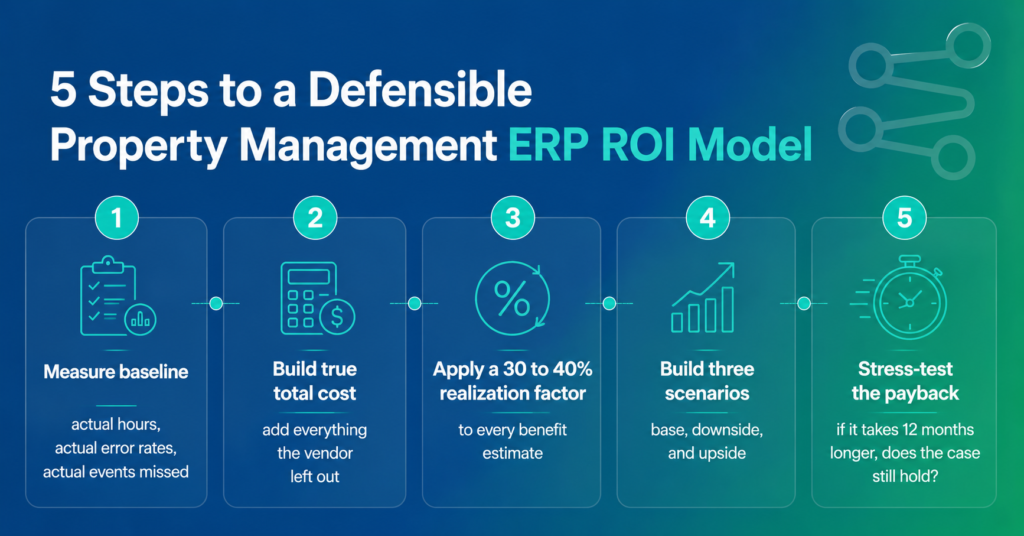
steps to a Property Management ERP ROI Model
StepWhat to DoWhy It Matters
1. Measure baselineRecord actual hours on close, AP, audit prep, and lease events missedWithout this, assumptions will not survive a board question
2. Build true total costAdd staff time, integrations, migration, and post-go-live supportPanorama Consulting Group finds organizations consistently undercount total ERP cost by 30 to 50%
3. Apply realization factorReduce every benefit estimate by 30 to 40%Accounts for adoption curve, change resistance, and delays
4. Build three scenariosBase case, downside (30% cost overrun), upside (full adoption by month 18)Most organizations land between base and downside
5. Stress-test paybackIf payback takes 12 months longer, is the case still sound?A fragile model means costs are understated or benefits are overstated

Questions Worth Asking Before Committing

  • Which clients with a similar portfolio size and structure can we speak with directly?
  • What percentage of clients license a full module suite but do not actively use all modules?
  • What do clients typically struggle with 12 months after go-live?
  • What ongoing costs are not included in the implementation quote?

What Does Good ROI Look Like at 12, 24, and 36 Months?

Metric12 Months24 Months36 Months
Financial ROILikely still negativeTurning positive40 to 80% cumulative (mid-market)
Month-end close2 to 4 days faster per entityAt or below business case targetMaterially faster, team no longer stretched
AP processing30 to 40% more volume per FTEStable, duplicates rareFully automated, minimal manual work
Reporting speedImproving, not yet reliable1 to 2 days post-closeReal-time for most reports
User adoption60 to 70% of transactions in ERP80 to 90%, spreadsheets declining90%+, ERP is trusted source of record
CAM reconciliationFirst cycle in new systemRunning cleanly, recovery documentedOptimized, disputes reduced
Audit readinessImproving, some gaps remainFirst clean audit in new systemMaterially faster prep
Portfolio growthStill manual in placesNew entities onboarding fasterGrowth absorbed without adding headcount

Frequently Asked Questions

When does property management ERP software start paying off? 

Most implementations run net-negative for the first 12 months. Mid-market operators see break-even around 24 months. Enterprise organizations typically take 36 to 60 months.

What is the most reliable ROI driver in property management ERP? 

Lease event management. Missing 3 to 8% of scheduled rent escalations annually is common without automation. On a $10 million rent roll, that is up to $800,000 in uncollected revenue per year.

How much does property management ERP actually cost in total? 

A realistic first-year total cost for a mid-market operator falls between $150,000 and $400,000 once software, implementation, internal staff time, integrations, and training are included. Software licensing alone is typically only 20 to 30% of that figure.

Why do ERP implementations fail to deliver projected ROI? 

The most common causes are underutilized modules, staff reverting to spreadsheets after go-live, and integrations that never stabilize. These are people and process problems, not technology problems.

How should non-financial benefits like investor confidence be included in an ROI model? 

They should appear as reasons to accept a longer payback period, not as revenue in the ROI numerator. Audit defensibility and scalability headroom justify a 36-month payback. They should not be assigned dollar values in the model.

Start With the Right Questions

Property management ERP software delivers real ROI. The operators who achieve it go in with accurate cost projections, build their business case on their own operational baseline, and treat the first 18 months as infrastructure rather than payback period.

The more meaningful question is not whether ERP delivers ROI. It is how long after go-live it takes before the organization trusts the system enough to stop running spreadsheets in parallel.

If the portfolio is at the stage where this analysis applies, the most useful starting point is a direct conversation about what the numbers actually look like for that specific portfolio structure.

Talk to Propertese about a business case grounded in the portfolio’s actual operations.

Implementing ERP Software in Real Estate: Timeline and Expectations

Key Takeaways

  • Vendors almost always quote the timeline the client wants to hear. Mid-market implementations realistically average 12 to 16 months. Enterprise organizations should plan for 24 to 36 months.
  • Data migration is where most real estate ERP projects lose time and budget. Start the data audit six months before implementation begins, not after the vendor arrives.
  • Hidden costs typically double the initial vendor quote. Internal staff time, consultant overages, and post-go-live support are real costs that appear nowhere in the sales proposal.
  • Real estate breaks generic ERP logic. Multi-entity structures, CAM reconciliation, and lease accounting under ASC 842 and IFRS 16 require depth that most general-purpose platforms do not have natively.
  • Tangible financial return in real estate takes 18 to 30 months. The first year is stabilization. The second year is when the efficiency gains actually show up.

When the Sydney Harbour Bridge was first proposed in the 1880s, engineers estimated it would take a few years to build. Construction did not begin until 1923. It opened in 1932. The delays were not because the engineers were incompetent. They were because the actual complexity of the project kept revealing itself as work progressed, and each new discovery added time nobody had originally accounted for.

Real estate ERP implementations follow the same pattern. The original timeline looks reasonable on paper. Then the data migration reveals 800 lease documents that need manual abstraction, and the CAM configuration takes three months instead of three weeks. Then the controller who owned the migration leaves mid-project.

This is not an unusual situation. It is the standard pattern for implementing ERP software in real estate.

Implementing ERP software in real estate is different from implementing ERP in manufacturing or professional services. Revenue is contractual. Entity structures involve dozens of legal entities. Lease accounting under ASC 842 and IFRS 16 requires architecture most general-purpose platforms simply do not have. According to ERP Research, the mismatch between vendor promises and real-world implementation outcomes is one of the most consistent patterns in the industry (source).

This post covers what mid-market and enterprise real estate teams should actually expect: realistic timelines, the eight phases and where each breaks down, the data migration problem in plain terms, hidden costs nobody budgets for, and what good looks like at 6, 12, and 24 months.

Why Is Implementing ERP Software in Real Estate More Complex Than Other Industries

Most ERP platforms were built for industries with predictable transaction cycles. A manufacturer ships a product, recognizes revenue, done. Real estate does not work that way.

Here is what makes real estate uniquely difficult for any ERP system:

1. Revenue recognition is contractual and time-distributed

A single commercial lease can carry more accounting complexity than an entire product line at a mid-sized manufacturer. Lease type, escalation schedules, TI allowances, free-rent periods, and ASC 842 balance sheet treatment all affect how revenue is recognized.

2. Multi-entity structures are extreme by any ERP standard

A 40-property portfolio may run 40 to 120 separate legal entities, each in its own LLC. Every entity needs its own chart of accounts, bank reconciliation, and tax treatment. Generic ERP systems handle two to five entities reasonably. Beyond that, the architecture begins to strain.

3. CAM reconciliation does not exist in generic ERP logic

The annual process of comparing actual operating expenses against tenant estimates, settling the difference, and applying property-specific gross-up provisions, cap structures, and exclusion lists requires months of configuration even in purpose-built platforms.

4. Investor and fund reporting is a separate discipline entirely

Waterfall calculations, preferred return tracking, IRR by asset and by fund, and K-1 preparation support are not financial accounting. They require either a dedicated module or a separate platform integrated with the ERP.

The net result: a real estate company implementing a generic ERP is fitting a general-purpose tool onto a highly specialized business and spending years backfilling the gaps with spreadsheets.

What Is a Realistic Real Estate ERP Software Implementation Timeline?

Vendors quote the timeline the client wants to hear during the sales process. By the time the real timeline becomes clear, the contract is already signed.

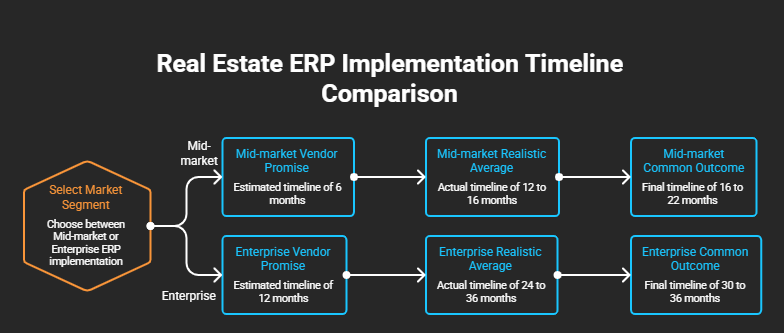
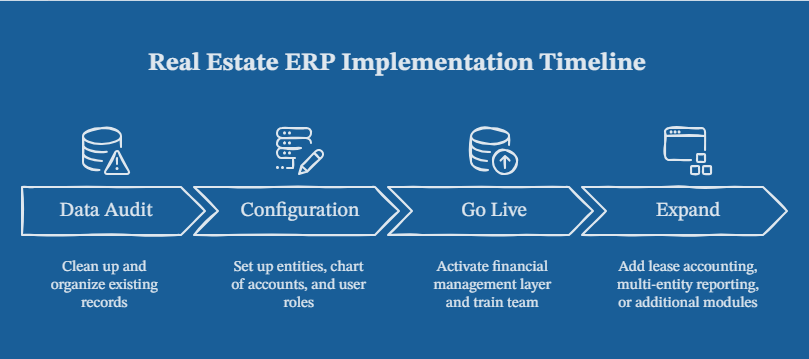
Real Estate ERP Implementation Timeline

Mid-Market Real Estate Companies (5 to 50 Properties)

  • Vendor promise: 6 months
  • Realistic average: 12 to 16 months
  • Common outcome: 16 to 22 months with meaningful budget overrun

The biggest timeline drivers at this size:

  • Entity structure setup across multiple LLCs
  • Lease data migration and abstraction
  • Integration development between property management and financial systems
  • Year-end validation of CAM reconciliation, investor distributions, and tax reporting

The bandwidth problem is also real. The controller and property accountants are the only people who can validate data and configure workflows. They are also running the existing business simultaneously.

Enterprise Real Estate Organizations (100+ Properties or $500M+ AUM)

  • Vendor promise: 12 months
  • Realistic average: 24 to 36 months
  • Common outcome: 30 to 36 months for multi-country, multi-GAAP implementations

One pattern worth naming explicitly: enterprise organizations frequently sign contracts with senior consultants and receive junior or offshore delivery. This is industry-wide. Ask explicitly who will be assigned to the project, what their real estate ERP credentials are, and whether contractual guarantees exist against personnel changes.

Get a realistic ERP timeline with Propertese

What Are the Eight Phases of Real Estate ERP Implementation?

Understanding the real estate software implementation steps, rather than the vendor-scripted version, is what separates teams that go in prepared from those that discover the gaps in month seven.

Phase 1: Scoping

Vendor promise: Complete requirements locked in two to four weeks. 

Reality: Six to twelve weeks, and requirements keep evolving.

The most common failure: requirements are documented but not validated by the people who will actually use the system. Property accountants, asset managers, and leasing coordinators are rarely in the room. Edge cases surface as emergencies later.

Phase 2: Vendor Selection

Vendor promise: A platform that fits 90% of real estate needs out of the box. 

Reality: Most real estate firms need significant customization or third-party modules for the remaining 30%.

Selecting on UI aesthetics or the sales relationship rather than architecture fit is one of the most expensive mistakes in real estate technology.

Phase 3: Data Migration

Covered in its own section below. The short version: every real estate ERP implementation underestimates data migration. Every single one.

Phase 4: Configuration and Customization

Vendor promise: Minimal customization needed, configured in a few weeks. 

Reality: CAM structures, intercompany rules, and approval workflows require months of configuration or custom development.

Configuration decisions made early, particularly chart of accounts design and entity structure, frequently prove wrong when tested against real data and must be rebuilt.

Phase 5: User Training

Vendor promise: Three to five training sessions and the team is ready. 

Reality: Training is delivered on sample data, not the organization’s own data, so staff cannot practice real workflows.

Property accountants, the most critical users, are consistently the last group trained. Without an internal super-user program, day-to-day questions have no clear owner after go-live.

Phase 6: Parallel Run

Vendor promise: A brief two to four-week validation period. 

Reality: Staff is doing twice the work, two systems, reconciling both, while managing daily operations.

Parallel runs are routinely cut short due to exhaustion. Discrepancies between old and new systems are frequently not resolved before go-live.

Phase 7: Go-Live

Vendor promise: A clean cutover with support standing by. 

Reality: Controlled chaos. Senior consultants who knew the configuration are already on the next project. Users have forgotten key workflows from training weeks earlier.

Going live before month-end, year-end, or peak leasing season is one of the most avoidable mistakes.

Phase 8: Post-Go-Live Stabilization

Vendor promise: 30 to 90 days of hypercare and the implementation is complete. 

Reality: The first month-end close in the new system takes two to three times longer than normal. The first CAM reconciliation surfaces configuration errors that testing did not catch.

Stabilization runs 6 to 12 months before the platform is actually stable. Treating it as done after vendor hypercare ends consistently leads to struggling through the first annual cycle.

Why Is Data Migration the Hardest Part of Real Estate ERP Implementation?

Data migration is consistently budgeted at 10 to 15% of implementation effort. The actual effort runs 25 to 40%. In real estate, the problem is worse than in most industries.

What Real Estate Data Migration Actually Involves

Lease records are the biggest challenge. Every active lease requires full abstraction:

  • Commencement and expiration dates
  • All renewal options with notice requirements and rent reset mechanisms
  • Base rent and escalation schedules
  • TI allowances, free-rent periods, and CAM exclusion lists
  • Every modification since the original document

For a 200-tenant commercial portfolio with two to four lease modifications per tenant over ten years, that is 600 to 800 legal documents read, interpreted, and entered accurately.

Chart of accounts is an accounting redesign exercise. Most organizations have one that evolved organically and was never designed for the reporting the business now needs. Getting the controller, CFO, and auditors to agree on how the business should be categorized financially takes four to eight weeks in mid-market implementations.

CAM reconciliation history creates a timing trap. If the cutover happens mid-CAM cycle, partial-year data must be completed in the legacy system before migration or migrated accurately enough to finish in the new one. Most organizations discover this problem during implementation, not during planning.

The fundamental issue: data migration is a business validation task, not a technical one. Every record must be reviewed by someone who understands what it should look like. That person is the property accountant or controller, who is already fully employed managing the existing business.

Best practice: Start the data audit six months before implementation begins. Treat data remediation as a resourced, independent workstream with its own dedicated owner.

What Are the Hidden Costs of Implementing ERP in Real Estate?

Most companies underestimate ERP implementation costs by 30 to 50%. A 25 to 35% contingency reserve on top of any vendor quote is responsible planning.

Internal Staff Time

The largest hidden cost never appears on the vendor invoice.

  • Controller: 40 to 80% of working time during implementation
  • Property accounting teams: 30 to 70%
  • Operations: 20 to 50%

A controller earning $150,000 giving 50% of their time for 12 months is a $75,000 cost the vendor proposal never mentions.

Consultant Overages

Every out-of-scope request, configuration change, or data issue requiring consultant time is billed as a change order. Without a rigorous approval process, professional services budgets are routinely exceeded by 40 to 80%.

Third-Party Integrations

Integrations between the ERP and existing tools, CRM systems, payment portals, document management, and investor portals, each require development, testing, and ongoing maintenance. Annual support and maintenance runs 15 to 22% of license value after go-live.

Well-configured integrations eliminate significant manual work. The guide on automating rental income tracking shows how much reconciliation effort disappears when payment portals connect directly to the ledger. Without that integration, the accounting team reconciles manually every single month.

Post-Go-Live Support

Standard vendor support covers product bugs. It does not cover configuration issues, reporting development, or workflow optimization. A post-go-live support retainer of $5,000 to $20,000 per month is operationally necessary for most mid-market organizations. It is almost never budgeted.

What Are the Biggest ERP Implementation Challenges in Real Estate?

Real estate ERP implementation fails for predictable reasons. Most of them are within the organization’s control.

1. Treating It as an IT Project

When the CIO owns the implementation and the CFO and COO are peripheral stakeholders, the system gets configured for technical correctness rather than operational usability. Real estate ERP implementations must be owned by Finance and Operations, with IT as a supporting function.

2. No Empowered Decision-Maker

Every configuration question requires someone with authority to decide quickly. Organizations that route decisions through committees experience constant delays as questions queue up for weeks at a time.

3. Going Live at the Wrong Time

Launching during quarter-end, fiscal year-end, a major acquisition, or a capital raise means running two parallel crises simultaneously. The external business pressure always wins.

4. Over-Customization

The pattern is consistent: implementation teams customize to match existing processes rather than redesigning processes to fit the platform. The result is a heavily modified system that breaks on every upgrade and requires ongoing maintenance the organization never budgeted for.

5. Wrong Platform for the Business Model

A commercial REIT implementing a platform designed primarily for residential property management will spend the entire project fighting the software’s assumptions. Platform-business model mismatch is one of the most expensive mistakes in real estate technology and nearly impossible to fix without a full re-implementation.

Serious financial analysis, like the discount rate selection in real estate DCF models, depends on clean, trustworthy financial data from the ERP. If the platform cannot produce that data accurately, the analysis fails regardless of how sophisticated the model is.

What Does Good Look Like at 6, 12, and 24 Months?

Understanding what success looks like at each stage prevents organizations from declaring victory too early or panicking during normal stabilization.

At 6 Months Post-Go-Live

Success looks like:

  • Monthly close running at or below the pre-implementation timeline
  • Go-live data backlogs cleared
  • Critical integrations functioning without daily manual intervention
  • An internal system owner with real authority to manage the platform

Real adoption metrics:

  • 85%+ user login rates weekly
  • Less than 10% of transactions processed outside the system
  • Helpdesk ticket volume trending downward

At 12 Months Post-Go-Live

Success looks like:

  • First CAM reconciliation completed in the new system with fewer manual adjustments than before
  • Year-end close at or faster than legacy timelines
  • External audit completed without material system-related findings
  • Investor reporting generated from the platform, not assembled in a spreadsheet

Target metric: 20% reduction in time to produce monthly financial packages.

At 24 Months Post-Go-Live

Success looks like:

  • New staff trained on the platform as standard onboarding
  • Reporting driving business decisions rather than satisfying compliance alone
  • ERP treated as the system of record across the organization

Research from The CFO Club finds that 97% of businesses with ERP systems report improved processes. In real estate, tangible financial return takes 18 to 30 months because the first year is stabilization and the second is when optimization actually begins.

ERP Implementation Checklist for Real Estate Teams

Having solid contract management and document management infrastructure before implementation begins significantly reduces the time needed to extract and validate lease data.

Before signing the contract:

  • Model total cost of ownership beyond licensing and implementation fees
  • Confirm who will be assigned to the project and verify their real estate ERP experience
  • Identify an internal business owner with decision-making authority
  • Budget a 25 to 35% contingency reserve above the vendor quote

Before data migration begins:

  • Start the data audit six months before implementation
  • Assign a dedicated owner for data remediation, not a part-time responsibility
  • Resolve duplicate vendor records and inconsistent naming conventions in the legacy system
  • Agree with the CFO and auditors on how much financial history to migrate

During implementation:

  • Schedule go-live away from month-end, year-end, and any major business events
  • Establish a change-order approval process before the first invoice arrives
  • Run parallel in all critical processes, including CAM and investor reporting, before go-live sign-off
  • Train internal super-users who will own the platform after the vendor leaves

Post-go-live:

  • Do not end hypercare until month-end close has run at least twice in the new system
  • Track user login rates, manual journal entry counts, and helpdesk volume monthly
  • Budget 12 months of ongoing support from the implementation partner
  • Treat the first CAM reconciliation cycle as a project, not a routine task

Frequently Asked Questions

How long does real estate ERP implementation take?

Mid-market portfolios realistically take 12 to 16 months. Enterprise organizations should plan for 24 to 36 months, regardless of what the vendor quotes during the sales process.

What causes most real estate ERP implementations to fail?

Bad data going in is the single most consistent cause. The second is handing ownership to IT instead of keeping Finance and Operations in control of every major decision.

How much does real estate ERP implementation actually cost?

Plan for two to four times the vendor’s initial quote. Internal staff time, consultant overages, third-party integrations, and post-go-live support rarely appear in the proposal but always appear in the final bill.

What is the single biggest mistake teams make before go-live?

Scheduling go-live during month-end, year-end, or a major business event. Two parallel crises always means one loses, and it is almost never the external one.

When does real estate ERP start delivering a return?

Expect 18 to 30 months before tangible financial return shows up. The first year is stabilization. The second is when efficiency gains become measurable.

Do we need to clean our data before implementation starts?

Yes, and the audit should begin six months before implementation, not after the vendor arrives. Data remediation started late is the most reliable predictor of a delayed go-live.

Conclusion

Before signing anything, two questions are worth sitting with. First, is the data clean enough to migrate? Second, is there one person in the organization with the authority and the time to own this project from day one to go-live?

If the answer to both is yes, the implementation has a real chance of staying on track. If either answer is uncertain, that is the conversation to have first.

Propertese can help work through both before a contract is ever signed.

Key Features of Modern Property Management ERP Software

Key Takeaways

  • Most platform demos show the wrong features first and the ones that matter most at scale rarely come up until after the contract is signed.
  • The general ledger is the feature that separates platforms because rent collection and maintenance tracking work similarly across almost every tool on the market.
  • Lease accounting depth matters far more than a renewal reminder since any system can store a lease end date but very few handle ASC 842 and IFRS 16 automatically.
  • AI features in property management software are useful but narrow with predictive maintenance and document processing being the only capabilities that are production-ready today.
  • Integration depth between modules matters more than feature count because a platform with thirty well-connected features outperforms one with eighty features that require manual handoffs.

Most real estate teams that switch platforms do so because of something that happened after go-live, not before it.

The evaluation went well. The platform covered everything on the checklist. The team felt confident in the decision. Then the portfolio added two new entities. A lender asked for segmented financial statements. The month-end close that used to take five days started taking twelve.

The platform did not fail at what it promised. The evaluation focused on the surface layer of features. These are the easiest to demonstrate but also the most similar across every platform on the market. The property management software features that determine whether a platform holds up over time are the ones underneath. That means the general ledger, the entity structure, the audit trail, and the reporting engine.

This post covers the key features of property management software at the level a decision-stage evaluator needs. Not a first-pass overview. A structured framework covering what to look for, what to ask during evaluation, and where most platforms stop short as portfolios grow.

What Is the Difference Between Basic and Enterprise Property Management ERP Software Features?

Basic property management software covers operations. Enterprise property management ERP covers operations plus the full financial backbone underneath.

Basic tools handle rent collection, maintenance requests, tenant communication, and lease tracking. These are the features of property management software that most teams evaluate first, and most platforms handle them reasonably well.

Enterprise platforms do all of that and add a real estate-specific general ledger, multi-entity accounting, compliance-grade audit trails, and investor-ready reporting. The operational features overlap significantly across platforms. The financial features do not.

The Eckelkamp case study is one of the clearest examples of this in practice. After consolidating operations onto a single ERP-connected platform, the team went from managing operations across separate systems to a unified setup with automated reconciliation and real-time financial visibility across the entire portfolio.

What Financial Management Features Should Property Management ERP Software Include?

Financial management is the layer that everything else in the platform depends on. A platform with strong tenant portals and a weak general ledger is an operations tool, not an ERP.

A General Ledger Built for Real Estate

A real estate-specific general ledger handles property-level transactions natively, meaning rent rolls, CAM reconciliation, tenant billing, and owner distributions all post without manual journal entries.

Most standard accounting tools were not built for these transaction types. CAM reconciliation alone involves allocating shared expenses across tenants based on lease terms, calculating caps, and billing the difference. If the platform handles that natively, it saves hours every quarter. If it does not, someone on the finance team is building those calculations manually.

During evaluation, ask the vendor to demonstrate a CAM reconciliation from source transaction to final tenant billing without exporting at any point. If an export appears anywhere in that demonstration, the general ledger is not as native as the sales materials suggest. Propertese handles common area maintenance natively within the platform, with CAM charges calculated and billed directly from lease terms.

This depth of financial infrastructure runs through the NetSuite integration, which brings enterprise-grade general ledger capabilities into the platform.

Accounts Receivable and Payable

AR and AP should run through the same platform as the general ledger so rent receipts, vendor invoices, and owner disbursements all post to the same ledger automatically.

When AR and AP live in a separate accounting tool, every transaction requires a sync that can drift, break, or create reconciliation gaps. Real Estate ERP like Propertese handles online rent payments and collections natively, so payments post directly to the correct ledger entries without a separate accounting integration.

Approval Workflows for Financial Transactions

Financial transactions that require approval should move through the platform’s own workflow engine rather than through email chains or external tools.

A vendor invoice should be created, routed for approval, approved, and posted to accounts payable without leaving the platform. Approval workflows handle this across rent payments, vendor bills, and lease events, which is one of the reasons Propertese clients report invoice processing running sixty-six percent faster after implementation.

Revenue Recognition

Revenue recognition in real estate involves more complexity than standard accounting handles well. Prepaid rent, security deposits, percentage-rent clauses in commercial leases, and stepped-rent schedules each follow specific rules. A platform that handles these natively, without manual journal entries at month-end, removes one of the most time-consuming parts of the finance team’s monthly cycle.

What Are the Key Features of Property Management ERP Software for Leasing?

Lease management is where the gap between basic and enterprise platforms shows up most clearly. Any platform can store a lease and send a renewal reminder. The question is what happens to that lease data once it is in the system.

Lease Event Flow

Lease Accounting Under ASC 842 and IFRS 16

For any portfolio holding commercial leases, the platform needs to calculate right-of-use assets and lease liabilities natively and post those entries to the general ledger automatically when a lease event occurs.

A lease modification, a renewal, or an early termination should trigger recalculations and update the ledger without a manual step. When these calculations happen in a spreadsheet alongside a Property Management tool, every lease event is a risk. A missed update creates a compliance gap that may not appear until an auditor finds it.

Getting the lease terms right before they reach the ledger matters just as much as the compliance entries themselves. A closer look at setting up a maintenance request portal shows how the same principle applies on the operations side: the workflow needs to be right before the financial posting can be trusted.

Propertese handles leasing and lease accounting through leasing management, where lease events post directly to the general ledger and ASC 842 entries update automatically.

Automated Rent Collection and Reconciliation

Rent collection automation is a standard feature in most platforms. What varies is reconciliation depth. The key question is whether collected rent posts to the correct tenant ledger, property account, and entity books simultaneously, or whether the finance team verifies and assigns postings manually after the fact.

Lease Renewal Workflows

A renewal alert tells someone a lease is expiring. A renewal workflow manages the entire process from negotiation through execution and updates the financial records once the new terms are signed. For portfolios managing hundreds of leases, automated renewal notices remove one of the most common sources of missed income and lapsed tenant relationships.

How Should Property Management ERP Software Handle Multiple Entities?

ERP-grade platforms manage multiple legal entities from a single login, with each entity keeping its own books and rolling up into a consolidated view automatically.

Most standalone property management platforms treat the entire portfolio as a single set of books. As soon as a business operates through more than one legal entity, which is common as soon as properties are held under different ownership structures or fund vehicles, that single-book approach breaks down.

1. Property and Unit Management Across Entities

Each property in the portfolio needs to be tracked at the unit level, including occupancy, lease details, and tenant records, while also mapping correctly to the legal entity that owns it. Property and unit management in Propertese tracks this at both levels simultaneously, so occupancy data and financial data always reflect the same underlying reality.

2. Consolidated Reporting Across Entities

Consolidated financial statements spanning multiple entities, segmented by property, fund, and subsidiary, should come directly from the platform without a manual assembly step. If producing a portfolio-wide income statement requires exporting entity-level reports and combining them in a spreadsheet, the platform is not handling consolidation natively.

During evaluation, ask the vendor to produce a consolidated income statement for a three-entity portfolio in real time. That demonstration tells more about multi-entity depth than any feature checklist.

What Maintenance and Operations Features Matter Most?

Maintenance is the feature category where most platforms perform consistently well, and where the differences between platforms are narrower than in the financial layer. The meaningful distinctions come down to how well the operations side connects to the financial side.

1. Work Order Management and Cost Tracking

Work orders should connect directly to the financial layer so a completed repair job posts to the correct property account and entity automatically when the work order is closed.

When this connection does not exist, the finance team receives invoices, matches them to work orders manually, creates journal entries, and posts them to the right accounts by hand. That process works for a small portfolio. It becomes a persistent backlog as the portfolio grows.

Maintenance request management tracks work orders from tenant submission through vendor assignment, completion, and cost posting, with every expense landing in the correct ledger entry without a separate step.

2. Vendor Management and Payment Processing

Vendor invoices tied to work orders should flow into accounts payable automatically. When work order management and vendor payments live in separate modules without a direct connection, each invoice requires a manual handoff that grows harder to manage at scale.

3. Preventive Maintenance Scheduling

Preventive maintenance scheduling should be tied to asset records rather than calendar reminders. A roof inspection is due because the asset record shows the last inspection date and the required interval, not because someone set a reminder ninety days ago.

What Does Good Reporting Look Like in Property Management Software?

Most platforms can produce a rent roll. Far fewer can produce a consolidated income statement across multiple entities, segmented by property and fund, pulled from live data without an export step. This is the clearest dividing line between tools that work for small portfolios and tools that scale with them.

Operational Versus Financial Reporting

Operational reports cover occupancy, rent collection, lease expiration schedules, and maintenance status. Financial reports cover income statements, balance sheets, cash flow, and audit-ready trial balances. Both should be native to the platform and draw from the same data source.

When operational and financial reporting pull from different sources, the numbers frequently disagree. Someone always has to reconcile them before they can be trusted.

Investor and Owner Reporting

For portfolios that report to outside investors or property owners, reports need to meet a higher standard than operational summaries. Segmented financials, distribution calculations, and period-over-period comparisons should come directly from the platform rather than from a spreadsheet layer on top of it.

Which features your portfolio needs

Where Do AI Features Actually Add Value in Property Management ERP Software?

The AI features in property management ERP software that are production-ready today fall into two categories: predictive maintenance alerts and document processing.

Everything else, fully autonomous reporting, compliance verification, investment decisions, is still in early development at most platforms. During evaluation, ask to see any AI feature working live on real data before counting it as a capability.

Predictive Maintenance Alerts

Machine learning models trained on asset age, work order history, and maintenance frequency can flag equipment likely to need attention before it fails. For large portfolios where manual tracking across hundreds of units is impractical, this reduces emergency repair costs and unplanned capital expenditure.

Document Processing and Lease Abstraction

AI-assisted document processing can extract key terms from lease agreements, reduce manual data entry when setting up new leases, and flag discrepancies between what a lease says and what was entered into the platform. For portfolios processing large volumes of new leases each quarter, this saves meaningful time.

How Do You Build a Property Management ERP Software Features List That Works?

The best features in property management software are not universal. The right starting point is the specific problem the portfolio is experiencing right now, not a vendor’s marketing checklist.

Working backward from three questions produces a more useful evaluation framework than any pre-built features list.

Where does the current setup break down? 

If month-end close is the problem, the evaluation should focus on general ledger depth, reconciliation automation, and reporting, whereas if multi-entity management is the issue, subsidiary accounting and consolidation are the priority. If lease administration is the recurring pain point, ASC 842 handling and renewal workflow depth matter most.

What does the portfolio look like in two years? 

A platform that handles the current entity count may not handle the count after the next acquisition or fund raise. Evaluating against the two-year structure rather than today’s structure avoids a painful migration twelve months later.

How well do the features connect to each other?

 A platform with strong lease management and a separate accounting tool that syncs once a night is a different product from one where both functions share the same data layer in real time. The integration depth between modules determines whether the feature list holds up under real operating conditions.

Frequently Asked Questions

What is the most important feature in property management software?

It depends on the portfolio. For single-entity operations, rent collection and lease tracking cover most daily needs. For portfolios with multiple entities or investor reporting, the general ledger is what determines whether the platform holds up over time.

How many features should a property management platform have?

Feature count does not matter. What matters is how well the features connect to each other. A platform where thirty features share the same data layer outperforms one with eighty features that require manual handoffs between them.

Is cloud-based property management software better than on-premise?

For most growing portfolios, yes. Cloud platforms release updates faster and maintain compliance changes without IT involvement. On-premise gives more data control but requires internal resources to keep the platform current.

How do I evaluate AI features in a property management demo?

Ask to see the feature running on real data in a live environment, not a staged walkthrough. Ask whether it is in general availability or still in beta.

What is the most overlooked feature during property management software evaluation?

The audit trail. It is invisible during normal operations but becomes critical the first time an auditor or investor asks to trace a specific transaction back to its source.

What to Do Next

The right property management ERP software features for any portfolio depend on where the business is today and where it is headed. If the current setup handles everything the portfolio needs, there is no reason to change. If specific capabilities are creating friction that keeps growing, that is worth a direct conversation about what a different platform would actually change.

Talk to Propertese about which features matter most for the portfolio today and where gaps are likely to appear as the business grows.

Benefits of Implementing a Real Estate ERP Software

Key Takeaways

  • Teams switch to ERP because something in their current setup is already costing them time or money
  • When every transaction flows into one place, reporting and compliance become much simpler
  • Managing multiple legal entities is where most standalone tools stop keeping up
  • The more the portfolio grows, the less extra work each new entity creates
  • A single-entity portfolio with simple accounting may not need ERP yet, and that is fine

Most finance teams that reach out to us do not start by asking about software. They start by describing a problem.

Month-end close that used to take five days now takes eleven. An investor asked for consolidated financials across three entities, and it took two people the better part of a day to build the report from scratch. A lease modification posted correctly in the property management platform but never reached the general ledger, and nobody caught it for six weeks.

These are not isolated incidents. They are what happens when a real estate portfolio grows past the tools that were set up to manage it.

Real estate ERP software is a single platform that manages a portfolio’s financial records, lease accounting, entity structure, and compliance trail in one place. It replaces the disconnected tools most growing teams rely on, so data flows automatically rather than being moved by hand.

The benefits of real estate ERP software are the direct answers to the problems above. According to JLL’s 2026 Global Real Estate Outlook, sixty percent of investors across all types still do not have a unified technology strategy for their real estate functions (source). ERP is that unified layer. The six benefits below explain exactly what changes when it is in place.

What Is Real Estate ERP Software?

Real estate ERP software is a platform that connects a portfolio’s financial records, lease data, entity structure, and compliance tracking into one system. Instead of running separate tools for accounting, property management, and lease administration, everything updates automatically in the same place.

The key difference between ERP and standard property management software is the financial layer. Property management tools handle daily operations like rent collection and maintenance. ERP adds a general ledger, multi-entity accounting, audit trails, and investor-grade reporting on top of those operations. Most growing portfolios start with property management software and add ERP when the accounting complexity outgrows what the PM tool was originally scoped to cover.

Most ERP benefits mean nothing until they connect to something the team is actually dealing with. Saying “better reporting” or “faster close” does not help anyone understand what will actually change on a Monday morning.

Every section in this post starts with a specific problem first. The benefit is what changes once that problem is solved. If the problem does not apply to the portfolio right now, the benefit probably does not either.

Benefit 1: One Financial Record for Every Transaction

The Problem Right Now

When lease data, rent payments, accounts payable, and the general ledger each run through a separate tool, the finance team becomes the connection between all of them. Every month-end close starts the same way: pulling figures from multiple platforms, reconciling them by hand, and tracking down every mismatch before anyone can sign off on the numbers. 

Our clients told us this reconciliation step alone was consuming four to five hours of senior staff time every single month before they made the switch. Over the course of a year, that is fifty to sixty hours spent on a task that should take twenty minutes.

How ERP Solves This

ERP connects every property transaction directly to the general ledger, so the same data that records a rent payment also updates the financial records automatically.

A rent payment, a lease amendment, or a vendor invoice posts to the financial records as part of the same workflow that created it. There is no export step and no re-entry. What the property system shows and what the accounting system shows are always the same thing.

Based on data from Propertese clients across 300-plus properties and 9,500-plus units, invoice processing runs sixty-six percent faster once approvals move off paper and email chains. This comes through the NetSuite integration, where the general ledger, accounts receivable, accounts payable, and revenue recognition all run on the same infrastructure.

This is the foundational benefit. Every other advantage in this post depends on having a single, accurate financial record underneath it.

Benefit 2: Multi-Entity Management 

The Problem Right Now

Growing real estate portfolios almost always end up operating through more than one legal entity. Different ownership structures, separate fund vehicles, properties in different jurisdictions. In most standalone property management setups, each entity means a separate set of books. Sometimes a separate login. Occasionally a separate software instance.

The back-office cost of managing that structure grows with every entity added. Intercompany transactions have to be tracked manually across systems. That is one of the most common sources of reporting errors we see in growing portfolios, and it gets worse with scale, not better.

How ERP Solves This

ERP manages every legal entity from a single login, with each entity keeping its own books and rolling up into one consolidated view automatically.

Adding a new subsidiary becomes a configuration step rather than a systems project. Intercompany transactions post correctly without manual tracking across separate systems.

For portfolios operating through more than one legal entity, subsidiary management in Propertese keeps each entity’s books separate while rolling everything up into one consolidated view from a single login.

For those managing capital across multiple investment vehicles, investment management builds on that same structure, covering fund-level reporting and investor distributions across entities. Multi-entity support is also one of the clearest dividing lines between platforms that scale and ones that plateau, worth keeping in mind when comparing property management options.

Benefit 3: Lease Accounting 

The Problem Right Now

ASC 842 and IFRS 16 require lease obligations to appear on the balance sheet. Right-of-use assets and lease liabilities have to be calculated, posted, and updated every time a lease is modified, renewed, or terminated early.

For a portfolio with dozens or hundreds of leases, tracking this in a spreadsheet alongside a Property Management tool is technically possible. It is also fragile. A missed update on a lease modification creates a compliance gap that often does not appear until an auditor finds it.

We have worked with portfolios where the spreadsheet tracking ASC 842 entries was last updated by someone who left the company eight months earlier. Nobody noticed because nothing broke visibly. The numbers on the balance sheet were wrong the entire time.

How ERP Solves This

ERP posts lease accounting entries to the general ledger automatically when a lease event occurs, so modifications, renewals, and terminations never require a separate manual step.

A renewal triggers the recalculation and updates the entries automatically. A modification adjusts the right-of-use asset and liability balances without anyone creating a journal entry by hand.

This does not remove the accounting team from the process. It moves them from building entries from scratch to reviewing entries the system already produced. That is a better use of their time and a more reliable process.

Understanding how lease terms affect financial outcomes is worth reading before any platform evaluation. The breakdown of net effective rent versus face rent shows how much financial exposure lives in the details of how lease terms are recorded, which is exactly where manual tracking creates risk. Propertese handles this through leasing and rental management that connects lease events directly to the ledger.

Benefit 4: Reporting

ERP vs Spreadsheet for Financial Reporting

The Problem Right Now

Most property management tools include some kind of reporting. The reports are built around individual properties. Occupancy, rent rolls, maintenance status. For day-to-day management, that is usually enough.

The problem starts when a CFO or investor asks for an income statement segmented by entity, property, and fund at the same time. The Property Management tool runs out of road. Someone exports the data, opens a spreadsheet, and builds the report by hand. It takes hours. By the time it is finished, some of the source data has already changed.

One of our clients described their month-end reporting process as a relay race where the baton gets dropped at every handoff. Three exports, two spreadsheets, one person who understands the formula. When that person went on leave, the report arrived two days late.

How ERP Solves This

ERP pulls financial reports directly from the live general ledger, so income statements, balance sheets, and cash flow reports come out segmented by entity, property, and fund without an assembly step.

This is one of the most measurable real estate ERP software benefits because the change shows up immediately. Based on data from Propertese clients, month-end close shortened by an average of ten days after this change. For teams reporting to investors on a fixed schedule, that difference determines whether the deadline is met comfortably or under pressure.

Clean, current data also improves the quality of financial decisions beyond month-end reporting. If the team does vacancy and absorption analysis as part of underwriting or portfolio review, this post on absorption rate and vacancy underwriting is worth reading. The quality of that analysis depends entirely on how reliable the underlying numbers are.

Benefit 5: Audit Trail 

The Problem Right Now

A basic activity log that records who logged in and when is not the same as an audit trail. Auditors want the full chain. Who created the financial entry. Who approved it. What changed along the way. What the original source transaction was.

Affordable housing operators, community associations, and portfolios with lender or investor oversight requirements tend to discover this gap first. It usually shows up at the worst moment. An auditor is in the room, they ask about a specific transaction from fourteen months ago, and the answer is somewhere across three email threads and a retired spreadsheet.

How ERP Solves This

ERP maintains a complete audit trail for every financial entry, recording who created it, who approved it, and when, so any transaction can be traced back to its source in seconds.

When an auditor asks why a specific number appears on the balance sheet, the answer comes from the system directly rather than from email threads and spreadsheets.

This benefit is invisible during normal operations. It only matters the moment it is needed. That is precisely the reason it cannot be an afterthought when evaluating platforms.

Benefit 6: Growth 

The Problem Right Now

In most growing real estate businesses, every new property or entity added to the portfolio creates more back-office work. More reconciliations, more manual data movement, more time spent on reporting. The operations team grows alongside the portfolio. The cost of managing the business scales at roughly the same rate as the business itself.

That ceiling shows up gradually. The team gets busier. Month-end close gets longer. Hiring more people becomes the default answer to a problem that is really about systems, not headcount.

How ERP Solves This

ERP centralizes the financial infrastructure so that adding a new property or entity does not create proportionally more back-office work.

Among the real estate ERP advantages that take time to appear rather than showing up immediately, this one compounds the most. The tenth entity runs through the same system as the first, with the same reporting and the same consolidation process.

Based on Propertese’s own operational data, the platform has processed over 10,500 leases across 300-plus properties and 9,500-plus units through a single platform instance. The back-office cost curve does not follow the same slope as the portfolio.

Real Estate ERP Implementation Timeline

Frequently Asked Questions

How fast do teams see results after going live with real estate ERP?

The first results most teams notice are faster invoice processing and a shorter month-end close. Both tend to appear within the first few reporting cycles after go-live. Longer-term benefits like reduced back-office scaling costs become visible over quarters rather than weeks.

What does real estate ERP software actually do?

Real estate ERP software connects property operations, lease accounting, and financial management into one platform. It replaces separate tools for accounting, property management, and lease tracking so data updates automatically rather than being moved by hand between systems.

When is real estate ERP worth the investment?

The clearest signals are multiple legal entities, investor or lender reporting on a fixed schedule, or a month-end close that consistently runs longer than it should. A single-entity portfolio with simple books and no investor reporting obligations works well with PM software plus QuickBooks or Xero. The case for ERP gets stronger as entity structure and reporting complexity increase.

How long does a real estate ERP implementation take?

It depends on data quality going in. Teams with organised, consistent records move faster. The most common cause of delays is messy historical data, such as duplicate records, inconsistent naming, or lease history that only exists in spreadsheets. A data clean-up pass before migration consistently saves more time than it costs. Many teams implement in stages, starting with financial management and adding lease accounting or multi-entity consolidation as needed.

What is the biggest risk of switching to real estate ERP?

Data quality going in. Migrations that start with messy records or financial history tracked only in spreadsheets take longer and produce unreliable initial results. A data clean-up pass before migration consistently saves more time than it costs.

How does real estate ERP compare to property management software? 

The core difference is the financial layer. Property management software handles rent, maintenance, and tenant communication well. ERP adds the general ledger, multi-entity accounting, and audit-grade reporting on top. For a full breakdown, the ERP vs property management software comparison covers when each makes sense and where they overlap.

How much does real estate ERP cost? 

Cost depends on portfolio size, the number of entities, and which modules are needed. Propertese is priced based on the specific structure of the portfolio rather than a flat per-unit or per-seat model. The most accurate starting point is a direct conversation about the portfolio rather than a published price list.

What is the best real estate ERP platform? 

The right platform depends on two things: whether it covers both the property operations side and the financial backbone, and whether it handles the entity structure of the specific portfolio. General-purpose ERP systems cover accounting but miss real estate-specific functions. Real estate-specific platforms vary widely on financial depth. Propertese is built around the combination of both, with the NetSuite integration providing the financial infrastructure and the platform handling the property layer on top.

What to Do Next

The benefits of real estate ERP software are specific, not universal. Each one answers a specific problem. If the portfolio is not experiencing the problem yet, the benefit is not relevant yet either.

If month-end close, multi-entity accounting, investor reporting, or audit readiness are creating friction that the current setup cannot address, those are worth a direct conversation with someone who can look at the specific portfolio rather than a generic one.

Talk to Propertese about whether the benefits above apply to the way the portfolio actually operates today.

How ERP Systems Transform Real Estate Operations

Key Takeaways

  • Spend less time closing books every month by having financial data, leases, and property records all updated in one place automatically.
  • Manage multiple legal entities without extra logins or extra systems by keeping every subsidiary under one platform.
  • Stop missing lease compliance deadlines by letting the software post ASC 842 and IFRS 16 entries to the ledger automatically.
  • Get investor and audit reports ready without building them from scratch because the reporting layer draws from live data rather than exported spreadsheets.
  • Grow the portfolio without growing the back-office workload since adding a new property or entity does not create a new set of manual tasks.

Real estate portfolios rarely get messy on purpose.

It usually starts simply. One tool handles rent collection because it was the easiest option at the time. A separate accounting system stays in place because nobody wants to migrate something that already works. A lease tracker gets added later because the other two tools do not capture lease terms properly.

Each decision makes sense on its own. But a few years later, the team is spending more time moving data between systems than actually managing properties. Month-end close stretches from five days to eleven. Owner reporting takes half a day of manual assembly. And when an auditor asks a specific question, the answer lives somewhere in an email chain from three months ago.

Industry analysis from ERP Research found that the shift toward lease accounting standards like ASC 842 and IFRS 16 was one of the main reasons real estate companies started replacing disconnected tools with a single platform (source). Once lease obligations had to appear on the balance sheet, tracking them in a spreadsheet became too risky.

This post covers what real estate operations management software actually is, how it solves these problems, and what to look for before making a decision.

What Is Real Estate Operations Management Software?

Real estate operations management software is a single platform that keeps financial records, leases, property data, and compliance information in one place, so teams do not have to move data between separate tools to get a complete picture.

Every part of the operation, rent payments, lease amendments, maintenance costs, and financial reports, updates automatically in the same system. When something changes on the ground, it shows up in the financials straight away, without anyone having to transfer it manually.

What Is the Difference Between ERP and Property Management Software?

These two terms get used as if they mean the same thing, but they cover different ground.

Property management software handles the day-to-day work of running buildings. It collects rent, logs maintenance requests, and tracks tenant communication. It is built for the people managing the properties.

Real estate ERP software does all of that and adds a complete financial layer underneath. That means a general ledger, multi-entity accounting, compliance tracking, and financial reports that an investor or auditor can rely on.

The simplest way to separate the two:

  • Property management software handles the operations side
  • Real estate ERP software handles operations plus the full financial backbone

Many growing portfolios start with property management software and work well with it for years. The limits tend to show up on the accounting side when the team starts managing multiple entities, reporting to outside investors, or preparing for audits. That is when the conversation about ERP usually starts.

Why Do Disconnected Property Systems Slow a Team Down?

Growing real estate businesses almost always end up running on several separate tools at the same time. Rent collection in one system, accounting in another, lease tracking in a spreadsheet. For a small portfolio, this is manageable. As the portfolio grows, the cost of keeping those systems in sync starts to add up.

Consider a team managing twenty apartment buildings across three legal entities. The rent data sits in a property management platform. The accounting team works in a separate general ledger. Lease renewals are tracked in a shared spreadsheet that multiple people edit, sometimes at the same time with no version control.

Each of these choices was reasonable when it was made. The problem is what happens at month-end. Someone has to pull data from all three places, check that the numbers agree, and investigate every mismatch before anyone can sign off. By the time the books are closed, some of the source data has already changed.

The bigger issue is timing. When a lease amendment or a maintenance cost happens in one system but takes days to appear correctly in the financial records, decisions get made using numbers that are already out of date.

How Does a Single Platform Change Day-to-Day Operations?

When property data, lease information, and financial records all sit in the same system, updates happen automatically rather than manually.

A lease change posts to the financial records as soon as it is saved. A new entity joins the portfolio without needing a separate login, a separate training session, or a separate system. A rent payment hits the bank account and lands in the correct ledger entry at the same time.

Propertese clients report measurable results from this shift:

Propertese Business Outcomes

For teams facing audits or investor reviews, the difference is just as clear. When the audit trail is part of the same platform as the transactions, tracing any entry back to its source takes seconds rather than hours of searching through exports and emails.

What Does Real Estate ERP Software Actually Include?

The features that matter most depend on how the portfolio is structured and what problems the team is actually dealing with. Below is a breakdown of the core capabilities and who benefits most from each one.

Real Estate ERP Features

A General Ledger Built for Real Estate

Every transaction in the portfolio eventually needs to post somewhere. That somewhere should be a general ledger that handles real estate-specific entries natively, things like CAM reconciliation, tenant billing, and owner distributions, without requiring manual journal entries to make the numbers work.

Propertese gets this depth through the NetSuite integration, which brings enterprise-grade accounting infrastructure directly into the platform. This is what makes faster invoice processing and shorter month-end closes possible for clients.

Managing Multiple Entities Without Multiple Systems

Most growing portfolios operate through more than one legal entity. Each entity needs its own set of books. But managing those books should not require a separate login or a separate software instance for each one.

Propertese handles this through subsidiary management, where every entity sits under one login with its own accurate records and a consolidated view across all of them. Investment firms and REIT-style operators tend to feel this gap first.

Lease Administration That Stays Compliant

Storing a lease end date and sending a renewal reminder is the basic level. The real standard is whether the platform handles lease accounting under ASC 842 and IFRS 16 natively, so that modifications, renewals, and terminations post automatically to the general ledger without a manual step.

Understanding how lease terms translate into financial entries is worth reading before evaluating any platform. The breakdown of net effective rent versus face rent shows how much financial exposure sits in details that look similar on the surface but carry very different accounting implications. Propertese manages leasing and rental accounting so these entries post correctly without manual intervention.

Maintenance Costs That Post to the Right Account

Every work order is a financial event. A completed repair job should post to the correct property account automatically when the work order is closed, rather than sitting in a queue waiting for someone on the finance team to match the invoice.

Getting the workflow right from the start makes a real difference. This guide on setting up a maintenance request portal covers the steps, approval flows, and automation that keep both the operations and finance sides accurate at the same time.

Multi-Currency Support at the Transaction Level

For portfolios with properties in different countries, currency conversion needs to happen when the transaction is recorded, not when the report is generated. Converting at month-end during reporting creates gaps in the numbers that show up mid-period and are harder to trace back to their source.

A Full Audit Trail for Every Entry

Every financial entry should trace back to who created it, who approved it, and when. During normal operations, this rarely comes up. During an audit or an investor review, it matters immediately. Platforms that can answer that question directly from the system remove a significant source of risk for teams managing affordable housing, community associations, or any portfolio with regular external oversight.

Is Real Estate ERP the Right Fit for Every Portfolio?

Not for every portfolio at every stage, and it is worth being direct about that.

A portfolio with two properties, one entity, and a simple accounting setup can run well on property management software plus a basic accounting tool for years. Adding ERP before the complexity requires it creates overhead that does not pay off yet.

The decision becomes clearer when a portfolio starts dealing with specific situations. Think about a business owner who runs a single coffee shop with no problem. Now imagine that same owner suddenly managing ten locations across three cities, each with separate ownership structures and different investors expecting monthly financial reports. The systems that worked for one shop simply cannot keep up with ten. The operation has grown past what they were built for.

Real estate portfolios work the same way. ERP becomes the right choice when:

  • The portfolio operates through more than one legal entity
  • Investors or lenders expect financial reports on a regular schedule
  • Month-end close is consistently running longer than it should
  • The team is spending significant hours moving data between systems manually

If none of those apply yet, the current setup is likely doing its job. The useful question is how fast the portfolio is growing and how long before those situations start to appear.

How Do You Move From Spreadsheets to ERP?

The most effective approach is to start with the specific function that is causing the most friction right now, rather than trying to move everything at once.

If month-end close is the main problem, the financial management layer deserves the first focus. If lease renewals are being missed, lease administration comes first. If investor reporting is taking too long to assemble, reporting and multi-entity management are where to start.

One step that consistently makes migrations go faster is cleaning up existing data before the move begins. Records with duplicate entries, inconsistent naming, or lease history that only exists in an old spreadsheet will slow down the migration and produce unreliable results on the new platform. Addressing that first saves more time than it costs.

Frequently Asked Questions

What is real estate operations management software?

It is a single platform that manages financial records, leases, property data, and compliance information together. Teams use it to replace separate tools for accounting, property management, and lease tracking.

Is real estate ERP the same as property management software?

No. Property management software covers day-to-day operations like rent collection and maintenance. Real estate ERP adds a full financial layer on top, including the general ledger, multi-entity accounting, and compliance tracking.

How many properties does a portfolio need before ERP makes sense?

Property count is not the right measure. A better signal is whether the portfolio operates through multiple entities, has investor reporting obligations, or has a month-end close that regularly runs longer than it should.

Does real estate ERP handle ASC 842 and IFRS 16?

A platform built for real estate should post lease accounting entries directly to the general ledger when a lease event occurs. If the platform requires a manual journal entry for every modification or renewal, it is not handling the standard natively.

How long does migration from spreadsheets take?

It depends on how clean the existing data is. Portfolios with well-organised records migrate faster. The most common delay is messy historical data that needs to be cleaned before it can be imported accurately.

Talk to Propertese

Real estate operations management software is not something that gets added to an existing stack. It replaces the stack.

If month-end close, investor reporting, or audit preparation are taking more time than they should, that is worth a direct conversation. Talk to the Propertese team about where the portfolio stands today.

ERP vs. Standalone Property Management Software: A Comparison

Key Takeaways

  • Property management software works well for smaller portfolios where rent collection, maintenance, and basic lease tracking are all that is needed.
  • ERP adds the financial layer that PM software does not include, such as a general ledger, multi-entity accounting, and audit-ready reporting.
  • Most teams notice the gap during month-end close when two systems show different numbers for the same period.
  • PM software and ERP can run together as long as they share a live connection rather than a manual data transfer.
  • The right choice depends on the size and structure of the portfolio, not on which software has the longer feature list.

In the age of sail, ships carried two navigators who calculated position independently. The thinking was simple: if both charts agreed, the ship was on course. If they disagreed, the captain had a serious problem on his hands.

Most real estate finance teams are still running this system today.

One number comes from the property management platform. A different number comes from the accounting system. Someone senior looks at both and decides which one to trust before the board meeting. Sometimes they match. When they do not, the next few hours disappear into finding out why.

This is the moment that brings most growing real estate businesses to the property management software vs ERP software comparison. Not a planned technology review. Not a budget cycle. A specific breakdown in how data moves between systems, and the realization that the team has been reconciling two sources of truth every single month without anyone deciding that was acceptable.

Both types of software do useful work. Understanding the difference between ERP and property management software comes down to what each one stops doing, and whether the portfolio needs the part the other one covers.

Deloitte’s 2026 commercial real estate outlook found that most global real estate leaders expect stronger revenue through 2026, but also pointed out that results depend heavily on data quality and how well operations are managed (source). The gap between PM software and ERP is a gap in exactly those two areas.

Why Do Real Estate Teams Start Comparing These Two?

Teams rarely go looking for this comparison on their own. Something in the current setup stops working, and the search begins.

Here are the most common triggers:

  • Pulling reports for an investor who wants financials split by property, entity, and fund, and realizing the current system cannot produce that without exporting to a spreadsheet first.
  • A lease change that saved correctly in the PM platform but never reached the accounting system, because the two tools sync once a night and not in real time.
  • A month-end close that keeps running longer than it should because someone has to manually reconcile data from two separate systems.

These are not signs that the property management software is broken. They are signs that the portfolio has grown past what the PM tool was originally set up to handle.

What Does Property Management Software Do Well?

Property management software is good at what it was designed for. Before these tools existed, managing a rental portfolio meant paper rent checks, phone calls for maintenance, and letters in the post for tenant communication.

Today, a well-configured PM tool handles all of this automatically:

  • Rent collection: online payment portals, automated reminders, and payment tracking at the tenant level
  • Maintenance requests: logged, assigned to the right person, tracked to completion, with a full history on record
  • Tenant communication: a portal where residents can pay, submit requests, and check their lease details without calling the office
  • Lease tracking: renewal dates surfaced before they pass, basic lease terms stored and accessible

For a portfolio with one legal entity, one set of books, and no outside investors expecting regular reports, a solid PM tool paired with something like QuickBooks handles the job well. If you are evaluating PM platforms specifically, the full comparison of property management CRM options covers how they differ on these core functions. Not every portfolio needs to go further than this.

Where Does Property Management Software Fall Short?

The limits tend to appear in three specific areas. Which one shows up first depends on how the portfolio is structured.

Financial Reporting Gets Harder as the Portfolio Grows

PM software reports are designed around individual properties. Occupancy rates, rent rolls, basic income and expenses per building. For day-to-day management, that is usually enough.

The problem starts when the portfolio needs reports that cross entities:

  • A consolidated income statement across multiple legal entities
  • Financials that separate results by fund, property, and ownership structure at the same time
  • Lease accounting reports that comply with ASC 842 or IFRS 16

At that point, the PM tool runs out of road. The only option is to export the data and build the report manually in a spreadsheet, which takes time and creates room for errors.

Managing Multiple Entities Becomes a Manual Job

As a real estate business grows, it almost always ends up with more than one legal entity. Different properties fall under different ownership structures. Fund vehicles get added. Some holdings are in different regions with different requirements.

Most PM software sees the whole portfolio as one thing. It does not split records cleanly by entity or produce separate books for each one while still showing a combined view at the top. That kind of structure is what ERP is built for, and PM software was not.

The Audit Trail Is Too Basic

A basic PM tool records who logged in and when. That is not enough for an audit.

A proper audit trail tracks every financial entry from start to finish. It shows who created it, who approved it, what changed, and when each step happened. Affordable housing operators, community associations, and portfolios that face regular external reviews find this gap first, usually when an auditor asks a question that the system cannot answer.

What Does ERP Add That Property Management Software Does Not?

ERP does not replace property management software. It adds the financial layer that runs underneath it.

That layer includes:

  • A general ledger that handles real estate-specific transactions natively
  • Separate books for each legal entity, with a consolidated view across all of them
  • An audit trail that traces every financial entry back to its source
  • Reports that pull live data and segment by property, entity, fund, and currency

When a portfolio uses the Propertese NetSuite integration, all of this runs on enterprise-grade accounting infrastructure. A lease change posts to the right entity’s books automatically. No one has to enter the same information twice into two different systems.

This also improves the quality of financial data for more complex decisions. Good financial analysis, such as building a DCF model with the right discount rate for real estate investments, only works when the underlying numbers are clean and traceable. That level of data quality comes from having every transaction in one system, not spread across several.

The reporting that comes with an ERP-connected platform is also a different product from what PM software offers. Instead of property snapshots, it produces income statements, balance sheets, and cash flow summaries broken down by subsidiary, property, and unit, pulling from data that updates in real time.

ERP vs Property Management System: Side by Side

CapabilityStandalone PM SoftwareERP-Connected Platform
Rent collectionStrong, with online portalsIncluded, entries post to the ledger automatically
Maintenance and work ordersStrong, with tenant-facing portalsIncluded, costs flow to the correct entity and property
Lease tracking and renewalsStandard featureIncluded, with ASC 842 and IFRS 16 entries posting automatically
General ledgerRequires a separate accounting toolBuilt-in, updates in real time
Multi-entity accountingRare or manualCore feature, managed from one login
Investor and owner reportingBasic, often requires manual assemblyBuilt into the reporting layer, segmented by entity and fund
Audit trailBasic login and activity logsFull entry-level trace, every change recorded
Multi-currencyRareTransaction-level conversion

PM software covers the top three rows well. ERP covers all eight. The question is which rows the portfolio actually needs.

When Should a Portfolio Stick With Property Management Software?

For a lot of real estate businesses, property management software is not a temporary solution. It is the right long-term fit.

A portfolio with one legal entity, fewer than a hundred units, and a finance team that closes the books in QuickBooks or Xero without any trouble does not need ERP. The added complexity would not pay off at that scale.

The same is true for property managers who look after a small number of buildings for one owner and have no investor reporting requirements. A PM tool with a good export function handles what they need.

A simple way to check if the current setup is still the right fit:

When Should a Portfolio Stick With Property Management Software

If all three of those are true, the current setup is working.

When Does ERP Become the Better Choice?

The shift from property management vs ERP software usually happens when a few of these conditions appear together rather than just one at a time.

  1. The portfolio has more than one legal entity. When properties are held under different entities, each one needs its own set of books. ERP handles this from a single login through subsidiary management, keeping each entity’s records separate while showing a combined view across all of them. Most PM tools cannot do this without workarounds.

2. Investors or lenders expect regular financial reports. When outside parties need financial statements on a fixed schedule, there is no time for manual report-building. An ERP platform produces those reports directly, without an export step.

3. Lease accounting standards apply. ASC 842 and IFRS 16 require specific entries every time a lease is modified, renewed, or ended early. Tracking these manually in a spreadsheet alongside a PM tool works until it doesn’t. An ERP-connected platform handles those entries as part of the lease event.

4. External audits happen regularly. For portfolios that face annual or more frequent audits, every financial entry needs to be traceable to its source. A PM tool activity log does not meet that standard.

5. The portfolio is growing quickly. When more entities, properties, and reporting requirements are being added each year, waiting to switch gets more expensive over time. The longer the team relies on workarounds, the harder the migration becomes.

ERP Readiness

Frequently Asked Questions

Can PM software and ERP work together?

Yes. Some portfolios use PM software for daily operations and connect it to ERP for the financial layer. The connection needs to be a live integration, not a nightly data file. A CSV export that runs once a day is not the same as a real-time sync.

What is the difference between ERP and real estate management software?

ERP is the broader category. It includes the general ledger, multi-entity accounting, compliance, and reporting infrastructure. The ERP vs real estate management software distinction usually comes down to one question: is the general ledger built into the platform or does it require a separate tool?

Is ERP too much for a small portfolio?

For many small portfolios, yes. A single-entity portfolio with simple accounting needs works well with PM software plus QuickBooks or Xero. ERP makes more sense once multiple entities, investor reporting, or lease accounting compliance come into the picture.

What does migrating from PM software to ERP actually involve?

The biggest delays come from messy data. Duplicate records, inconsistent naming, and lease history that only exists in spreadsheets all slow things down. Cleaning the data before the migration starts consistently saves more time than it costs.

Do all ERP systems work for real estate?

No. General-purpose ERP systems cover accounting infrastructure but leave out real estate-specific functions like rent roll management, lease tracking, and maintenance workflows. A real estate ERP, or a PM platform connected to an ERP like Propertese, covers both layers.

Conclusion

The property management software vs ERP software decision does not have a single right answer. It depends on how the portfolio is structured, what the reporting requirements are, and whether the current setup is creating problems that keep getting bigger.

If month-end close runs well and reports come out of the system without extra work, the current setup is doing its job. If those things are starting to slip, that is worth a direct conversation rather than another workaround.

Talk to Propertese about where the portfolio stands and whether a different setup would actually change things.