




Finding the best property management software in 2026 means balancing technology, scale, and efficiency. As property management grows more data-driven, cloud-based platforms have become essential for both small landlords and enterprise real estate firms. The best software for your business depends on portfolio size, property types, and operational workflows.
Property management software centralizes leasing, accounting, maintenance, and communications. Yet there’s no universal answer to “the best.” What fits a small landlord often falls short for a commercial operator handling thousands of units. Cloud-based systems now dominate because they deliver the flexibility and scalability modern firms demand.
Key takeaways:
- The best property management software should align with your portfolio scale and business workflow.
- Look for automation, accounting depth, and real-time data integration.
- Forecast two years ahead to avoid costly platform migrations.
- Cloud-based tools lead for accessibility and scalability.
- Platforms like Propertese, AppFolio, and Buildium define the 2026 software landscape.
Criteria for choosing property management software
Selecting the right platform starts with operational alignment. Evaluate based on portfolio size, accounting needs, automation, integration options, and overall cost.
Key evaluation factors:
- Portfolio fit: Match capabilities to your asset types and unit count.
- Accounting compliance: Ensure GAAP-compliant trust accounting and automated owner statements.
- Maintenance management: Look for work order tracking and vendor coordination.
- System integrations: Confirm compatibility with Enterprise Resource Planning (ERP), payment, and e-signature tools.
- Training and onboarding: Smooth user adoption minimizes downtime.
Trust accounting manages client funds under fiduciary standards. An owner portal provides investors with real-time statements and performance data.
Growth exposes limitations quickly; the right platform supports expansion confidently. Choose property management software that fits your roadmap—not just your current state.
Overview of leading property management software
The 2026 field of top software includes established providers and emerging innovators.
Platform | Typical portfolio | Core strengths | Style |
Propertese | 100–5,000+ units | Automation, ERP integrations, scalability | Enterprise cloud |
AppFolio | 100–5,000 units | Automation, mobile app, ease of use | Cloud-based |
Buildium | 50–1,500 units | Simplicity, affordability, setup speed | Cloud-based |
RentManager | 500–5,000+ units | Accounting depth, reporting customization | Cloud/on-prem |
DoorLoop | 100–1,500 units | Transparency, integration, modern UI | Cloud-based |
Yardi | 500–10,000+ units | Advanced analytics, commercial focus | Enterprise cloud |
Rentvine | 100–2,000 units | Clean interface, strong integrations | Cloud-based |
TurboTenant / Innago / Stessa | <100 units | Free entry, basic automation | Cloud-based |
Cloud-based property management software delivers browser-based access, automated updates, and unified tools across leasing, accounting, and reporting.
Propertese
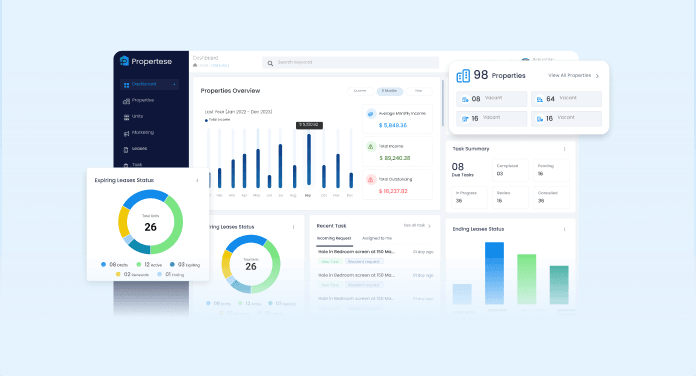
Propertese is built for firms managing 100 to 5,000+ units that need a unified view of performance and operations. It integrates leasing, accounting, maintenance, and financial workflows into one scalable system.
Highlights include:
- Lease and investment management with automated rent and expense workflows
- Centralized maintenance dashboards and vendor management
- Custom reporting and real-time financial insights
- Deep integrations with NetSuite, Xero, DocuSign, and Zillow
- Role-based access controls and workflow automation for compliance
By removing manual errors and consolidating siloed systems, Propertese delivers full operational visibility and efficiency. It remains a leading choice for growth-focused property managers. Explore how it compares to niche options such as mobile home park management tools.
AppFolio
AppFolio supports firms managing 100+ units, combining automation, intuitive UX, and cloud accessibility.
- Pricing: Core from $1.40/unit (min. $280/month) and Plus from $3.00/unit (min. $900/month)
- Automated rent posting, renewals, and maintenance tracking
- Mobile experience for on-the-go task management
Many firms transition to AppFolio as portfolios exceed 400 units due to its accessible automation features.
Buildium
Buildium remains a reliable option for growing residential and mixed portfolios.
- Pricing tiers: Essential $62/month, Growth $192/month, Premium $400/month
- Core tools: trust accounting, owner and tenant portals, and reporting templates
Trust accounting ensures accurate handling of deposits and client funds—key for compliance. It’s often chosen by small landlords preparing to scale.
RentManager
RentManager centers on accounting strength, with more than 450 built-in reports supporting complex ownership structures and compliance. It can be hosted on-premise or in the cloud. For accounting-heavy operations, RentManager remains a trusted contender among professional managers.
DoorLoop
DoorLoop offers a clean interface and straightforward pricing starting at about $59 per month. Key advantages include QuickBooks Online integration, AI-assisted leasing, and flexible plans. Its transparency and approachable design appeal to smaller mid-market teams seeking simplicity.
Yardi
Yardi serves large-scale residential and commercial portfolios.
- Yardi Breeze: 50–1,500 units, priced around $100–$400/month
- Yardi Voyager: enterprise-grade solution with comprehensive analytics
Its modular design accommodates multiple asset types and strict compliance requirements, appealing to corporate users with specialized needs.
Rentvine
Rentvine targets mid-market managers seeking intuitive workflows and robust integrations.
- Pricing: about $2.50/unit/month with a $199 minimum
- Integrations with maintenance tools like Lula and advanced trust accounting
Rentvine offers a straightforward choice for teams wanting a modern interface and unified financial tracking.
TurboTenant, Innago, and Stessa
These platforms serve landlords with fewer than 100 units. They provide free or low-cost access covering rent collection, screening, and basic expense tracking.
A tenant portal enables online rent payments and maintenance requests, while an owner portal offers transparent reporting. These tools suit early-stage landlords but may require upgrades as portfolios expand.
Key feature comparisons and pricing models
Core feature | Propertese | AppFolio | Buildium | RentManager | DoorLoop | Yardi | Rentvine |
Accounting & trust | ✔ | ✔ | ✔ | ✔ | ✔ | ✔ | ✔ |
Maintenance automation | ✔ | ✔ | ✔ | ✔ | ✔ | ✔ | ✔ |
Owner/tenant portals | ✔ | ✔ | ✔ | ✔ | ✔ | ✔ | ✔ |
Integrations (ERP/API) | ✔ | ✔ | ✔ | ✔ | ✔ | ✔ | ✔ |
Custom dashboards | ✔ | ✔ | Partial | ✔ | ✔ | ✔ | ✔ |
AI tools | ✔ | ✔ | Partial | None | ✔ | ✔ | ✔ |
Common pricing structures include:
- Per-unit monthly fees with minimums
- Tiered subscription plans
- Freemium tiers with paid add-ons
Selecting software based on portfolio size and business priorities
Your choice should reflect both current operations and future growth goals.
Portfolio size | Recommended options |
<100 units | TurboTenant, Innago, Stessa |
100–1,500 units | Buildium, DoorLoop, Rentvine |
1,500+ units | AppFolio, Yardi, Propertese |
Plan for where your business expects to be within two years to avoid migrations and maintain continuity.
For deeper insights, explore CRM comparisons in our CRM software guide.
Implementation considerations and integration requirements
Successful deployment depends on structured planning. Typical steps include:
- Data migration from legacy systems
- Staff training and pilot testing
- Integration with accounting and payment platforms
A well-connected system reduces data re-entry and compliance risk. Propertese simplifies this process through native integrations detailed in our accounting software comparison.
Final recommendations for different property management needs
There is no single “best” software—only the best match for your operations and scale.
- Enterprise growth: Propertese, AppFolio, Yardi
- Mid-market balance: Propertese, Buildium, DoorLoop, RentManager
- Small portfolios: TurboTenant, Innago, Stessa
The right platform strengthens control, increases efficiency, and scales with your business.
Frequently asked questions
What are the essential features to look for in property management software?
Look for automation across rent collection, maintenance, accounting, and tenant and owner portals.
How does pricing structure impact long-term software costs?
Unit-based pricing can add up as portfolios grow, so scalable, transparent models offer better value over time.
Which software options are best suited for small landlords versus large portfolios?
Smaller landlords often start with entry-level tools, while large and expanding portfolios benefit from integrated platforms like Propertese.
What role do integrations play in selecting property management software?
Integrations link property, accounting, and payment systems, reducing manual updates and ensuring data accuracy.
How can automation improve property management efficiency?
Automation accelerates renewals, rent processing, and maintenance scheduling while minimizing errors.
Conclusion
In 2026, the best property management software combines automation, integration, and scalability. Whether you manage 50 or 5,000 units, select a platform that grows with you. For portfolio owners seeking full visibility and enterprise-grade tools, Propertese is a full-scale property management ERP that helps you manage smarter and achieve greater control.